Ukjent sin avatar

Vagal tone and the inflammatory reflex

En studie som beskriver mekanismene bak hvordan vagus nerven henger sammen med immunsystemet. Med en sterk vagusnerve (høy HRV) kan betennelser dempes.

http://www.ccjm.org/content/76/Suppl_2/S23.long

Inhibition of sympathoexcitatory circuits is influenced by cerebral structures and mediated via vagal mechanisms. Studies of pharmacologic blockade of the prefrontal cortex together with neuroimaging studies support the role of the right hemisphere in parasympathetic control of the heart via its connection with the right vagus nerve. Neural mechanisms also regulate inflammation; vagus nerve activity inhibits macrophage activation and the synthesis of tumor necrosis factor in the reticuloendothelial system through the release of acetylcholine. Data suggest an association between heart rate variability and inflammation that may support the concept of a cholinergic anti-inflammatory pathway.

The neurovisceral integration model of cardiac vagal tone integrates autonomic, attentional, and affective systems into a functional and structural network. This neural network can be indexed by heart rate variability (HRV). High HRV is associated with greater prefrontal inhibitory tone. A lack of inhibition leads to undifferentiated threat responses to environmental challenges.

The cholinergic anti-inflammatory pathway

Acetylcholine and parasympathetic tone inhibit proinflammatory cytokines such as interleukin (IL)-6. These proinflammatory cytokines are under tonic inhibitory control via the vagus nerve, and this function may have important implications for health and disease.5

The cholinergic anti-inflammatory pathway is associated with efferent activity in the vagus nerve, leading to acetylcholine release in the reticuloendothelial system that includes the liver, heart, spleen, and gastrointestinal tract. Acetylcholine interacts with the alpha-7 nicotinic receptor on tissue macrophages to inhibit the release of proinflammatory cytokines, but not anti-inflammatory cytokines such as IL-10.

Approximately 80% of the fibers of the vagus nerve are sensory; ie, they sense the presence of proinflammatory cytokines and convey the signal to the brain. Efferent vagus nerve activity leads to the release of acetylcholine, which inhibits tumor necrosis factor (TNF)-alpha on the macrophages. Cytokine regulation also involves the sympathetic nervous system and the endocrine system (the hypothalamic-pituitary axis).

Inverse relationship between HRV and CRP

In a study of 613 airplane factory workers in southern Germany, vagally mediated HRV was inversely related to high-sensitivity CRP in men and premenopausal women, even after controlling for urinary norepinephrine as an index of sympathetic activity.6

Inverse relationship between HRV and fibrinogen

In a related report from the same study, vagal modulation of fibrinogen was investigated.7 Fibrinogen is a large glycoprotein that is synthesized by the liver. Plasma fibrinogen is a measure of systemic inflammation crucially involved in atherosclerosis.

CONCLUSION

The brain and the heart are intimately connected. Both epidemiologic and experimental data suggest an association between HRV and inflammation, including similar neural mechanisms. Evidence of an association between HRV and inflammation supports the concept of a cholinergic anti-inflammatory pathway.

Ukjent sin avatar

The inflammatory reflex: the role of the vagus nerve in regulation of immune functions

Nevner mekanismene bak hvordan vagus nerven demper betennelsesreaksjoner og kan bidra i autoimmune sykdommer.

http://www.ncbi.nlm.nih.gov/pubmed/22263327

Abstract

Experimental studies published in past years have shown an important role of the vagus nerve in regulating immune functions. Afferent pathways of this cranial nerve transmit signals related to tissue damage and immune reactions to the brain stem. After central processing of these signals, activated efferent vagal pathways modulate inflammatory reactions through inhibiting the synthesis and secretion of pro-inflammatory cytokines by immune cells. Therefore, pathways localized in the vagus nerve constitute the afferent and efferent arms of the so-called «inflammatory reflex» that participates in negative feedback regulation of inflammation in peripheral tissues. Activation of efferent pathways of the vagus nerve significantly reduces tissue damage in several models of diseases in experimental animals. Clinical studies also indicate the importance of the vagus nerve in regulating inflammatory reactions in humans. It is suggested that alteration of the inflammatory reflex underlies the etiopathogenesis of diseases characterized by exaggerated production of pro-inflammatory mediators. Therefore, research into the inflammatory reflex may create the basis for developing new approaches in the treatment of diseases with inflammatory components.

Ukjent sin avatar

Effect of short-term practice of breathing exercises on autonomic functions in normal human volunteers

Nevner hvordan sakte pust bedrer tilstanden i det autonome nervesystem. De bruker 6 sek inn og 6 sek ut i denne studien, som stimulerer vagusnerven best.

Klikk for å få tilgang til 0807.pdf

Background & objectives: Practice of breathing exercises like pranayama is known to improve autonomic function by changing sympathetic or parasympathetic activity. Therefore, in the present study the effect of breathing exercises on autonomic functions was performed in young volunteers in the age group of 17-19 yr.

Methods: A total of 60 male undergraduate medical students were randomly divided into two groups: slow breathing group (that practiced slow breathing exercise) and the fast breathing group (that practiced fast breathing exercise). The breathing exercises were practiced for a period of three months. Autonomic function tests were performed before and after the practice of breathing exercises.

Results: The increased parasympathetic activity and decreased sympathetic activity were observed in slow breathing group, whereas no significant change in autonomic functions was observed in the fast breathing group.

Interpretation & conclusion: The findings of the present study show that regular practice of slow breathing exercise for three months improves autonomic functions, while practice of fast breathing exercise for the same duration does not affect the autonomic functions.

Ukjent sin avatar

Zazen and Cardiac Variability

Endelig en studie som nevner noen effekter av Zen meditasjon hvor fokus er på å puste veldig sakte, helt ned til 1 pust/min, bl.a. varme. Viser hvordan HRV påvirkes forskjellig, hvor hos noen økes hjerterytmen betraktelig i små perioder, noe som kan være en effekt av ting som skjer under meditasjonen. Desverre innser de at de burde ha målt kroppstemperatur, CO2, blodsirkulasjon og flere parametere for å se tydeligere hva som skjer i kroppen under så sakte pust.

http://www.psychosomaticmedicine.org/content/61/6/812.long

Figure 3 shows pre-Zazen rest period data from a Zen master (KS). This individual breathed close to 6 breaths/min throughout the rest period. Note the comparative absence of high-frequency cardiac variability and the major low-frequency peak at 0.1 Hz. A very-low-frequency peak also is notable. Note the periodic occurrence of irregularities in cardiac rhythm, superimposed on the sinus rhythm, each with a short R-R interval followed by a long one.

Figure 4 shows the last 5-minute period of Zazen from KS. During this period, respiration rate was slowed to less than 1 breath/min. Cardiac variability at this time occurred almost exclusively within the very-low-frequency range (Figure 4), with a power of more than 13 times greater than at rest.

Feelings of Warmth

The participants’ experiences of warmth during Zazen suggest that the body’s thermoregulatory system may have been affected by practice of this discipline. Subject KS, whose very-low-frequency wave amplitudes particularly increased, specifically remarked on his feelings of increased warmth during Zazen. Perhaps breathing at this very slow rate stimulated sympathetic reflexes that affect oscillations in HR within this very-low-frequency range. The meaning of these observations remains ambiguous, however, because we did not specifically examine thermoregulation, vascular tone, blood pressure, or any index of sympathetic activity. Although increases in HR occurred among some Rinzai subjects, these changes were small and not significant. Additional data are required on vascular and body temperature changes during Zazen and their possible relationship with increased sympathetic arousal and HR very-low-frequency wave activity. Previous observations of experienced Indian Yogis have similarly shown significant increases in body temperature during practice of yoga (58).

Ukjent sin avatar

Influence of breathing frequency on the pattern of respiratory sinus arrhythmia and blood pressure: old questions revisited

Mer om hvordan pustefrekvens styrer HRV, eller RSA (Respiratory Sinusoid Arrythmia) som de kaller det i denne studien. Nevner at 0,1 Hz (6 pust i minuttet) gir bedre HRV enn 0,2 Hz (12 pust i minuttet). Den viser også at 0,1 Hz gir høyest CO2 i utpusten. Og den bekrefter at det er vagus som styrer HRV siden blokkade av et hormon ikke påvirket HRV.

http://ajpheart.physiology.org/content/298/5/H1588

Respiratory sinus arrhythmia (RSA) is classically described as a vagally mediated increase and decrease in heart rate concurrent with inspiration and expiration, respectively. However, although breathing frequency is known to alter this temporal relationship, the precise nature of this phase dependency and its relationship to blood pressure remains unclear. In 16 subjects we systematically examined the temporal relationships between respiration, RSA, and blood pressure by graphically portraying cardiac interval (R-R) and systolic blood pressure (SBP) variations as a function of the respiratory cycle (pattern analysis), during incremental stepwise paced breathing. The principal findings were 1) the time interval between R-R maximum and expiration onset remained the same (∼2.5–3.0 s) irrespective of breathing frequency (P = 0.10), whereas R-R minimum progressively shifted from expiratory onset into midinspiration with slower breathing (P < 0.0001); 2) there is a clear qualitative distinction between pre- versus postinspiratory cardiac acceleration during slow (0.10 Hz) but not fast (0.20 Hz) breathing; 3) the time interval from inspiration onset to SBP minimum (P = 0.16) and from expiration onset to SBP maximum (P = 0.26) remained unchanged across breathing frequencies; 4) SBP maximum and R-R maximum maintained an unchanged temporal alignment of ∼1.1 s irrespective of breathing frequency (P = 0.84), whereas the alignment between SBP minimum and R-R minimum was inconstant (P > 0.0001); and 5) β1-adrenergic blockade did not influence the respiration-RSA relationships or distinct RSA patterns observed during slow breathing, suggesting that temporal dependencies associated with alterations in breathing frequency are unrelated to cardiac sympathetic modulation. Collectively, these results illustrate nonlinear respiration-RSA-blood pressure relationships that may yield new insights to the fundamental mechanism of RSA in humans.

Moreover, despite extensive research, it remains unclear as to whether RSA is driven by respiratory synchronous oscillations in blood pressure via the arterial baroreflex or whether RSA and blood pressure are independently related to respiration via nonbaroreflex mechanisms (41417284146). Clarification of these fundamental relationships is important for our understanding of how autonomic neural outflow is coupled with respiratory activity, especially given that RSA is considered a surrogate of cardiac parasympathetic modulation and is widely applied in the calculation of spontaneous baroreflex sensitivity (72434363739).

Following an initial 5-min stabilization period, paced breathing was commenced at 0.20, 0.15, and 0.10 Hz in randomized order for 5 min each, with 2-min rests between trials.

Table 1.

Effect of breathing frequency on baseline variables

Breathing Frequency, Hz
0.20 0.15 0.10 P
Respiratory sinus arrhythmia amplitude, ms 123 ± 44 167 ± 69 227 ± 92 <0.0001
R-R interval, ms 954 ± 83 958 ± 85 976 ± 82 0.17
Systolic blood pressure amplitude, mmHg 6.6 ± 1.8 8.8 ± 3.4 10 ± 3.1 <0.0001
Systolic blood pressure, mmHg 120 ± 14 119 ± 13 117 ± 14 0.40
Mean arterial blood pressure, mmHg 79 ± 8.2 78 ± 8.0 79 ± 9.6 0.81
Diastolic blood pressure, mmHg 62 ± 7.1 62 ± 7.2 61 ± 8.5 0.88
End-tidal CO2, % 5.04 ± 0.90 5.11 ± 0.93 5.20 ± 0.94 0.41
  • Values are means ± SD. No differences in R-R interval, systolic blood pressure, mean arterial blood pressure, diastolic blood pressure, or end-tidal CO2 were found across the breathing frequencies.

  • * Statistically significant compared with 0.20 Hz;

  • † statistically significant compared with 0.15 Hz.

The present investigation is the first to apply a pattern analysis approach to characterize nonlinearities in the temporal relationships between respiration, RSA, and blood pressure within the boundaries of the respiratory cycle. Under the conditions of this study the five major findings are: 1) the time interval between R-R maximum and expiration onset remained the same irrespective of breathing frequency, whereas R-R minimum progressively shifted from expiratory onset into midinspiration with slower breathing; 2) two qualitatively distinct stages of cardiac acceleration during slow 0.10-Hz breathing were observed in most subjects; 3) both the time intervals between inspiration onset and SBP minimum and between expiration onset and SBP maximum were unchanged by breathing frequency; 4) SBP maximum and R-R maximum maintained a fixed temporal alignment irrespective of breathing frequency, whereas, in contrast, the alignment between SBP minimum and R-R minimum varied according to breathing frequency; and 5) β1-adrenergic blockade did not influence the respiration-RSA relationships or distinct RSA patterns observed during slow breathing.

Finally, consistent with the established literature, we observed a clear relationship between breathing frequency and RSA amplitude (11234549). In this study 0.10-Hz breathing was associated with a ∼1.8-fold higher RSA amplitude compared with 0.20-Hz breathing. This is most likely due to breathing frequency coinciding with, and thus significantly augmenting, low frequency R-R interval fluctuations. The mechanism(s) behind this resonance phenomenon is unclear, but one proposal is that the augmentation of cardiovascular oscillations associated with slow breathing is due to global enhancement of arterial baroreflex sensitivity (7).

Conclusion

In summary, this study revealed several previously undescribed nonlinearities in respiration-RSA-blood pressure relationships in conscious humans. In contrast to prior studies, we found R-R minimum was not temporally aligned to expiration, beginning in late inspiration with slower breathing. Similarly, the onset of R-R maximum was not fixed to inspiratory onset but occurred in late expiration at slower breathing frequiencies. We also found that R-R maximum consistently occured ∼2.5–3.0 s following expiratory onset irrespective of breathing frequency. We observed two qualitatively distinct stages of cardiac acceleration during slow 0.10-Hz breathing, whereby the rate of cardiac acceleration occurring before inspiration was consistently less than the rate of cardiac acceleration following inspiratory onset, which to the best of our knowledge has not previously been described. Since these temporal dependencies were unaltered by selective β1-adrenergic blockade, they are most likely due to vagally mediated mechanisms. Furthermore, SBP maximum and R-R maximum maintained a temporal alignment of ∼1.1 s irrespective of breathing frequency whereas the delay between SBP minimum and R-R minimum became longer with slower breathing. These results demonstrate that the application of pattern analysis to the study of heart rate and blood pressure variability has potential to yield new insights into fundamental relationships between breathing and autonomic regulation of cardiovascular function.


Ukjent sin avatar

Relative timing of inspiration and expiration affects respiratory sinus arrhythmia.

Nevner at det er 3 variabler som styrer hva som gir høyest HRV: 1. pustefrekvens. 2. mengeden luft per pust. 3. forholdet mellom lengden av innpust og utpust. Nevner at en rask og tydelig innpust blokkerer vagus.

http://www.ncbi.nlm.nih.gov/pubmed/10901389

1. The effect of a variation in inspiration and expiration times on heart rate variability was studied in 12 healthy subjects (mean age 30+/-6 years; five females). 2. Two 2 min trials of controlled breathing, with either short inspiration followed by long expiration or long inspiration followed by short expiration, were compared. Average expiration/inspiration time ratios were 1.0 and 3.4, respectively. The respiration rate in both trials was approximately 10 cycles/min. 3. In trials with short inspiration followed by long expiration, respiratory sinus arrhythmia (RSA; as measured by mean absolute differences and by the high frequency band) was significantly larger than in trials with long inspiration followed by short expiration. This effect could not be accounted for by differences in respiration rate or respiratory amplitude. The higher RSA during fast/slow respiration is primarily due to a more pronounced phasic heart rate increase during inspiration, indicating that inspiratory vagal blockade is sensitive to the steepness of inspiration. 4. Respiration rate and tidal volume are respiratory variables known to modulate RSA. The results of the present study indicate that RSA can also be modulated by a third respiratory variable, the expiratory/inspiratory time ratio.

Ukjent sin avatar

PHASE RELATIONSHIP BETWEEN NORMAL HUMAN RESPIRATION AND BAROREFLEX RESPONSIVENESS

Nevner hvordan forskjellige pustefrekvenser påvirker det autonome nervesystemet.

http://jp.physoc.org/content/304/1/489.full.pdf+html

1. We studied the influences of phase of respiration and breathing frequency upon human sinus node responses to arterial baroreceptor stimulation.

2. Carotid baroreceptors were stimulated with brief (0.6 sec), moderate (30 mmHg) neck suction during early, mid, and late inspiration or expiratin at usual breathing rates, or, during early inspiration and expiration at breathing rates of 3, 6, 12, and 24 breaths/min.

3. Baroreceptor stimuli applied during early and mid inspiration and late expiration provoked only minor sinus node inhibition; stimuli begun during late inspiration and early expiration provoked maximum sinus node inhibition.

4. At breathing rates of 3, 6 and 12 breaths/min, expiratory baroreflex responses were significantly greater than inspiratory responses; at 24 breaths/min, however, inspiratory and expiratory baroreceptor stimuli produced comparable degrees of sinus node inhibition.

5. Our results delineate an important central biological rhythm in normal man: human baroreflex responsiveness oscillates continuously during normal, quiet respiration. The phase shift of baroreflex responsiveness on respiration suggests that this interaction cannot be ascribed simply to gating synchronous with central inspiratory neurone activity. Regularization of heart rate during rapid breathing is associated with loss of the differential inspiratory-expiratory baroreflex responsiveness which is present at usual breathing rates.

Ukjent sin avatar

Magnesium: Novel Applications in Cardiovascular Disease – A Review of the Literature

En review studie fra 2012 som inneholder det meste om Magnesium, spesielt rettet mot betennelser i hjerte/kar og nervesystemet.

http://www.karger.com/Article/FullText/339380

Magnesium L-lactate and L-aspartate are the oral magnesium compounds that have the greatest bioavailability, are the most water-soluble and have the greatest serum and plasma concentrations [8].

After a mean follow-up of 9.8 years and adjusting for confounders, the authors concluded that women in the highest quintile (an intake of 400 mg/day of magnesium) had a decreased HTN (hypertension) risk (p < 0.0001) versus those in the lowest quintile (approx. 200 mg/day of magnesium) [20].

Because of magnesium’s anti-inflammatory, statin-like and anti-mineralizing effects, a role for it is emerging in cardiovascular and neurological medicine.

The potential impact of magnesium in cardiovascular and neurological health, the abundance and low cost of the supplement, the relatively low side effect profile and the paucity of information in the literature about this common mineral suggest that more studies should be conducted to determine its safety and efficacy. The majority of human trials with magnesium thus far have not been interventional, but based on food questionnaires which may not be accurate and are subject to a recall bias. Further work is also needed to determine the mechanism of action by which magnesium modulates the mineralization and inflammation of the cardiovascular and nervous systems.

Ukjent sin avatar

The Polyvagal Perspective

Denen Studien beskriver Stephen Porges sitt arbeid med å forstå Vagus nerven og hvordan den forholder seg til pusten og til psyken.

http://www.ncbi.nlm.nih.gov/pmc/articles/PMC1868418/

The Polyvagal Theory introduced a new perspective relating autonomic function to behavior that included an appreciation of autonomic nervous system as a “system,” the identification of neural circuits involved in the regulation of autonomic state, and an interpretation of autonomic reactivity as adaptive within the context of the phylogeny of the vertebrate autonomic nervous system. The paper has two objectives: First, to provide an explicit statement of the theory; and second, to introduce the features of a polyvagal perspective. The polyvagal perspective emphasizes how an understanding of neurophysiological mechanisms and phylogenetic shifts in neural regulation, leads to different questions, paradigms, explanations, and conclusions regarding autonomic function in biobehavioral processes than peripheral models. Foremost, the polyvagal perspective emphasizes the importance of phylogenetic changes in the neural structures regulating the autonomic nervous system and how these phylogenetic shifts provide insights into the adaptive function and the neural regulation of the two vagal systems

Ukjent sin avatar

Cardiovascular and Respiratory Effect of Yogic Slow Breathing in the Yoga Beginner: What Is the Best Approach?

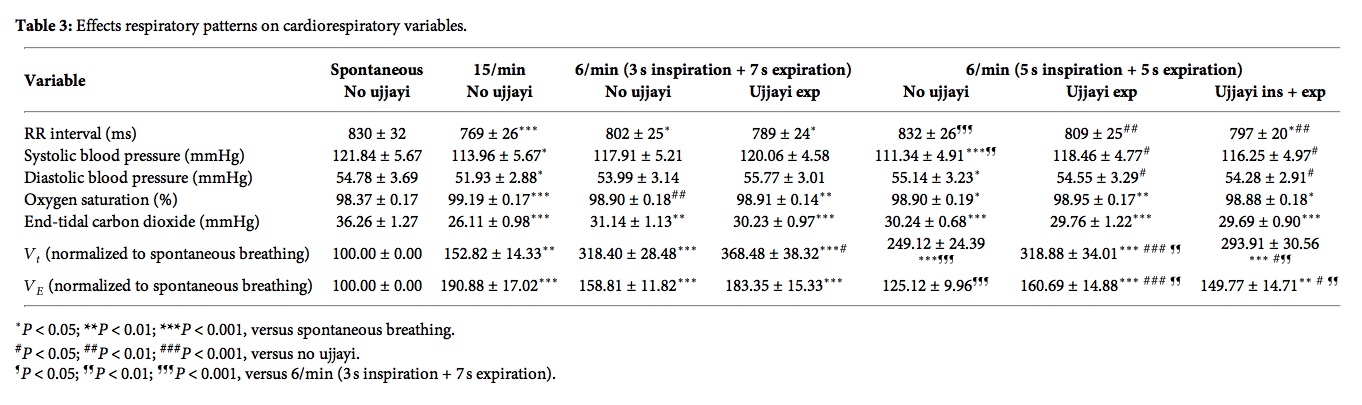
Svært spennende studie ang pustens påvirkning på vagusnerven, som bekrefter Breathing System sin Autonome pust, 5 sek inn og 5 sek ut, altså 6 pust i minuttet.

Nevner hvordan en usymmetrisk pust, f.eks. 3 inn og 7 ut, ikke påvirker vagusnerven i særlig stor grad. Og at ujjayi påvirker vagusnerven dårligere enn uanstrengt sakte pust. Ujjiayi pust har andre positivie effekter.

Nevner også at CO2 synker fra 36 til 30 mmHg når man puster 5/5 i forhold til når man ikke gjør pusteteknikk (spontan pust), men synker til 26 mmHg når man puster 15 pust i minuttet. Selv med 7s utpust synker CO2 ned til 31 mmHg. Dette er motsatt av hva studien på CO2 hos angstpasienter viser, hvor CO2 øker selv når pustefrekvensen senkes fra 15 til 12, og øker mer jo saktere pustefrekvensen er.

Nevner også noe svært interessant om at små endinger i oksygenmetning kan gi store endringer oksygentrykket pga bohr-effekt kurven som flater veldig ut ved 98% slik at en 0.5% økning i oksygenmetning kan likevel gir 30% økning i oksygentrykket.

http://www.hindawi.com/journals/ecam/2013/743504/

The slow breathing with equal inspiration and expiration seems the best technique for improving baroreflex sensitivity in yoga-naive subjects. The effects of ujjayi seems dependent on increased intrathoracic pressure that requires greater effort than normal slow breathing.

Respiratory research documents that reduced breathing rate, hovering around 5-6 breaths per minute in the average adult, can increase vagal activation leading to reduction in sympathetic activation, increased cardiac-vagal baroreflex sensitivity (BRS), and increased parasympathetic activation all of which correlated with mental and physical health [14]. BRS is a measure of the heart’s capacity to efficiently alter and regulate blood pressure in accordance with the requirements of a given situation. A high degree of BRS is thus a good marker of cardiac health [5].

The slow breathing-induced increase in BRS could be due to the increased tidal volume that stimulates the Hering-Breuer reflex, an inhibitory reflex triggered by stretch receptors in the lungs that feed to the vagus [6]. In addition, the slow breathing increases the oxygen absorption that follows greater tidal volume , as a result of reduction in the effects of anatomical and physiological dead space [78]. This might in turn produce another positive effect, that is, a reduction in the need of breathing. Indeed, a reduction in chemoreflex sensitivity and, via their reciprocal relationships, an increase in BRS, have been documented with slow breathing [913].

 pustmønster CO2
In comparison to spontaneous breathing, fast breathing led to a reduction in BRS, whilst all slow breathing (with or without ujjayi breathing) increased BRS. This increase was seen in both the symmetrical (5 second inspiration and expiration) and asymmetrical (3 second inspiration and 7 second expiration) slow breathing conditions. Engaging ujjayi breathing on the exhalation had the effect of reducing the increase in BRS of slow breathing alone, and this was further reduced with ujjayi on the inspiration and expiration (which was not significantly higher than baseline). These differences were even more pronounced with respect to controlled breathing at 15 breath/minute, which also showed highly significant differences with respect to spontaneous breathing, but in the opposite direction.
When slow breathing was done in conjunction with ujjayi breathing, oxygen saturation further increased, though only slightly. Overall, however, this was a highly significant change given that baseline oxygen saturation was already high approximately 98.3% (Table 3).
However, with 15 breath/minute controlled breathing the increase in oxygen saturation occurred with a large relative increase in Ve and a marked drop in end-tidal carbon dioxide. Conversely, with slow breathing, the increase in oxygen saturation occurred with only a moderate increase in Ve and drop in carbon dioxide.
The greatest improvement was found in slow breathing without ujjayi, while breathing controlled at a rate of 15/min caused a drop in BRS. In all forms of slow breathing there was a statistically significant increase in oxygen saturation from the mean baseline of 98.3%, confirming the relationship between high levels of oxygen absorption and BRS.
In this study, we show that slow breathing and increased oxygen absorption lead to enhanced BRS. This might result from several possible factors, all interrelated. In theory, the increase in arterial oxygen partial pressure increases blood pressure, which in turn could stimulate the baroreceptors and improve the BRS gain. This was recently observed in healthy [28] and diabetic subjects [25]. The seemingly small extent of the increase in oxygen saturation should not be overlooked. In fact, the haemoglobin dissociation curves states that at higher saturation values small changes reflex large changes in the partial pressure of oxygen.
Because the oxygen tension (and not oxygen saturation) is the chemoreflex input signal, this explains why in a previous study the administration of oxygen in normoxia induced a significant increase in BRS and parasympathetic activity despite a small increase in oxygen saturation [25].
We did not find any significant difference between asymmetrical and symmetrical breathing during slow breathing. We suggest that most of these results could be due to the prolonged expiratory time (in fact the 3-second inspiratory time of the asymmetrical breathing was very close to the spontaneous breathing). In the yoga tradition several degrees of asymmetries were adopted. While some of these could have specific effects (and could be matter for further investigations), our results suggest that an expiratory time of at least 5 seconds was sufficient to elicit most of the results observed.
Based on our findings, slow breathing with similar inspiration and expiration times appears the most effective and simple way to heighten the BRS and improve oxygenation in normoxia. Ujjayi breath demonstrates limited added benefit over slow breathing done at 6/min in normoxia; however, the effects could be more pronounced in hypoxia, and this could be matter for future investigations.