Ukjent sin avatar

INCREASED INTERSTITIAL CONCENTRATIONS OF PYRUVATE AND LACTATE IN THE TRAPEZIUS MUSCLE OF PATIENTS WITH FIBROMYALGIA: A MICRODIALYSIS STUDY

Om at fibromyalgi innebærer høyere grad av melkesyre i musklene, og at dette er en av bidragene til den kroniske smerten.

http://www.medicaljournals.se/jrm/content/?doi=10.2340/16501977-0581&html=1

«There was a significant group effect (p = 0.039) with higher interstitial lactate concentrations in FMS compared with CON (Fig. 2a).»

«There was a highly significant difference in interstitial concentration of pyruvate (p < 0.001) between the 2 groups; the concentrations were higher among the FMS patients (Fig. 2b).»

«One possible explanation for the higher [pyruvate] in FMS of the present study is changes in the lactate-pyruvate metabolism via lactate dehydrogenase isoforms (18). Another alternative is that a reduction in tissue oxygenation in FMS (8) may result in higher [pyruvate] due to a shift towards an anaerobic state. Such a circumstance might also cause the significantly higher [lactate].»

«The aerobic capacity of the muscle is largely governed by the number of mitochondria and their enzymes (20). Lindh et al. reported lower capillary density and enzymes associated with aerobic metabolism in FMS (21); however, it is unknown if a general deconditioning in FMS involves the postural trapezius. The mitochondrial density increases as result of exercise (see (22) for references) and affects the level of metabolites (i.e. enhanced aerobic capacity).»

«Lactate is also involved in peripheral nociception, and it appears to facilitate the response of acid-sensing ion channel 3 (ASIC-3) to low pH (26). Such ASIC channels are considered as molecular transducers for nociception and mechanosensation (26).»

«It has been reported that FMS has abnormal cardiovascular responses to low-grade mental stress (35). Several studies indicate altered sympathetic activation in FMS (36–39), which in turn may affect [lactate] (40). Sympathetic activation may also cause decreased blood flow even without hypoxia (26, 41).»
Ukjent sin avatar

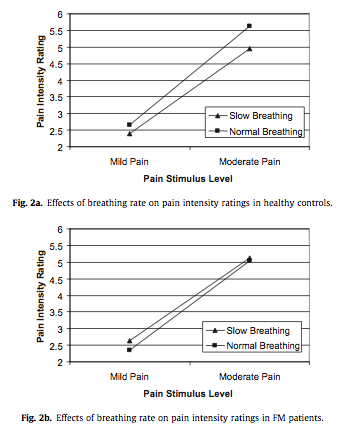
The effects of slow breathing on affective responses to pain stimuli: an experimental study.

Viktig studie om pustens regulering av smerte som nevner at å senke pustefrekvens demper smerte betraktelig for frisk mennesker, men hos Fibromyalgi er det ikke nok i seg selv som smertedemping.

http://www.ncbi.nlm.nih.gov/pubmed/20079569

Dropbox link: https://dl.dropboxusercontent.com/u/17457302/Forskning%20mappe%20for%20terapi/STUDIE%20-%20The%20effect%20of%20slow%20breathing%20on%20affective%20responses%20to%20pain%20stimul.pdf
Dropbox link til kommentar om fibromyalgi: https://dl.dropboxusercontent.com/u/17457302/Forskning%20mappe%20for%20terapi/Respiration-induced%20hypoalgesia%20-%20%20Additional%20evidence%20for%20pain%20modulation%20deficits%20in%20fibromyalgia.pdf

«M and HC were exposed to low and moderate thermal pain pulses during paced breathing at their normal rate and one-half their normal rate. »

«Participants who reported higher levels of trait positive affect prior to the experiment showed greater decreases in negative affect as a result of slow versus normal breathing.  »

«FM patients and normal controls were instructed to breathe at either their normal rate or 1/2 that rate during four blocks of four trials.  »

«An inspection of resting breathing rates for the two groups revealed no differences between groups: an average rate of 13.68 (SD = 3.54) breaths per minute for FM patients, and 13.63 (SD = 2.17) for HCs.  »

Skjermbilde 2013-05-12 kl. 11.31.28

«These findings are consistent with those of an observational investigation, which found lower breathing rates were associated with reduced pain intensity and unpleasant- ness ratings when participants meditated while receiving pulses of painful heat [12]. »

«Since all participants were administered trials where pain was administered, the potential benefit of interventions that include the practice of meditation in the treatment of pain patients is sup- ported. However, the mixed findings for FM patients give us pause. It may be more difficult to engender states of relaxation needed to endure pain in FM patients through slow paced breathing alone. »

«Taken together these findings are consistent with the model of pain as a homeostatic emotion. In this model, the neurophysiologi- cal processes that underlie how slow breathing influences pain begins with the increased bronchiopulmonary afferent activity. This activity produces increased activation in the left mid-insula and anterior insula [24], as well as increased activation in the left anterior cingulate associated directly with increased heart rate variability [18], corresponding with a shift in sympathovagal tone. This activation counterbalances the acute activation in the right anterior insula produced by painful stimulation [2] by virtue of opnent interaction [4].»

«The findings indicate that a slower breathing rate is a useful target in interventions for patients in pain. Reductions in pain and negative affect may be ex- pected when people are guided to halve their respiration rate.  »

«However, for FM patients, the data suggest that med- itative breathing alone is insufficient. Clinical interventions that address positive affective disregulation, appear necessary to assist FM patients in the management of their chronic pain. «

Ukjent sin avatar

painDETECT

Online spørsmålskjema som viser om smertene kommer fra nevropati eller ikke.

Klikk for å få tilgang til painDETECT-Questionaire-01.pdf

Denne Studien viser helel 88% sikkerhet som diagnoseverktøy: http://www.ncbi.nlm.nih.gov/pubmed/17022849

«Simple, patient-based, easy-to-use screening questionnaires can determine the prevalence of neuropathic pain components both in individual LBP patients and in heterogeneous cohorts of such patients.»

«The PD-Q is a reliable screening tool with high sensitivity, specificity and positive predictive accuracy; these were 84% in a palm-top computerised version and 85%, 80% and 83%, respectively, in a corresponding pencil-and-paper questionnaire.»

Ukjent sin avatar

Breathing pattern disorders, motor control, and low back pain

Viktig artikkel fra Leon Chaitow om pustens rolle i ryggsmerter. Beskriver hva som skjer med nervesystemet, med bindevevet og muskelkontroll i ryggraden. Og nevner hvordan progesteron og blodsukker påvirker pusten.

http://leonchaitow.com/wp-content/uploads/pdfs/Breathing%20Pattern%20Disorders%20and%20back%20pain.pdf

«Nixon and Andrews16 have summarised the emerging symptoms resulting from hypocapnoea in a deconditioned individual, as follows: “Muscular aching at low levels of effort; restlessness and heightened sympathetic activity; increased neuronal sensitivity; and, constriction of smooth- muscle tubes (e.g. the vascular, respiratory and gastric- intestinal) can accompany the basic symptom of inability to make and sustain normal levels of effort.” »

«Lum7 notes, “Alkalosis alone cannot fully explain the symptoms [of chronic hyperventilation]. Altitude adaptation allows residents of high altitudes to remain well, despite chronic respiratory alkalosis. In symptomatic hyperventilation however, the PCO2 fluctuates, often wildly, causing constantly changing pH in nerve cells and tissue fluid to which no adaptation is possible…significant amounts of CO2 can be lost in a few minutes of overbreathing, immediately causing respiratory alkalosis. Compensation, by excretion of bicarbonate, is relatively slow and may take hours or days.” »

«Seyal et al36 note that hyperventilation increases the excitability of both cutaneous and motor axons, and that in experimental animals, HVS increases excitability of hippocampal neurons. Their research, involving healthy humans, demonstrates that hyperventilation increases the excitability of the human corticospinal system. »

«Lum 38 reports,: “During moderate hyperventilation, loss of CO2 ions from neurons stimulates neuronal activity, causing increased sensory and motor discharges, muscular tension and spasm, speeding of spinal reflexes, heightened perception (photophobia, hyperacusis) and other sensory disturbances. More profound hypocapnoea, however, increasingly depresses activity. This parallels the clinical state: initial alertness with increased activity, progressing through decreased alertness, to stupor and coma.” »

«An altered pH in the local chemical environment of peripheral nociceptors, such as occurs with respiratory alkalosis, helps to induce mechanical sensitisation and ischaemic pain.47,48 »

«Hodges further hypothesises: “Although investigation of spinal mechanics is required to confirm the extent to which spinal control is compromised by increases in respiratory demand, it is hypothesised that such a compromise may lead to increased potential for injury to spinal structures and reduced postural control. During strenuous exercise, when the physical stresses to the spine are greater, the physiological vulnerability of the spine to injury is likely to be increased.”

«Progesterone is a respiratory stimulant, making patients with BPD most vulnerable during the post-ovulation phase of the menstrual cycle.10 »

«Blood sugar levels are, “clinically the most important of these non-ventilatory factors. When blood glucose is below the middle of the normal range (i.e. below 4.4 mmol/L) the effects of overbreathing are progressively enhanced at lower levels.” 81 «

Ukjent sin avatar

Placebo response to manual therapy: something out of nothing

Nevner at placebo bør inkluderes som en del av behandling for å maksimere smertedempende effekt og behandlingsresultater.

http://www.ncbi.nlm.nih.gov/pmc/articles/PMC3172952/pdf/jmt-19-01-011.pdf

«We suggest that manual therapists conceptualize placebo not only as a comparative intervention, but also as a potential active mechanism to partially account for treatment effects associated with manual therapy. We are not suggesting manual therapists include known sham or ineffective interventions in their clinical practice, but take steps to maximize placebo responses to reduce pain.»

Ukjent sin avatar

Skeletal and hormonal effects of magnesium deficiency

Nevner magnesium sin rolle i smerte, referert til fra wiki artikkel om neurogenic inflammation.

http://www.ncbi.nlm.nih.gov/m/pubmed/19828898/

«Mg deficiency in the rat and/or mouse results in increased skeletal substance P, which in turn stimulates production of cytokines. With the use of immunohistocytochemistry, we found that Mg deficiency resulted in an increase in substance P, TNFalpha and IL1beta. «

Ukjent sin avatar

Peripheral Neuropathy Fact Sheet

Om perifer nevropati og årsaker. Nevner blodsirkulasjon og at nerven får oksygenmangel når blodkar trekker seg sammen.

http://www.ninds.nih.gov/disorders/peripheralneuropathy/detail_peripheralneuropathy.htm#183593208

«Vascular damage and blood diseases
can decrease oxygen supply to the peripheral nerves and quickly lead to serious damage to or death of nerve tissues, much as a sudden lack of oxygen to the brain can cause a stroke. Diabetes frequently leads to blood vessel constriction. Various forms of vasculitis (blood vessel inflammation) frequently cause vessel walls to harden, thicken, and develop scar tissue, decreasing their diameter and impeding blood flow. This category of nerve damage, in which isolated nerves in different areas are damaged, is called mononeuropathy multiplex or multifocal mononeuropathy.»

Ukjent sin avatar

Complex Interaction of Sensory and Motor Signs and Symptoms in Chronic CRPS

Nevner sammenhengen mellom nervebetennelser, stress, depresjon, m.m. i kroniske smerter. Bl.a. at «varm» vs «kald» tilstand i hånden viser til om det er i starten eller har pågått lenger enn 1 år. Den «kalde» tilstanden er mer smertefull.

http://www.plosone.org/article/info%3Adoi%2F10.1371%2Fjournal.pone.0018775#pone-0018775-g007

«we developed a model based on interaction analysis suggesting a complex hierarchical interaction of peripheral (injury/sensory loss) and central factors (pain/disability/stress/depression) predicting motor dysfunction and hyperalgesia.»

«As the presence of an inducible autonomic nervous system autoantigen has been recently demonstrated in CRPS patients, one may speculate about possible interactions between autoimmune and inflammatory processes dominating the acute phase of CRPS, whereas in chronic CRPS the clinical signs of peripheral neurogenic inflammation and autonomic dysfunction may have mostly subsided due to post-inflammatory burn-out.»

«Furthermore, it has been demonstrated that patients initially classified as “cold” CRPS showed more pain when re-evaluated several years after the initial assessment [3]. “Warm” CRPS seems to be predominant in the acute phase of CRPS, where signs of peripheral neurogenic inflammation dominate»