Ukjent sin avatar

The Dietary Intake of Wheat and other Cereal Grains and Their Role in Inflammation

Nevner det meste om hvordan hvete og korn påvirke vår helse, med mye fokus på lekk-tarm syndrom. Nevner også Paleo Diet. Den viser til at betennelsesmarkører ikke er så forskjellige før eller etter korn-diett, muligens fordi målemetodene ikke er sensitive nok. I studier som sammenligner grovkorn og finkorn på helse er kontrollgruppen vanlig finkorn og man ser derfor ingen endring i betennelser fra eller til.

http://www.mdpi.com/2072-6643/5/3/771

Helle Studien i dropbox.

«cereal grains contain ―anti-nutrients,‖ such as wheat gluten and wheat lectin, that in humans can elicit dysfunction and disease.»

«Inflammation is the response of the innate immune system triggered by noxious stimuli, microbial pathogens and injury. When a trigger remains, or when immune cells are continuously activated, an inflammatory response may become self-sustainable and chronic. Chronic inflammation has been associated with many medical and psychiatric disorders, including cardiovascular disease, metabolic syndrome, cancer, autoimmune diseases, schizophrenia and depression [1–3]. Furthermore, it is usually associated with elevated levels of pro-inflammatory cytokines and acute phase proteins, such as interferons (IFNs), interleukin (Il)-1, Il-6, tumor necrosis factor-α (TNF-α), and C-reactive protein (CRP).»

«Stimulation of immune cells by gliadin is not only restricted to CD patients; the incubation of peripheral blood mononuclear cells (PBMC) from healthy HLA-DQ2-positive controls and CD patients with gliadin peptides stimulated the production of IL-23, IL-1β and TNF-α in all donors tested. Nevertheless, the production of cytokines was significantly higher in PBMC derived from CD patients [14]. Similar results were obtained by Lammers et al. [15], who demonstrated that gliadin induced an inflammatory immune response in both CD patients and healthy controls, though IL-6, Il-13 and IFN-γ were expressed at significantly higher levels in CD patients. »

«Human data showing the influence of WGA intake on inflammatory markers are lacking, however, antibodies to WGA have been detected in the serum of healthy individuals [56]. Significantly higher antibody levels to WGA were measured in patients with CD compared to patients with other intestinal disorders. These antibodies did not cross-react with gluten antigens and could therefore play an important role in the pathogenesis of this disease [57].»

«Refined wheat products contain less WGA, but still contain a substantial amount of gluten. It should be noted that whole grains contain phytochemicals, like polyphenols, that can exert anti-inflammatory effects which could possibly offset any potentially pro-inflammatory effects of gluten and lectins [73]. »

«The substitution of refined cereal grains and white bread with three portions of whole wheat food or one portion of whole wheat food combined with two servings of oats significantly decreased the systolic blood pressure and pulse pressure in middle-aged, healthy, overweight men and women, yet none of the interventions significantly affected systemic markers of inflammation [70]».
«Most of the intervention studies mentioned above attempted to increase whole grain intake and were using refined grain diets as controls, thereby making it very difficult to draw any conclusions on the independent role of cereal grains in disease and inflammation.»

«In healthy sedentary humans, the short-term consumption of a paleolithic type diet improved blood pressure and glucose tolerance, decreased insulin secretion, increased insulin sensitivity and improved lipid profiles [75].»

«The patients receiving gluten reported significantly more symptoms compared to the placebo group. The most striking outcome of this study was that for all the endpoints measured, there were no differences in individuals with or without HLA-DQ2/DQ8, indicating that the intake of gluten can cause symptoms also in individuals without this specific HLA-profile. No differences in biomarkers for inflammation and intestinal permeability were found between both groups, however, inflammatory mediators have been implicated in the development of symptoms in patients with irritable bowel syndrome [78]. It could therefore be inferred that the markers used to measure inflammation and intestinal permeability were not sensitive enough to detect subtle changes on the tissue level.»

Ukjent sin avatar

Why does my shoulder hurt? A review of the neuroanatomical and biochemical basis of shoulder pain

Beskriver smertefunksjon og perifere forklaringsmodeller for skuldersmerter.

http://m.bjsm.bmj.com/content/early/2013/02/20/bjsports-2012-091492.long?view=long&pmid=23429268

«This means that any cause of inflammation in or around the shoulder may give rise to the so-called ‘irritable’ shoulder joint. Therefore, clinically it may be difficult to discriminate between rotator cuff tendinopathy and calcific tendinitis or inflammatory joint disease, for example; there is a clear lack of clarity with regard to whether common diagnostic tests used in clinical examination are useful in differentially diagnosing pathologies of the shoulder.68 ,72»

«A variety of factors including patient expectation, emotions such as anxiety and mood all have significant effects on the complex neurobiological process that lies behind placebo analgesia.79 ,80«

Ukjent sin avatar

Carbon dioxide pressure-concentration relationship in arterial and mixed venous blood during exercise

Om hvordan CO2 endrer seg under trening og at CO2 handler mest om å regulere pH.

http://jap.physiology.org/content/90/5/1798.long

«Although the mean mixed venous PCO 2 rose from 47 Torr at rest to 59 Torr at the lactic acidosis threshold (LAT) and further to 78 Torr at Max, the Cv̄CO2 rose from 22.8 mM at rest to 25.5 mM at LAT but then fell to 23.9 mM at Max.»

«We conclude that changes in buffer base and pH dominate the PCO 2-CCO 2 relationship during exercise, with changes in Hb and blood oxyhemoglobin saturation exerting much less influence.»

«This study discloses several important findings. 

1) During exercise, CCO 2 and [HCO Formula ] do not consistently increase in proportion to PCO 2

2) Because of the acidemia caused by increased lactate production, Cv̄CO2 and mixed venous [HCO Formula ] decrease to near resting values as maximalV˙O 2 is approached, despite increasing Pv̄CO2

3) Above LAT, while Pv̄CO2 increases to high levels, PaCO2 decreases because of ventilatory compensation for the exercise lactic acidosis; consequently, CaCO2 decreases to a greater degree than does Cv̄CO2

4) The increase in Cv̄CO2-CaCO2during exercise is mainly due to the increase in Cv̄CO2 below LAT and the decrease in CaCO2 above LAT.

5) Changes in SO 2 and Hb have minor influences on the PCO 2-CCO 2 relationship during exercise, whereas changes in pH due to changes in buffer base have a major influence.

6) Because pHdecreases more than pHa, there are large errors in calculated Cv̄CO2-CaCO2 when the pH change is ignored. 

7) At rest and during all levels of exercise, over threefourths of the total CO2exchange from the blood to lung gas (i.e., Cv̄CO2-CaCO2) is due to dissociation of [HCO Formula ], whereas less than one-fourth is due to the combination of venoarterial differences in [CO2] and [NH-CO2] at rest to Max.»

«It is clear that the dissociation of [HCO Formula ] plays the dominant role in CO2 exchange at the lung, whereas [CO2] and [NH-CO2] play smaller roles in total CO2 exchange. Although PCO 2differences account for the transfer of CO2 out of blood, >75% of the quantity transferred comes from the dissociation of mixed venous [HCO Formula ].»

«We have shown that Cv̄CO2 in blood actually decreases during exercise above the LAT, despite increasing PCO 2. The major reason for this is that the CO2 dissociation curve is shifted downward when lactic acid is generated during exercise.»

Her er CO2 Disossiation Curve: 

Ukjent sin avatar

INCREASED INTERSTITIAL CONCENTRATIONS OF PYRUVATE AND LACTATE IN THE TRAPEZIUS MUSCLE OF PATIENTS WITH FIBROMYALGIA: A MICRODIALYSIS STUDY

Om at fibromyalgi innebærer høyere grad av melkesyre i musklene, og at dette er en av bidragene til den kroniske smerten.

http://www.medicaljournals.se/jrm/content/?doi=10.2340/16501977-0581&html=1

«There was a significant group effect (p = 0.039) with higher interstitial lactate concentrations in FMS compared with CON (Fig. 2a).»

«There was a highly significant difference in interstitial concentration of pyruvate (p < 0.001) between the 2 groups; the concentrations were higher among the FMS patients (Fig. 2b).»

«One possible explanation for the higher [pyruvate] in FMS of the present study is changes in the lactate-pyruvate metabolism via lactate dehydrogenase isoforms (18). Another alternative is that a reduction in tissue oxygenation in FMS (8) may result in higher [pyruvate] due to a shift towards an anaerobic state. Such a circumstance might also cause the significantly higher [lactate].»

«The aerobic capacity of the muscle is largely governed by the number of mitochondria and their enzymes (20). Lindh et al. reported lower capillary density and enzymes associated with aerobic metabolism in FMS (21); however, it is unknown if a general deconditioning in FMS involves the postural trapezius. The mitochondrial density increases as result of exercise (see (22) for references) and affects the level of metabolites (i.e. enhanced aerobic capacity).»

«Lactate is also involved in peripheral nociception, and it appears to facilitate the response of acid-sensing ion channel 3 (ASIC-3) to low pH (26). Such ASIC channels are considered as molecular transducers for nociception and mechanosensation (26).»

«It has been reported that FMS has abnormal cardiovascular responses to low-grade mental stress (35). Several studies indicate altered sympathetic activation in FMS (36–39), which in turn may affect [lactate] (40). Sympathetic activation may also cause decreased blood flow even without hypoxia (26, 41).»

Ukjent sin avatar

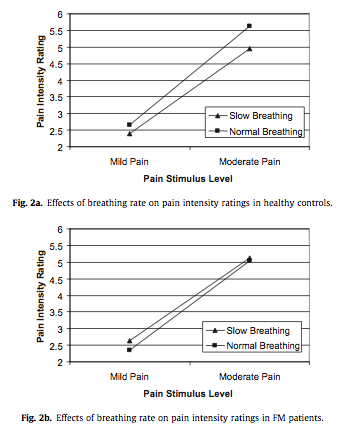
The effects of slow breathing on affective responses to pain stimuli: an experimental study.

Viktig studie om pustens regulering av smerte som nevner at å senke pustefrekvens demper smerte betraktelig for frisk mennesker, men hos Fibromyalgi er det ikke nok i seg selv som smertedemping.

http://www.ncbi.nlm.nih.gov/pubmed/20079569

Dropbox link: https://dl.dropboxusercontent.com/u/17457302/Forskning%20mappe%20for%20terapi/STUDIE%20-%20The%20effect%20of%20slow%20breathing%20on%20affective%20responses%20to%20pain%20stimul.pdf
Dropbox link til kommentar om fibromyalgi: https://dl.dropboxusercontent.com/u/17457302/Forskning%20mappe%20for%20terapi/Respiration-induced%20hypoalgesia%20-%20%20Additional%20evidence%20for%20pain%20modulation%20deficits%20in%20fibromyalgia.pdf

«M and HC were exposed to low and moderate thermal pain pulses during paced breathing at their normal rate and one-half their normal rate. »

«Participants who reported higher levels of trait positive affect prior to the experiment showed greater decreases in negative affect as a result of slow versus normal breathing.  »

«FM patients and normal controls were instructed to breathe at either their normal rate or 1/2 that rate during four blocks of four trials.  »

«An inspection of resting breathing rates for the two groups revealed no differences between groups: an average rate of 13.68 (SD = 3.54) breaths per minute for FM patients, and 13.63 (SD = 2.17) for HCs.  »

Skjermbilde 2013-05-12 kl. 11.31.28

«These findings are consistent with those of an observational investigation, which found lower breathing rates were associated with reduced pain intensity and unpleasant- ness ratings when participants meditated while receiving pulses of painful heat [12]. »

«Since all participants were administered trials where pain was administered, the potential benefit of interventions that include the practice of meditation in the treatment of pain patients is sup- ported. However, the mixed findings for FM patients give us pause. It may be more difficult to engender states of relaxation needed to endure pain in FM patients through slow paced breathing alone. »

«Taken together these findings are consistent with the model of pain as a homeostatic emotion. In this model, the neurophysiologi- cal processes that underlie how slow breathing influences pain begins with the increased bronchiopulmonary afferent activity. This activity produces increased activation in the left mid-insula and anterior insula [24], as well as increased activation in the left anterior cingulate associated directly with increased heart rate variability [18], corresponding with a shift in sympathovagal tone. This activation counterbalances the acute activation in the right anterior insula produced by painful stimulation [2] by virtue of opnent interaction [4].»

«The findings indicate that a slower breathing rate is a useful target in interventions for patients in pain. Reductions in pain and negative affect may be ex- pected when people are guided to halve their respiration rate.  »

«However, for FM patients, the data suggest that med- itative breathing alone is insufficient. Clinical interventions that address positive affective disregulation, appear necessary to assist FM patients in the management of their chronic pain. «

Ukjent sin avatar

Multipotential Mesenchymal Stem Cells Are Mobilized into Peripheral Blood by Hypoxia

Nevner at ved 50% mindre oksygen så kommer en type stamceller ut, MSC, som kan bli skjelett, blodkar og fettceller. Men å få 50% mindre oksygen ved pusteteknikker er svært vanskelig. Ved 4000 moh kan vi få det til om vi er der lenger enn 3 uker, slik som musene i denne studien.

http://onlinelibrary.wiley.com/doi/10.1634/stemcells.2006-0164/full

«Hypoxia-induced mobilization appears to be specific for MSCs since total circulating hematopoietic progenitor cells were not significantly increased»

«Certain stem cells are able to exit their production site, circulating into blood before reseeding their target tissues. In the case of hematopoietic stem cells (HSCs), such circulation is essential during development since they migrate from one site to the next (embryonic aorta-gonad-mesonephros region, fetal liver, adult bone marrow).»

«Adult male Wistar rats (7 weeks, 220 g; Harlan, Gannat, France, http://www.harlan.com) were housed for 3 weeks in a hypoxic chamber (50 kPa), which caused chronic hypoxia, as previously described [27], and were compared with matched control rats housed in normoxic conditions (101 kPa). «

Viser hvor mye stamceller som er i blod (PBH) i hypoxi (50 kPa) relativt til normoxi (PBN – 101 kPa)

«In conclusion, we report that few MSCs circulate in the PB under stationary conditions in rats. Large amounts of MSCs can be mobilized (an increase of almost 15-fold) under hypoxic conditions. These data demonstrate that MSCs can be mobilized into the PB via stimuli distinct from those involved in hematopoietic stem cell mobilization.»

Ukjent sin avatar

Hypoxia: Are stem cells in it for the long run?

Om stamceller og at hypoxi og HIF-a er viktig for deres overlevelse og funksjon.

http://www.landesbioscience.com/journals/cc/article/14535/

«tudies by others over the past 10 years has also indicated that hypoxia and Hif expression are essential for self-renewal and are involved in the regulation of proliferation for some types of stem cells. «

Ukjent sin avatar

Aerobically generated CO2stored during early exercise

Beskriver hvordan CO2 lagres i kroppen under trening og bidrar til bikarbonat buffer kapasitet.

http://jap.physiology.org/content/87/3/1048.long

«Over a similar time frame, the femoral vein blood pH and plasma K+ and Formulaconcentrations increase without an increase in Formula. Thus CO2 from aerobic metabolism is converted toFormularather than being eliminated by the lungs.»

«We conclude that a major component of the aerobically generated increase in CO2 stores is the newFormulagenerated as phosphocreatine is converted to creatine.»

Ukjent sin avatar

Physiological mechanisms dissociating pulmonary CO2 and O2 exchange dynamics during exercise in humans

Beskriver hvordan forholdet mellom CO2 og O2 endrer seg unde trening, og spesielt over melkesyreterskel hvor bikarbonat også begynner å spille inn i homeosasen av pH i blod.

http://ep.physoc.org/content/92/2/347.long

«During incremental exercise, the increased rate of Graphic relative to pulmonary O2 uptake (Graphic) can be used to quantify θL validly if aerobic and hyperventilatory sources can be ruled out, i.e. θL is then attributable to the decrease in muscle and blood [HCO3]. In many cases, however, very rapid incrementation of work rate and/or prior depletion of CO2 stores (by volitional or anticipatory hyperventilation) can yield a ‘false positive’ non-invasive estimation of θL(‘pseudo-threshold’) resulting from a slowing of the rate of wash-in of transient CO2stores.»

«Since the tissue capacitance for CO2 is appreciably greater than for O2 (Farhi & Rahn, 1955), this means that the respiratory exchange ratio (R), i.e. the ratio of the volumes of CO2and O2 exchanged across the tissue of interest per unit time, will differ from that of the respiratory quotient (RQ), i.e. the ratio of the amounts of metabolic CO2 and O2 produced and consumed, respectively, by the tissue per unit time not only across the lung, where it is most typically determined and from which inferences are most typically drawn, but also across the muscle vascular bed itself. »

«But, in addition, skeletal muscle contraction results in a transient metabolic alkalosis in the force-generating units (Steinhagen et al. 1976; Kemp, 2005) and in the venous effluent of the exercising muscle (Wasserman et al. 1997) as a result of the net proton (H+) trapping associated with the high-energy phosphate utilization, i.e. H+ release as ATP is split, and H+ uptake consequent to phosphocreatine (PCr) splitting (Kushmerick, 1997).»

«This transient alkalosis therefore results in a component of the metabolically produced CO2 being retained within the muscle.»

Ukjent sin avatar

Lactic acid buffering, nonmetabolic CO2 and exercise hyperventilation: a critical reappraisal

Om non-metabolic CO2, altså CO2 som ikke skapes i mitokondriene men kommer fra bikarbonat-reaksjoner med melkesyre.

www.ncbi.nlm.nih.gov/pubmed/15890562‎
Hele studien i dropbox: https://dl.dropboxusercontent.com/u/17457302/Nonmetabolic_CO2.pdf

«It has been suggested that hyperventilation and the disproportionate increase in VCO2 versus VO2 above the ventilatory threshold (V(TH)) in ramp exercise are due to the production of nonmetabolic CO2 in muscle because of lactic acid buffering by plasma bicarbonate entering the cell in exchange with lactate»

«(1) bicarbonate is not the main buffer in the muscle; (2) the decrease in standard bicarbonate concentration is not the mirror image of the increase in lactate concentration; (3) buffering by bicarbonate does not increase CO2 production in muscle (no nonmetabolic CO2 is produced in tissues); (4) the CO2 flow to the lungs, which should not be confused with VCO2 at the mouth, does not increase at a faster rate above than below V(TH).»

Forklaring på Non-Metabolic CO2 her:

Non-Metabolic Carbon Dioxide

At rest and during moderate exercise, lactic acid will not increase in your muscles because all that is produced is also used. Once you reach more challenging work rates, production exceeds use and the acid enters your blood. To maintain a healthy pH, sodium bicarbonate in your blood buffers most lactic acid by breaking it down to water and carbon dioxide. This results in additional carbon dioxide that must be released by your blood.

Read more: http://www.livestrong.com/article/524672-what-effect-does-exercise-have-on-the-amount-of-carbon-dioxide-released-by-the-blood/#ixzz2SmWggmYh