Ukjent sin avatar

The role of carbon dioxide (and intracellular pH) in the pathomechanism of several mental disorders. Are the diseases of civilization caused by learnt behaviour, not the stress itself?

Spennede studie som nevner mange viktige prinsipper rundt CO2 og hinter til at det er veldig mye vi har misforstått.

Beskriver spesielt godt hvordan lav CO2 (alkalose) gjør at cellemembraner blir mer permeabal (slipper ting lettere igjennom) for å balansere pH inne i cellen. Noe som fører til at også Ca2+ slippes inn i cellene og f.eks. muskelceller trekker seg mer sammen og nerveceller fyrer av lettere. Kroppen trenger mer oksygen og den setter igang en negativ spiral hvor økt pustefrekvens gir mindre CO2 som gir mer behov for oksygen og dermed en videreføing av økt pustefrekvens. Høy CO2 (acidose) gjør det motsatte, muskler slapper av, nervene roes ned og cellen beskyttes.

http://www.ncbi.nlm.nih.gov/pubmed/20128395
Hele studien: http://www.mppt.hu/images/magazin/pdf/xi-evfevfolyam-3-szam/a-szendioxid-es-az-intracellularis-ph.pdf

The role of carbon dioxide (CO2) is underestimated in the pathomechanism of neuropsychiatric disorders, though it is an important link between psyche and corpus.

The actual spiritual status also influences respiration (we start breathing rarely, frequently, irregularly, etc.) causing pH alteration in the organism;

on the other hand the actual cytosolic pH of neurons is one of the main modifiers of Ca2+-conductance, hence breathing directly, quickly, and effectively influences the second messenger system through Ca2+-currents. (Decreasing pCO2 turns pH into alkalic direction, augments psychic arousal, while increasing pCO2 turns pH acidic, diminishes arousal.)

One of the most important homeostatic function is to maintain or restore the permanence of H+-concentration, hence the alteration of CO2 level starts cascades of contraregulation. However it can be proved that there is no perfect compensation, therefore compensational mechanisms may generate psychosomatic disorders causing secondary alterations in the «milieu interieur».

Authors discuss the special physico-chemical features of CO2, the laws of interweaving alterations of pCO2 and catecholamine levels (their feedback mechanism), the role of acute and chronic hypocapnia in several hyperarousal disorders (delirium, panic disorder, hyperventilation syndrome, generalized anxiety disorder, bipolar disorder), the role of «locus minoris resistentiae» in the pathomechanism of psychosomatic disorders. It is supposed that the diseases of civilization are caused not by the stress itself but the lack of human instinctive reaction to it, and this would cause long-lasting CO2 alteration. Increased brain-pCO2, acidic cytosol pH and/or increased basal cytosolic Ca2+ level diminish inward Ca2+-current into cytosol, decrease arousal–they may cause dysthymia or depression. This state usually co-exists with ATP-deficiency and decreased cytosolic Mg2+ content. This energetical- and ion-constellation is also typical of ageing-associated and chronic organic disorders. It is the most important link between depression and organic disorders (e.g. coronary heart disease). The above-mentioned model is supported by the fact that H+ and/or Ca2+ metabolism is affected by several drugs (catecholemines, serotonin, lithium, triaecetyluridine, thyroxine) and sleep deprivation, they act for the logically right direction.

If we take our breath deeply or frequently our pulse speeds up proving that CO2 has left the pacemaker cells of heart, and the alkalic cytoplasm allowes Ca2+ to enter in the cytosol. If we keep on this kind of breathing for a long time, our pulse will slowly come back to the incipient frequency because the organism compensates the alteration of pH in the cytosol. The lack of H+ in cytosol increases conductance of Ca 2+ and some other ions (Harvey et al.), thus it increases contraction, metabolism and O2 requirement (Laffey et al.), and also increases excitability of neurons in the peripherium (Macefield et al.) and in the brain (Stenkamp et al.). All these events can be explained by the simple fact that lack of H+ (=alkalosis) increases transmembrane conductance of ions and (consequently) increases active ion-pumping mechanisms too (because the original ion-status has to be restored). By contrast, acidosis decreases the transmembrane Ca 2+-conductance (Tombaugh & Somjen), decreases excitability of neurons, and the decreased Ca 2+-conductance can dramatically affect neurotransmitter re- lease (Dodge et al..).

Then chronic hypocapnia or hypercapnia is followed by cascades which alter the whole ionmileu in the cells, they may alter even the neurotransmitter/endocrine sta- tus (Dodge et al.). Therefore, it is inappropriate to call that process a “compensational mechanism”, this name suggests that it is all right, while it is not! According to Claude Bernard alteration of milieu interieur can result in illness. It is very important that the new ion milieu is similarly stable as the original one and it does not allow the organism to restore the original status. Therefore we should name this happening a „complication” (in- stead of “compensation”).
Ukjent sin avatar

Fractional end-tidal CO2 as an index of the effects of stress on math performance and verbal memory of test-anxious adolescents.

Man tenker vanligvis, f.eks. under trening at høy CO2 fører til hyperventilering. Men vi vet også at hyperventilering fører til lav CO2, som vist i denne studien på ungdom med eksamensangst.

http://www.ncbi.nlm.nih.gov/pubmed/9792486

The research reported here was derived from the hypothesis that hyperventilation contributes to the decrement in performance observed in test-anxious students. From this point of view, students identified as test-anxious would be expected to hyperventilate to a greater extent than non-test-anxious students when confronted with the stress of testing. The experiment reported here tested this hypothesis by continuous capnographic monitoring of end-tidal CO2 and respiration frequency of 16 high- and 16 low-test-anxious boys and girls (ages 12-14 years) before and during tests of math and word-recall memory under conditions of high- and low-stress (i.e. ‘strong’ motivational instruction versus ‘weak’ motivational instructions). Consistent with predictions, high test-anxious students displayed lower levels of end-tidal CO2 (under the high-stress condition) and faster respiration frequencies than low test-anxious students. Both high- and low-test-anxious students scored higher on the math test under high-stress conditions, but differences between recall scores were not significant. Collateral data revealed a positive relationship between scores on the Nijmegen Hyperventilation Questionnaire and the Revised Suinn Test Anxiety Behavior Scale, and a negative relationship between the questionnaire scores (self reports of frequency of symptoms of hypocapnia) and drop in level of end-tidal CO2 during testing, i.e. high-test-anxiety group reported a greater frequency of symptoms of hyperventilation and a larger drop in level of end-tidal CO2 during testing than low-test-anxiety group.

Ukjent sin avatar

The effect of two manipulative therapy techniques and their outcome in patients with sacroiliac joint syndrome

Denne studien viser at manipulering av SI leddet i korsbeinet fungerer bedre om man også gjør manipulering av korsryggen. Dette prinsippet viser at uansett hva man behandler så er det bedre om man inkluderer flere deler av kroppen.

Vi må innse at menneskekroppen ikke er en mekanisme, men en organisme.

http://www.sciencedirect.com/science/article/pii/S136085921100026X

A single session of SIJ and lumbar manipulation was more effective for improving functional disability than SIJ manipulation alone in patients with SIJ syndrome. Spinal HVLA manipulation may be a beneficial addition to treatment for patients with SIJ syndrome.

Ukjent sin avatar

End-tidal CO2 as a predictor of survival in out-of-hospital cardiac arrest.

Nevner hvordan CO2 mengden i blod kan brukes til å vurdere ovelevelsesgraden av hjertestans.

Spontan blodsirkulasjon gjenopprettes når EtCO2 er på 27,6 mmHg.

http://www.ncbi.nlm.nih.gov/pubmed/22107764

The mean initial EtCO2 was 18.7 (95%CI = 18.2-19.3) for all patients. Return of spontaneous circulation was achieved in 695 patients (22.4%) for which the mean initial EtCO2 was 27.6 (95%CI = 26.3-29.0). For patients who failed to achieve ROSC, the mean EtCO2 was 16.0 (95%CI = 15.5-16.5).

Ukjent sin avatar

Cardiovascular and Respiratory Effect of Yogic Slow Breathing in the Yoga Beginner: What Is the Best Approach?

Svært spennende studie ang pustens påvirkning på vagusnerven, som bekrefter Breathing System sin Autonome pust, 5 sek inn og 5 sek ut, altså 6 pust i minuttet.

Nevner hvordan en usymmetrisk pust, f.eks. 3 inn og 7 ut, ikke påvirker vagusnerven i særlig stor grad. Og at ujjayi påvirker vagusnerven dårligere enn uanstrengt sakte pust. Ujjiayi pust har andre positivie effekter.

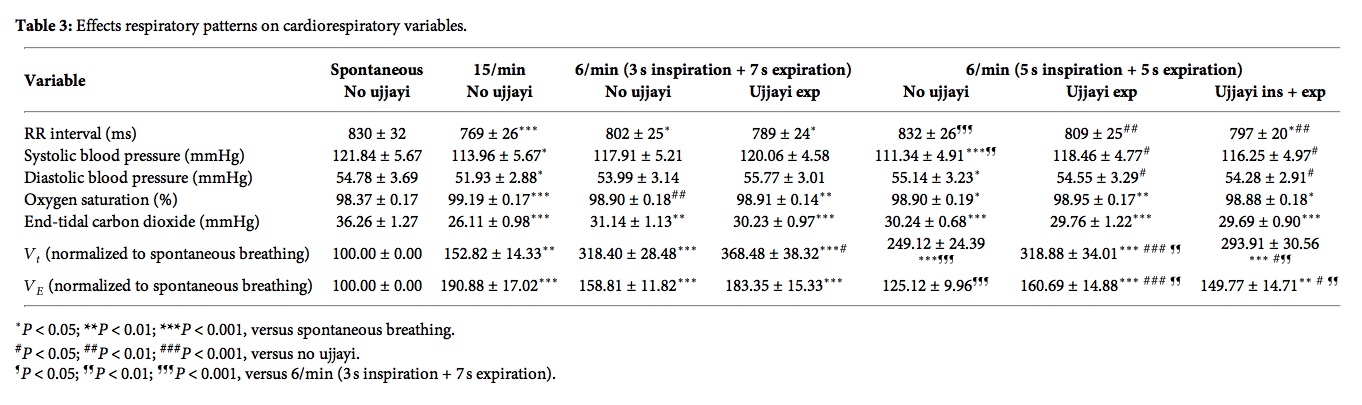
Nevner også at CO2 synker fra 36 til 30 mmHg når man puster 5/5 i forhold til når man ikke gjør pusteteknikk (spontan pust), men synker til 26 mmHg når man puster 15 pust i minuttet. Selv med 7s utpust synker CO2 ned til 31 mmHg. Dette er motsatt av hva studien på CO2 hos angstpasienter viser, hvor CO2 øker selv når pustefrekvensen senkes fra 15 til 12, og øker mer jo saktere pustefrekvensen er.

Nevner også noe svært interessant om at små endinger i oksygenmetning kan gi store endringer oksygentrykket pga bohr-effekt kurven som flater veldig ut ved 98% slik at en 0.5% økning i oksygenmetning kan likevel gir 30% økning i oksygentrykket.

http://www.hindawi.com/journals/ecam/2013/743504/

The slow breathing with equal inspiration and expiration seems the best technique for improving baroreflex sensitivity in yoga-naive subjects. The effects of ujjayi seems dependent on increased intrathoracic pressure that requires greater effort than normal slow breathing.

Respiratory research documents that reduced breathing rate, hovering around 5-6 breaths per minute in the average adult, can increase vagal activation leading to reduction in sympathetic activation, increased cardiac-vagal baroreflex sensitivity (BRS), and increased parasympathetic activation all of which correlated with mental and physical health [14]. BRS is a measure of the heart’s capacity to efficiently alter and regulate blood pressure in accordance with the requirements of a given situation. A high degree of BRS is thus a good marker of cardiac health [5].

The slow breathing-induced increase in BRS could be due to the increased tidal volume that stimulates the Hering-Breuer reflex, an inhibitory reflex triggered by stretch receptors in the lungs that feed to the vagus [6]. In addition, the slow breathing increases the oxygen absorption that follows greater tidal volume , as a result of reduction in the effects of anatomical and physiological dead space [78]. This might in turn produce another positive effect, that is, a reduction in the need of breathing. Indeed, a reduction in chemoreflex sensitivity and, via their reciprocal relationships, an increase in BRS, have been documented with slow breathing [913].

 pustmønster CO2
In comparison to spontaneous breathing, fast breathing led to a reduction in BRS, whilst all slow breathing (with or without ujjayi breathing) increased BRS. This increase was seen in both the symmetrical (5 second inspiration and expiration) and asymmetrical (3 second inspiration and 7 second expiration) slow breathing conditions. Engaging ujjayi breathing on the exhalation had the effect of reducing the increase in BRS of slow breathing alone, and this was further reduced with ujjayi on the inspiration and expiration (which was not significantly higher than baseline). These differences were even more pronounced with respect to controlled breathing at 15 breath/minute, which also showed highly significant differences with respect to spontaneous breathing, but in the opposite direction.
When slow breathing was done in conjunction with ujjayi breathing, oxygen saturation further increased, though only slightly. Overall, however, this was a highly significant change given that baseline oxygen saturation was already high approximately 98.3% (Table 3).
However, with 15 breath/minute controlled breathing the increase in oxygen saturation occurred with a large relative increase in Ve and a marked drop in end-tidal carbon dioxide. Conversely, with slow breathing, the increase in oxygen saturation occurred with only a moderate increase in Ve and drop in carbon dioxide.
The greatest improvement was found in slow breathing without ujjayi, while breathing controlled at a rate of 15/min caused a drop in BRS. In all forms of slow breathing there was a statistically significant increase in oxygen saturation from the mean baseline of 98.3%, confirming the relationship between high levels of oxygen absorption and BRS.
In this study, we show that slow breathing and increased oxygen absorption lead to enhanced BRS. This might result from several possible factors, all interrelated. In theory, the increase in arterial oxygen partial pressure increases blood pressure, which in turn could stimulate the baroreceptors and improve the BRS gain. This was recently observed in healthy [28] and diabetic subjects [25]. The seemingly small extent of the increase in oxygen saturation should not be overlooked. In fact, the haemoglobin dissociation curves states that at higher saturation values small changes reflex large changes in the partial pressure of oxygen.
Because the oxygen tension (and not oxygen saturation) is the chemoreflex input signal, this explains why in a previous study the administration of oxygen in normoxia induced a significant increase in BRS and parasympathetic activity despite a small increase in oxygen saturation [25].
We did not find any significant difference between asymmetrical and symmetrical breathing during slow breathing. We suggest that most of these results could be due to the prolonged expiratory time (in fact the 3-second inspiratory time of the asymmetrical breathing was very close to the spontaneous breathing). In the yoga tradition several degrees of asymmetries were adopted. While some of these could have specific effects (and could be matter for further investigations), our results suggest that an expiratory time of at least 5 seconds was sufficient to elicit most of the results observed.
Based on our findings, slow breathing with similar inspiration and expiration times appears the most effective and simple way to heighten the BRS and improve oxygenation in normoxia. Ujjayi breath demonstrates limited added benefit over slow breathing done at 6/min in normoxia; however, the effects could be more pronounced in hypoxia, and this could be matter for future investigations.


Ukjent sin avatar

om hudens rolle

One key to understanding living organisms, from those that are made up of one cell to those that are made up of billions of cells, is the definition of their boundary, the separation between what is in and what is out. The structure of the organism is inside the boundary and the life of the organism is defined by the maintenance of internal states with in boundary. Singular individuality depends on the boundary.

– Antonio Demasio, The Feenling of What Happens.

Ukjent sin avatar

Neurosensory mechanotransduction through acid-sensing ion channels.

Veldig interessant studie som nevner at pH-sanse nerveceller(ASIC) finnes i Merkel og Ruffini celler i huden, og at i ASIC knockout mus så reagerer de ikke på trykk.

http://www.ncbi.nlm.nih.gov/pubmed/23490035

The ASIC proteins are involved in neurosensory mechanotransduction in mammals. The ASIC isoforms are expressed in Merkel cell-neurite complexes, periodontal Ruffini endings and specialized nerve terminals of skin and muscle spindles, so they might participate in mechanosensation.

In knockout mouse models, lacking an ASIC isoform produces defects in neurosensory mechanotransduction of tissue such as skin, stomach, colon, aortic arch, venoatrial junction and cochlea. The ASICs are thus implicated in touch, pain, digestive function, baroreception, blood volume control and hearing.

Ukjent sin avatar

The Pathogenesis of Muscle Pain

Viktig studie fra S.Mense som nevner mange aspekter av muskelsmerter, som trykksensitivitet, sentral sensitering og referert smerte.

http://www.cfids-cab.org/cfs-inform/Neuroendocrin/mense03.pdf

The typical muscle nociceptor responds to noxious local pressure and injections of BKN; however, in animal experiments, receptors also can be found that are activated by one type of noxious stimulation (mechanical or chemical) only. This finding indicates that different types of nociceptors are present in skeletal muscle, similar to the skin in which mechano-, mechano-heat-, and poly-modal nociceptors have been reported to exist [12••].

The sensitization is associated with a decrease in the mechanical threshold of the receptor so that it responds to weak pressure stimuli. The sensitized muscle receptor still is connected to nociceptive central nervous neurons and thus elicits subjective pain when weak mechanical stimuli act on the muscle. This sensitization of muscle nociceptors is the best established peripheral mechanism explaining local tenderness and pain on movement of a pathologically altered muscle.

Of these neuropeptides, SP is of particular interest because, in experiments on fibers from the skin, SP has been shown to be predominantly present in nociceptive fibers [26]. The peptides are released during excitation of the ending and influence the chemical milieu of the tissue around the receptor. This means that a nociceptor is not a passive sensor for tissue-threatening stimuli, but actively changes the micromilieu in its vicinity by releasing neuropeptides. SP has a strong vasodilating and permeability increasing action on small blood vessels.

Mechanism of referral of muscle pain

The expansion of the input region of the inflamed GS muscle nerve likely underlies the spread and referral that is common in patients with muscle pain. The mechanisms mentioned previously can explain referral as follows: when a muscle is damaged, the patient will perceive local pain at the site of the lesion. If the nociceptive input from the muscle is strong or long-lasting, central sensitization in the dorsal horn neurons is induced, which opens silent synapses and leads to an expansion of the target area of that muscle in the spinal cord (or brain stem). As soon as the expansion reaches sensory neurons that supply peripheral areas other than the damaged muscle, the patient will feel pain in that area outside the initial pain site. In the area of pain referral, no nociceptor is active and the tissue is normal. The referral is simply caused by the excitation induced by the original pain source, which spreads in the central nervous system and excites neurons that supply the body region in which the referred pain is felt. This way, a trigger point in the temporalis muscle can induce pain in the teeth of the maxilla when the trigger point-induced central excitation spreads to sensory neurons that supply the teeth [43•].

Ukjent sin avatar

to studier på hvordan huden reagerer på trykkømhet

To studier på hvordan huden påvirker trykksensitivitet.

Ene nevner at trykkømhet i fibromyalgi er værst over der en nerve er, ikke så mye over knokler eller muskler.  Nevner at en bedøvende krem på huden ikke endrer trykkømhet.

Andre nevner at trykkømhet normalt faktisk blir mindre av en bedøvende krem, og bekrefter at ømheten er større over en nervebane enn over knokkel eller muskel.

Increased pressure pain sensibility in fibromyalgia patients is located deep to the skin but not restricted to muscle tissue

http://www.sciencedirect.com/science/article/pii/0304395996000127

The site with underlying nerve had a lower PPT than the bony site (P > 0.001) and the ‘pure’ muscle site (P > 0.001), respectively. These relations remained unaltered by skin hypoesthesia.

Application of EMLA, compared to control cream, did not change PPTs over any area examined. The results demonstrated that pressure-induced pain sensibility in FM patients is not most pronounced in muscle tissue and does not depend on increased skin sensibility.

Pressure pain thresholds in different tissues in one body region. The influence of skin sensitivity in pressure algometry.

http://www.ncbi.nlm.nih.gov/m/pubmed/10380724

The PPT was significantly (p < 0.001) lower at the «muscle/nerve» site than at the bony and «pure» muscle sites.

However, PPTs after control cream were lower (p < 0.001) over all examined areas than those obtained prior to cream application. Thus, EMLA cream increased PPTs compared to control sites in all examined areas (p < 0.001). Under the given circumstances, skin pressure pain sensitivity was demonstrated to influence the PPT.