Ukjent sin avatar

Inflammation Induces Ectopic Mechanical Sensitivity in Axons of Nociceptors Innervating Deep Tissues

Viktig studie som nevner hvordan betennelser i nervene gir lavere terskel for nociceptiv avfyring, altså smerte selv ved lette trykk, og kan gi spontane avfyringer, altså smerte uten noen fysiologisk årsak.

http://jn.physiology.org/content/90/3/1949.full

«Here we show that inflammation led to mechanical sensitivity of the axons of a subset of mechanically sensitive primary sensory neurons. Dorsal root recordings were made from 194 mechanically sensitive neurons that innervated deep and cutaneous structures and had C, Aδ, and Aαβ conduction velocities. »

«However, the axons of neurons innervating deep structures and having C- or Aδ-conduction velocities became mechanically sensitive during the neuritis, and also exhibited an increased incidence of spontaneous discharge. »

«However, the axons of neurons innervating deep structures and having C- or Aδ-conduction velocities became mechanically sensitive during the neuritis, and also exhibited an increased incidence of spontaneous discharge. »

«Primary sensory neurons are considered to “sense” only at their endings, within the structure they innervate. Sensory quality and localization are normally initiated by the activation of modality-specific sensory transducers in the tissue being stimulated, resulting in action potentials that are carried by axons, bundled in nerves, to the CNS. However, in many human patients, movements of intact, apparently uninjured nerves far from the innervated tissue can elicit radiating pain (e.g., “sciatica”). Such movement-induced radiating pain could be explained by the induction of ectopic sensory function along the axon.»

Svært viktig sitat som nevner at dette ikke gjelder i huden, men i dypere nivåer av kroppen.
«Using extracellular recording techniques in a model of neuritis, we now report that inflammation of intact axons leads to axonal mechanical sensitivity. We found that this phenomenon was limited to slowly conducting axons innervating noncutaneous structures.»
«Deep RFs were identified through the skin and proved by moving the overlying skin and repeating the effective stimulus to the same underlying spot, through a different portion of skin. »

«Action potentials in the absence of evident or applied stimuli are termed ongoing activity(OA). Ongoing activity was recorded for 2 min after the RF was located, and after mechanical stimulation of the nerve. During CFA neuritis, more deep neurons with C- and Aδ-axons had OA (19/111) than did cutaneous neurons with C- and Aδ-axons recorded during the same experiments [2/43; P < 0.05 (chi-square)], or than did deep neurons with C- and Aδ-axons recorded during the control experiment [1/27; P = 0.05 (Fisher’s exact)]. »

Betennelser i nervene gir hypeaemi, økt blodgjennomgstrømning. Dette er nok bare i akuttfasen.
«At 7 days postoperatively, the affected section of the nerve was characterized by encasement with granulation tissue and hyperemia of the intrinsic vasculature. Histology of the lesion demonstrated epineurial edema, increased lymphocytes, and a massive infiltration of macrophages within the epineurium and the granuloma (Fig. 4, B, D, and F). »

«These data demonstrate that neurons innervating deep structures and having properties of nociceptors (i.e., slow conduction velocities and high mechanical activation thresholds) developed axonal mechanical sensitivity during neuritis. »

«We employed noxious stimuli in the search for receptive fields, and thus especially for deep neurons, the tissues containing the terminals were often swollen, and therefore inflamed, before identification. Such inflammation is likely to reveal the latent receptive fields of otherwise silent nociceptors (Kress et al. 1992), making specific identification of such neurons improbable. Inflammation is also known to induce ongoing activity. Although we observed a statistically significant, increased incidence of ongoing activity in deep neurons during neuritis, these data must also be considered carefully because of the methodology used to identify the receptive fields. With these data, we cannot rule out that the axons of silent nociceptors from either deep or cutaneous tissues become mechanically sensitive during neuritis.»

«The development of axonal mechanical sensitivity was induced by local inflammation, which was characterized by the recruitment of epineurial macrophages and lymphocytes. This cellular infiltrate may play a key role in the axonal mechanical sensitivity. These cells lead to increased levels of tumor necrosis factor alpha, which increases sodium conductance in mammalian cell membranes (Hribar et al. 1999) and induces spontaneous activity in nociceptors when applied to axons (Leem and Bove 2002; Sorkin et al. 1997). »

«Second, the membrane potential in sensory neurons oscillates, dependent on Na+ channels, and normally approaches but does not reach the triggering threshold of the neuron (Amir et al. 1999). These oscillations become greater as the membrane is depolarized (Amir et al. 1999). Such oscillations would be potentiated by increased sodium conductance or sodium current, and could lead to spontaneous activity. Importantly, these oscillations are more pronounced in neurons innervating noncutaneous structures (Liu et al. 2002), which may be the basis for our observations that only the axons of noncutaneous neurons became mechanically sensitive.»

«Moreover, cutaneous allodynia seems dependent on at least transient activation of slowly conducting axons (Vatine et al. 1998). These findings, and ours, suggest that the observed sensitivity change was related to changes in the sensitivity of higher-order neurons that receive convergent information from the noncutaneous peripheral neurons that were sensitized by the neuritis. Alternatively, the cutaneous sensitivity may have been secondary to changes in ongoing activity of silent nociceptors (not specifically recorded from, as discussed above), or transient changes in neurons with faster conducting axons, which were not tested before or at the peak of heightened cutaneous sensitivity.»

«The appearance of axonal mechanical sensitivity during neuritis is consistent with reports of typically deep pain radiation provoked by mechanical stimulation of inflamed human dorsal roots (Kuslich et al. 1991; Smyth and Wright 1958; G. M. Bove and Z. H. Bajwa, unpublished observations), and radiating deep pain in the apparent absence of nerve injury (Verdugo and Ochoa 1993). »

Nevner at betente nerver er viktig forståelse for å forklare symptomene som kommer med sykdommer som har betennelser som utgangspunkt.
«Neuritis has long been recognized as a common malady of the peripheral nervous system (Gowers 1886), and can occur as a result of direct nerve injury or by extension from other diseases with inflammatory components, such as diabetes and endometriosis (Dyck et al. 2000; Zager et al. 1998). »

«Neuritis may be a common denominator in these otherwise seemingly unrelated disorders. The development of axonal mechanical sensitivity seems necessary to explain some clinical features of patients with radiating pain worsened by movements (e.g., “sciatica”), suffered by more than one-half of the population at some point in their lives (Frymoyer et al. 1983; Hult 1954).»
Ukjent sin avatar

The underlying mechanisms for development of hypertension in the metabolic syndrome

Studie som nevner «alt» om insulinresistens og hva det gjør i kroppen: magefett, symatisk overstimulering, oksidativt stress og blodkardysfunksjon, renin-angiotensin, betennelser og søvnapne.

http://www.nutritionj.com/content/7/1/10

«Visceral obesity, insulin resistance, oxidative stress, endothelial dysfunction, activated renin-angiotensin system, increased inflammatory mediators, and obstructive sleep apnea have been proposed to be possible factors to develop hypertension in the metabolic syndrome. These factors may induce sympathetic overactivity, vasoconstriction, increased intravascular fluid, and decreased vasodilatation, leading to development of hypertension in the metabolic syndrome.»

«As shown in Figure 1, accumulated visceral adipose tissue produce and secrete a number of adipocytokines, such as leptin, tumor necrosis factor-α (TNF-α), interleukin-6 (IL-6), angiotensinogen, and non-esterified fatty acids (NEFA), which induce development of hypertension [11]. «

«Insulin resistance is the main pathophysiologic feature of the metabolic syndrome. Several mechanisms connect insulin resistance with hypertension in the metabolic syndrome. An anti-natriuretic effect of insulin has been established by accumulating data indicating that insulin stimulates renal sodium re-absorption [1214]. This anti-natriuretic effect is preserved, and may be increased in individuals with insulin resistance, and this effect may play an important role for development of hypertension in the metabolic syndrome [15].»

«NEFA has been reported to raise blood pressure, heart rate, and α1-adrenoceptor vasoreactivity, while reducing baroreflex sensitivity, endothelium-dependent vasodilatation, and vascular compliance[28]. Insulin resistance increases plasma leptin levels, and leptin has been reported to elevate sympathetic nervous activity, suggesting that leptin-dependent sympathetic nervous activation may contribute to an obesity-associated hypertension [29]. Accumulating data suggest that metabolic syndrome is associated with markers of adrenergic overdrive [30].»

«In rats with the metabolic syndrome, induced by chronic consumption of a high fat, high refined sugar [31], hypertension is associated with oxidative stress [32], avid nitric oxide (NO) inactivation, and down-regulation of NO synthase (NOS) isoforms and endothelial NOS activator[32], suggesting that oxidative stress and endothelial dysfunction may be strongly associated with development of hypertension in the metabolic syndrome. Further, recent evidences suggest that oxidative stress, which is elevated in the metabolic syndrome [33], is associated with sodium retention and salt sensitivity [34].»

«The renin-angiotensin system (RAS) plays a crucial role in blood pressure regulation, by affecting renal function and by modulating vascular tone. The activity of the RAS appears to be regulated by food intake, and overfeeding of rodents has been reported to lead to increased formation of angiotensin II in adipocytes [38]. «

«Recent cohort studies have demonstrated that high-sensitivity C-reactive protein (hsCRP) independently presents additive prognostic values at all levels of metabolic syndrome [45]. Ridker PM, et al. suggest a consideration of adding hsCRP as a clinical criterion for metabolic syndrome[45]. Abnormalities in inflammatory mediators have been also reported to be implicated with development of hypertension.»

«TNF-α is involved in the pathophysiology of hypertension in the metabolic syndrome. TNF-α stimulates the production of endothelin-1 and angiotensinogen [48,49].»

«IL-6 stimulates the central nervous system and sympathetic nervous system, which may result in hypertension [54,55]. The administration of IL-6 leads to elevation in heart rate and serum norepinephrine levels in women [56]. Further, IL-6 induces an increase in plasma angiotensinogen and angiotensin II [57], leading to development of hypertension.»

«Patients with OSA are often considered to be obese, however, Kono M et al. reported that OSA was associated with hypertension, dyslipidemia, and hyperglycemia, independent of visceral obesity [59]. «

Ukjent sin avatar

Vascular insulin abnormalities, hypertension, and accelerated atherosclerosis

Studie som bekrefter at insulin resistens (ikke høyt insulinnivå alene) gjør at blodkar trekker seg sammen og hemmer blodsirkulasjon. Pluss at de mister sin sensitivitet for sammentreking og utvidelse, de blir med andre ord stive.

http://www.ncbi.nlm.nih.gov/pubmed/8503434

«However, recent data from our laboratory suggest that cellular insulin resistance rather than hyperinsulinemia per se may lead to hypertension. The basic tenet proposed in this article is that a deficiency of insulin at the cellular level represents a common mechanism that is involved in the development of hypertension in both type I and type II diabetes mellitus»

«For example, recently reported studies from our laboratory demonstrate that insulin attenuates the vascular contractile response to phenylephrine, serotonin, and potassium chloride. Thus, it appears that insulin normally modulates (attenuates) vascular smooth muscle contractile responses to vasoactive factors, and insulin resistance should accordingly be associated with enhanced vascular reactivity.»

Ukjent sin avatar

Carbon dioxide influence on nitric oxide production in endothelial cells and astrocytes: Cellular mechanisms

Viktig studie som nevner hvordan CO2 forholder seg til NO og vasodilasjon. Nevner mekanismene bak eNOS og nNOS og hva som faktisk skjer i cellene. Denne studien er på celler, men beskriver mye av det som skjer in vivo og refererer til andre viktige studier.

http://www.ncbi.nlm.nih.gov/pmc/articles/PMC3073030/

«Cerebral vessels may regulate cerebral blood flow by responding to changes in carbon dioxide (CO2) through nitric oxide (NO) production. »

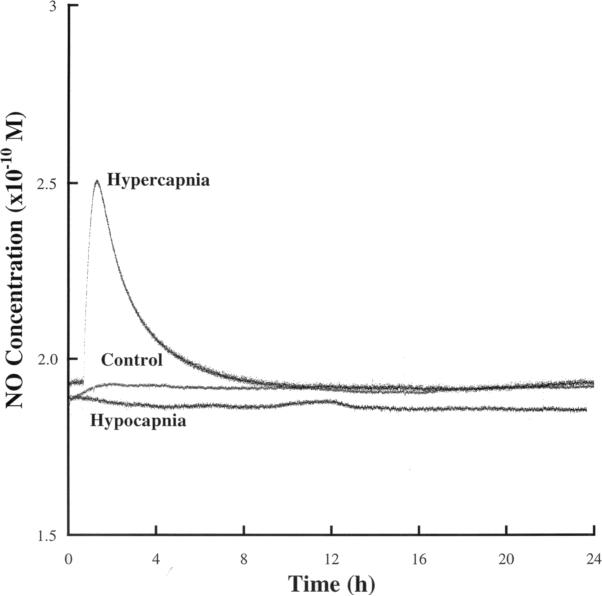
«NO levels in endothelial cells increased during hypercapnia by 36% in 8 hours and remained 25% above baseline. NO increase in astrocytes was 30% after 1 hour but returned to baseline at 8 hours. NLA blocked NO increase in endothelial cells under hypercapnia.»

«This study suggests that cerebral endothelial cells and astrocytes release NO under normocapnic conditions and NO production is increased during hypercapnia and decreased during hypocapnia independent of pH. Further, this demonstrates that endothelial cells may play a pivotal role in chemoregulation by modulating NOS activity.»

«Modulation of cerebral vascular tone in response to changes in the arterial partial pressure of carbon dioxide (pCO2) is defined as chemoregulation. In humans hypocapnia produces vasoconstriction resulting in decreased cerebral blood flow (CBF), whereas hypercapnia produces vasodilation and increased CBF (Lavi et al., 2003). »

«Using nitric oxide synthase (NOS) inhibitors, several in vivo studies have suggested that vasodilation in response to increased pCO2may be mediated by NO (Lavi et al., 2006). »

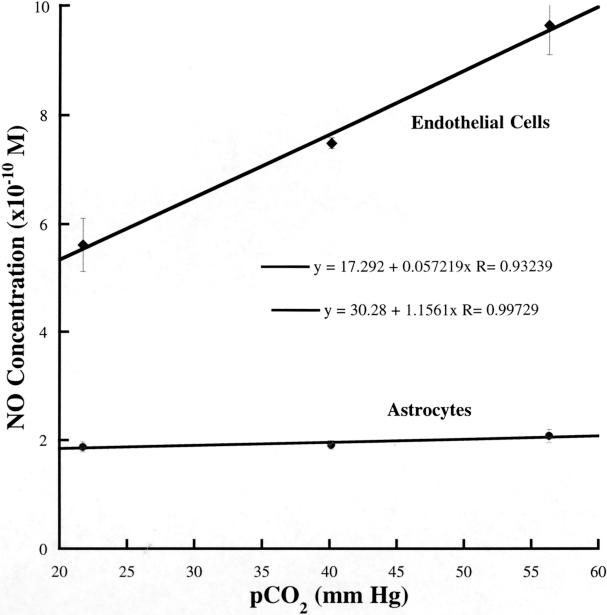
«Under hypercapnic conditions (pCO2 56.3±8.7 mmHg), NO concentration increased from baseline levels to a mean of 10±0.6×10⁻¹⁰M during the first 4 hours (Figure 1A). NO concentration peaked at 36% (10.2±0.5×10⁻¹⁰M) above baseline at 8 hours and stabilized 25% (9.4±0.5×10⁻¹⁰M) above baseline until completion of the experiment.»

«By plotting NO changes as a function of pCO2, we could disregard time as a variable in NO production (Figure 3) to establish that changes in NO levels correlate with changes in pCO2 (R=0.99).»

CO2 og NO

«Under hypercapnic conditions (pCO2 56.3±8.7 mmHg), human fetal astrocytes increased NO production by 30% over baseline values to a mean level of 2.5±1.2×10⁻¹⁰M in the first hour of hypercapnia (Figure 2). NO production then gradually decreased to control levels after 8 hours and remained at control levels for the remainder of the experiments.»

CO2 og NO i astrocytt

«The pH values were kept stable within a neutral gap under normocapnic (7.39±0.01), hypercapnic (7.36±0.02) and hypocapnic (7.40±0.01) conditions.»

» Stimulation of NOS in the endothelial cells is consistent with the NO-dependent vasodilation and increased CBF that occur in vivo during hypercapnia, as has been shown in rats (Iadecola, 1992) and in primates (Thompson et al., 1996). Decreased NO production by endothelial cells also correlates with the in vivo vasoconstrictive response to hypocapnia shown previously (Lavi et al., 2003;Thompson et al., 1996).»

«Thus, it is unlikely that eNOS is responsible for the early or fast phase response during chemoregulation in vivo. There are several explanations for this phenomenon. First, nitrite (NO2), being a storage pool of NO, can be reduced to NO under acidic and hypoxic conditions in vivo (Cosby et al., 2003). Under these conditions nitrite releases NO in the presence of deoxygenated hemoglobin in blood (Cosby et al., 2003;Nagababu et al., 2003) or neuroglobin (Burmester et al., 2000) in neurons acting as a nitrite reductase (Petersen et al., 2008). »

«The chemoregulatory response to CO2 changes in vivo is rapid, occurring on the order of milliseconds; our results did not demonstrate this component of the chemoregulatory response.»

«Cerebrovascular reactivity in response to CO2 is impaired in diabetic or hypertensive patients with endothelial dysfunction (Lavi et al., 2006), suggesting an important role for endothelial cells in modulating CBF response to CO2. »

«It has been reported that the ATP-sensitive K+ channels play a pivotal role in microvessel vasodilation of the cerebral cortex in response to decreased pH corresponding to mild hypercapnia and that a NOS inhibitor could not alter this vasodilation (Nakahata et al., 2003).»

Ukjent sin avatar

The role of systemic inflammation in age-related muscle weakness and wasting

Om at kronisk betennelse svekker muskler, spesielt i alderdom. Det er mengden av TNF-a og varigheten som avgjør om det virker muskelsvekkende eller ikke. Store mengder over lang tid tærer på muskelen ved at cellene går inn i apoptose (celledød).

http://onlinelibrary.wiley.com/doi/10.1111/j.1600-0838.2009.01018.x/abstract

«Thus, the negative effect of systemic inflammation on muscle strength at old age may only become apparent when it exceeds a certain threshold and persists for a prolonged period.»

«Satellite cell function may be affected by circulating factors, as muscle regeneration in old mice sharing the circulation of young mice is not impaired. Chronic low-grade systemic inflammation in old organisms may be that environmental factor.»

«TNFα destabilizes MyoD, a muscle-specific transcription factor involved in satellite cell proliferation and differentiation, and induces apoptosis of satellite cells, particularly at old age. »

«Yet, the increase in TNFα during the normal inflammatory response helps, rather than impairs, the repair process. This apparent contradiction may be resolved by the fact that the effects of TNFα are concentration and time dependent.»

Ukjent sin avatar

The role of corticosteroids in the regulation of vascular tone

Viser til mekanismene for hvordan kortisol (og stress) hemmer blodsirkulasjon og over tid kan gi høyt blodtrykk og mange medfølgende sykdommer. Kortisols effekt på blodkar sammentrekning er først og fremst ved å øke reaksjonen og blodkarcellenes sensitivitet til adrenalin. Men også øke nyrenes tilbakeholdelse av salt.

http://cardiovascres.oxfordjournals.org/content/41/1/55.full

«In addition, corticosteroids in lesser amounts are essential for the maintenance of peripheral vascular resistance in healthy persons. This review details the proposed mechanisms by which corticosteroids maintain and, in excess, enhance vascular tone.»

«Disease states resulting from excesses of circulating (adreno)corticosteroids include primary hyperaldosteronism, renal artery stenosis, ACTH-secreting tumors, and administration of glucocorticoids for treatment of other diseases. Hypertension is commonly associated with these diseases. »

«Potent vasoconstrictor hormones that have been investigated include α-adrenergic agonists (norepinephrine), angiotensin II, arginine vasopressin, endothelin and thromboxanes.»

«Results from other studies have suggested that corticosteroids act directly on blood vessels in potentiating norepinephrine vasoconstrictor actions. »

«Corticosteroids enhance contractile responses to norepinephrine in humans. For example, Kurland and Freedberg [20]administered increasing doses of norepinephrine intravenously to three patients before and 24 h after initiation of glucocorticoid therapy and observed much greater pressor responses in the presence of corticosteroid than in the absence of corticosteroid. »

«For the most part, glucocorticoids and mineralocorticoids have been reported to enhance the vasoconstrictor actions of angiotensin II.»

Viser til at forskjellige steder i kroppen har forskjellig sensitivitet for kortisol:
«It is possible that differences in responses to corticosteroids in vascular beds in different parts of the body may explain the above-mentioned discrepancies. »

«From the above review, one can see that corticosteroids foster hypertension not only by enhancing renal sodium reabsorption but also by augmenting vascular tone. «

Ukjent sin avatar

Endothelial dysfunction as a possible link between C-reactive protein levels and cardiovascular disease

Nevner at lavgrads betennelse er utgangspunktet for arterosklerose. Og at det hemmer endotelfunksjonen, altså blodkar cellenes evne til å trekke seg sammen og utvide seg.

http://www.clinsci.org/cs/098/0531/cs0980531.htm

«Low-grade chronic inflammation, characterized by elevated plasma concentrations of C-reactive protein (CRP), is associated with an increased risk of atherosclerotic cardiovascular disease.»

«These data demonstrate for the first time a relationship between low-grade chronic inflammation and basal endothelial NO synthesis (measured using an invasive method), and support the notion that endothelial dysfunction is a critical intermediate phenotype in the relationship between inflammation and cardiovascular disease.»

«Inflammation may increase cardiovascular risk via effects on known cardiovascular risk factors (e.g. lipid profiles), by altering other putative risk markers (e.g. fibrinogen, plasminogen activator inhibitor-1), or by impairing carbohydrate metabolism [2]. «

«In this clinical study we provide, to the best of our knowledge, the first direct evidence for an association between endothelial dysfunction and low-grade chronic inflammation. »

Viser til at blodkar får vansker med å slappe av når det er betennelsesfaktorer tilstedet:
«Our data also complement previous experiments by Bhagat et al. [6,7], who noted that infusion of endotoxin or pro-inflammatory cytokines [interleukin-1, tumour necrosis factor-a (TNF-a)] into superficial hand veins of healthy volunteers (provoking a local acute inflammatory response) caused a selective impairment of endothelium-dependent relaxation. «

«Correlation does not imply causality, but the relationship we have suggested between inflammation and endothelial dysfunction is biologically plausible. Low-grade chronic vascular inflammation may promote biochemical (e.g. peroxidative) and cellular changes in the vessel wall.»

Viser at NO produksjonen synker ved betennelse og gjør at blodet lettere levrer seg, som videre øker sjansen for sammentrekning, trombose og full avstengning av blodkar.
«A decrease in basal NO production secondary to low-grade chronic inflammation would favour increased expression of cell-surface adhesion molecules for leucocytes and platelets, promote interaction between these cells and the vascular endothelium, and induce procoagulant activity. Such effects, in turn, might increase the likelihood of vasospasm, thrombosis and vessel occlusion [1]. Thus endothelial dysfunction may be a critical factor in the relationship between low-grade chronic inflammation and cardiovascular disease.»

Ukjent sin avatar

Alteration of substance P-mediated vasodilatation and sympathetic vasoconstriction in the rat knee joint by adjuvant-induced inflammation

Nevner at kronisk bentente ledd mister reaksjonsevnen på nerveimpulser og blodsirkulasjon. Kunne trengt å lese hele denne studien.

http://www.sciencedirect.com/science/article/pii/0304394094900027

«In control knees, nerve stimulation produced a frequency-dependent vasoconstruction»

«Chronically inflamed joints showed virtually no response to either nerve stimulation or SP application, suggesting a radical alteration in sympathetic and neuropeptidergic actions.»

Ukjent sin avatar

Inflammation and Atherosclerosis

Arterosklerose, stive og trange blodkar, har blitt sett på som et kolesterolproblem, men viser seg å være en betennelsesproblem. Nok en bekreftelse på at kolestrol ikke er farlig, mens betennelse er det. Statiner og andre kolesterolsenkende midler, trengs det lenger nå som vi vet dette?

http://circ.ahajournals.org/content/105/9/1135.full

«Recent advances in basic science have established a fundamental role for inflammation in mediating all stages of this disease from initiation through progression and, ultimately, the thrombotic complications of atherosclerosis. »

«In addition, low-grade chronic inflammation, as indicated by levels of the inflammatory marker C-reactive protein, prospectively defines risk of atherosclerotic complications, thus adding to prognostic information provided by traditional risk factors.»

«Moreover, certain treatments that reduce coronary risk also limit inflammation. In the case of lipid lowering with statins, this anti-inflammatory effect does not appear to correlate with reduction in low-density lipoprotein levels. «

Ukjent sin avatar

Positive Effect of an Autologous Platelet Concentrate in Lateral Epicondylitis in a Double-Blind Randomized Controlled Trial

Viser at Platelet-Rich Plasma (PRP) gir betraktelig økning i regnerering av tennisalbue. Med apnea-trening pumper milten ut ny PRP, så denne studien kan bekrefte apnea som helbreldelse. Resultatene er langt bedre enn ved kortisoninjeksjoner.

http://ajs.sagepub.com/content/38/2/255.short

«Treatment of patients with chronic lateral epicondylitis with PRP reduces pain and significantly increases function, exceeding the effect of corticosteroid injection. »

«The results showed that, according to the visual analog scores, 24 of the 49 patients (49%) in the corticosteroid group and 37 of the 51 patients (73%) in the PRP group were successful, which was significantly different (P <.001).»