Ukjent sin avatar

Effect sizes of non-surgical treatments of non-specific low-back pain

Nevner at akupunktur er den beste behandling mot uspesifikke ryggsmerter, bedre enn feks. kiropraktisk manipulering.

http://www.ncbi.nlm.nih.gov/pmc/articles/PMC2223333/

Numerous randomized trials have been published investigating the effectiveness of treatments for non-specific low-back pain (LBP) either by trials comparing interventions with a no-treatment group or comparing different interventions. In trials comparing two interventions, often no differences are found and it raises questions about the basic benefit of each treatment. To estimate the effect sizes of treatments for non-specific LBP compared to no-treatment comparison groups, we searched for randomized controlled trials from systematic reviews of treatment of non-specific LBP in the latest issue of the Cochrane Library, issue 2, 2005 and available databases until December 2005. Extracted data were effect sizes estimated as Standardized Mean Differences (SMD) and Relative Risk (RR) or data enabling calculation of effect sizes. For acute LBP, the effect size of non-steroidal anti-inflammatory drugs (NSAIDs) and manipulation were only modest (ES: 0.51 and 0.40, respectively) and there was no effect of exercise (ES: 0.07). For chronic LBP, acupuncture, behavioral therapy, exercise therapy, and NSAIDs had the largest effect sizes (SMD: 0.61, 0.57, and 0.52, and RR: 0.61, respectively), all with only a modest effect. Transcutaneous electric nerve stimulation and manipulation had small effect sizes (SMD: 0.22 and 0.35, respectively). As a conclusion, the effect of treatments for LBP is only small to moderate. Therefore, there is a dire need for developing more effective interventions.


Ukjent sin avatar

Understanding the Process of Fascial Unwinding

Studie som nevner hvordan «fascial unwinding» skjer ved hjelp av stimulering av mekanoreseptorer i huden. Parasympatikus aktiveres og gjør at muskelspenninger slipper taket.

http://ijtmb.org/index.php/ijtmb/article/view/43/75

Hypothetical Model: During fascial unwinding, the therapist stimulates mechanoreceptors in the fascia by applying gentle touch and stretching. Touch and stretching induce relaxation and activate the parasympathetic nervous system. They also activate the central nervous system, which is involved in the modulation of muscle tone as well as movement. As a result, the central nervous system is aroused and thereby responds by encouraging muscles to find an easier, or more relaxed, position and by introducing the ideomotor action. Although the ideomotor action is generated via normal voluntary motor control systems, it is altered and experienced as an involuntary response.

Conclusions: Fascial unwinding occurs when a physically induced suggestion by a therapist prompts ideomotor action that the client experiences as involuntary. This action is guided by the central nervous system, which produces continuous action until a state of ease is reached. Consequently, fascial unwinding can be thought of as a neurobiologic process employing the self-regulation dynamic system theory.

In this paper, I propose a model based on scientific literature to explain the process and mechanism of fascial unwinding (Fig. 1). The model is based on the theories of ideomotor action by Carpenter(18) and Dorko,(16) fascia neurobiologic theory by Schleip,(4,5) and the psychology of consciousness by Halligan and Oakley.(19)

A set of conditions are required to initiate or facilitate the unwinding process. The therapist’s sensitivity and fine palpation skills form the most important part of these conditions, but it is also imperative that the client be able to relax and “let go” of his or her body.

In the first stage—the initiation or induction phase— the therapist working on a client will introduce touch or stretching onto the tissue. Touch is the entrance requirement for the process of unwinding. Touch stimulates the fascia’s mechanoreceptors and, in turn, arouses a parasympathetic nervous system response.(5) As a result of this latter response, the client is in a state of deep relaxation and calm, sometimes followed with rapid eye movement, twitching, or deep breathing—a state that can be observed clinically.(20,21) In this state, the conscious mind is relaxed and off guard. Stimulation of mechanoreceptors also influences the central nervous system. The central nervous system responds to this proprioceptive input by allowing the muscles to perform actions that decrease tone or that create movement in a joint or limb, making it move into an area of ease. At this point, ideomotor reflexes occur. Ideomotor action pertains to involuntary muscle movement, which can manifest in various ways and is directed at the central nervous system.(22)

These reflexes occur unconsciously, indicating dissociation between voluntary action and conscious experience.(23) In clinical situations, the client is unaware of the unconscious movement and thinks that it is generated by the therapist. This unconscious movement or stretching sensation stimulates a response in the tissue, providing a feedback to the central nervous system as outlined in the theory of ideomotor action.(24) The process is repeated until the client is relaxed or has reached a “still point” or state of ease.

The indirect stimulation of the autonomic nervous system (that is, the parasympathetic nervous system), which results in global muscle relaxation and a more peaceful state of mind, represents the heart of the changes that are so vital to many manual therapies. Gentler types of myofascial stretching and cranial techniques have also long been acknowledged to affect the parasympathetic nervous system.(25) Bertolucci(20) observed that, when a client is being treated with a muscle repositioning technique, the client begins to show involuntary motor reactions—reactions that include the involuntary action of related muscles and rapid eye movements. Several studies have evaluated the physiologic changes in the autonomic nervous system that occur as a result of craniosacral and MFR interventions,(21,26) clinically-known techniques that can trigger the unwinding process.

Recent studies have used heart rate variability, respiratory rate, skin conductance, and skin temperature as measures of physiologic change. Zullow and Reisman(26) indicated an increase in parasympathetic activity resulting from the compression of the fourth intracranial ventricle (CV4) maneuver and sacral holds, as measured by heart rate variability. Using heart rate variability measurement, Henley et al.(25) demonstrated that cervical MFR shifts sympathovagal balance from the sympathetic to the parasympathetic nervous system.

Dorko(16) was the first to suggest that fascial unwinding can be simply explained as an ideomotor movement. McCarthy et al.(29) were the first to document unwinding as an ideomotor-based manual therapy in the treatment of a patient with chronic neck pain. Their research showed that a reduction in pain intensity and perceived disability can be achieved with the introduction of ideomotor treatment.

A model built upon the neurobiologic, ideomotor action, and consciousness theories is proposed to explain the mechanism of unwinding. Touch, stretching, and manual therapy can induce relaxation in the parasympathetic nervous system. They also activate the central nervous system, which is involved in the modulation of muscle tone as well as movement. This activation stimulates the response to stretching: muscles find areas and positions of ease, the client experiences less pain or is more relaxed, thereby introducing the ideomotor action. The ideomotor action is generated through normal voluntary motor control systems, but is altered and experienced as an involuntary reaction. The stretching sensation provides a feedback to the nervous system, which in turn will generate the movements again.

Ukjent sin avatar

Ny behandlingsform mot hodepine og nakkespenninger på Verkstedet

Muskelspenninger helt øverst i nakken bidrar til mange problemer. F.eks. hodepine, spenningsmigrene, kjevespenning, nakkeplager, bevegelsessmerter i nakken, dårlig søvn, m.m.. Spesielt smerter i panna og tinningene har ofte utgangspunkt i området øverst i nakken.

På Verkstedet har vi nå en ny behandlingsform som løser opp dette problemområdet på en svært behagelig og overraskende effektiv måte, og med en eksepsjonelt elegant forklaringsmodell som er på vei til å revolusjonere forståelsen av smertebehandling verden over.

I området som kalles Occiput helt øverst i nakken har vi mange muskler som styrer hodets balanse i alle vinkler. Muskel- og leddterapeuter(fysio, kiro, osteo, massører, osv) tenker vanligvis at det er muskelspenningene som er problemet og at det gjør vondt fordi musklene er stive og inneholder triggerpunkter, eller fordi et ledd er låst. Men med denne nye behandlingsformen innser vi at det er nervesystemet som har problemer, ikke musklene eller leddene. Musklene og leddene gjør bare det nervesystemet befaler. Og det er nervesystemet helt ytterst i huden som reagerer på trykk, IKKE muskelene eller bindevevet. Når vi trykker på en muskel eller et triggerpunkt så er det altså ikke trykket på muskelen du kjenner, men trykket på nervene helt ytterst i huden.

Når vi endelig innser at det er de sensoriske nervene rett under huden som reagerer på trykk og opplevelsen av smerte eller stråling ut panna og tinningene, så kan vi også behandle disse direkte.

I konvensjonell medisin har man skjønt at det er nervetrådene som har problemer. Når det har blitt et seriøst problem kaller de det Trigeminusnevralgi eller Occipetal Nevralgi. Men her behandles disse nervene med f.eks. nedfrysing, bedøvelse, Botox eller avbrenning. I forhold til den nye behandlingformen vi har tatt inn på Verkstedet er dette unødvendig smertefulle og inngripende behandlingsmodeller. Og det værste av alt, de er dyre og har ikke spesielt god effekt heller.

Forskere har også sett at om man bedøver huden når man er støl etter trening, så forsvinner smerten. Selv når man er støl, hvor det kjennes ut som at man har vondt inni muskelen og det er vondt å bevege muskelen, så er det egentlig i nervene helt ytterst i huden som bidrar til smerteopplevelsen. Dette er ikke lett å forstå fordi det er ikke det vi har lært, og det er ikke slik det kjennes ut. Vi har lært at muskelsmerter sitter i musklene, og vi kan verifisere det ved at det «kjennes ut» som at det sitter i musklene. Men som forskerne her har påvist, smerten opprettholdes egentlig i nervetrådene i huden.  https://mariusblomstervik.no/2013/07/14/c-tactile-fibers-contribute-to-cutaneous-allodynia-after-eccentric-exercise/

Med vår nye behandlingsmetode får du en umiddelbar release av muskelspenninger og smerte øverst i nakken. Ikke fordi vi masserer hardt, bedøver eller brenner av nerver, men fordi vi gir huden en behaglig og mild strekk som åpner opp for de minste nervetrådene i huden. De får mer blodsirkulasjon, mer plass, mer næring, og en behagelig stimuli som demper smerte i løpet av noen få minutter.

I forskning regner man at en smertereduksjon på 2 poeng i en 10-poeng skala er «statistisk signifikant». Klienter rappoerterer en umiddelbar reduksjon på 6-8 poeng med denne behandlingsformen. Det er ganske radikalt.

Og det er svært overraskende at noe så enkelt og noe så behagelig kan gi en så stor endring i smerteopplevelsen. Selv de som er vandt til behandling hvor «vondt skal vondt fordrive» lar seg overraske av effekten i dette behandlingskonseptet.

Behandlingsformen kalles DermoNeuroModulation. Legg merke til dette navnet. Dette er begynnelsen på en revolusjon i behandling av smertetilstander. Dermo betyr huden, Neuro betyr nerver, Modulation betyr å endre. Altså, vi endrer nervesystemets respons med behandling av hudens nerver.

Varigheten av forbedringen er avhengig av mange faktorer, bla. ernæring, trening, stressreduksjon og alvorlighetsgraden man kommer med i utgangspunktet. For de fleste gir det en radikal bedring allerede etter første gang, og vanligvis trenger man 2-4 ganger for å få de mest solide resultatene. Noen trenger mer, noen trenger mindre, men ALLE blir overrasket over effekten.

Ta kontakt om du ønsker å se om denne behandlingsformen kan hjelpe for din hodepine eller nakkespenninger. Trykk her for online bestilling 

Ukjent sin avatar

Influence of forward head posture on scapular upward rotators during isometric shoulder flexion

Denne nevner at Forward Head Posture gir en større spenning i trapzius når man løfter hendene. For å få trapzius og nakkespenninger til å slappe av må man altså få hodet tilbake i nøytral posisjon.

http://www.sciencedirect.com/science/article/pii/S1360859209000813

Significantly increased EMG activity in the upper trapezius and lower trapezius and significantly decreased EMG activity in the serratus anterior were found during loaded isometric shoulder flexion with FHP. Thus, FHP may contribute to work-related neck and shoulder pain during loaded shoulder flexion while sitting.

These results suggest that maintaining NHP is advantageous in reducing sustained upper and lower trapezius activity and enhancing serratus anterior activity as compared with FHP during loaded shoulder flexion.

Ukjent sin avatar

Alterations in Cortical and Cerebellar Motor Processing in Subclinical Neck Pain Patients Following Spinal Manipulation.

Interessant studie som nevner at personer med kronisk smerte (i nakken) får endret aktivitet i lillehjernen, som styrer våre bevegelsesmønstre. Med manipulering etterfulgt av 20 minutter motorisk trening blir lillehjernens aktivitet lik de som ikke har smerte. Studien nevner manipulering av ryggraden, men sannsynligvis vil også percussor eller en hvilken som helst annen behandling gi samme effekten.

http://www.ncbi.nlm.nih.gov/pubmed/24035521

Subclinical neck pain patients have altered CBI when compared with healthy controls, and spinal manipulation before a motor sequence learning task changes the CBI pattern to one similar to healthy controls.

Ukjent sin avatar

Three-Dimensional Mathematical Model for Deformation of Human Fasciae in Manual Therapy

Spennende studie som viser at tykkere bindevevsområder som fascia latae og plantar fascia ikke kan deformeres i strukturell integrering, men mykere bindevev som f.eks. rundt nesen kan det. Den forteller at det kreves enormt med strykk og strekk for å skape endringer i bindevev, så den releasen for opplever i strukturell integrering er sannsynligvis heller endringer i «twisting or extension forces» i vevet. Bindevevet blir ikke lengre eller deformert på noen som helst måte, det blir mer fleksibelt.
http://www.jaoa.org/content/108/8/379.long

The palpable sensations of tissue release that are often reported by osteopathic physicians and other manual therapists cannot be due to deformations produced in the firm tissues of plantar fascia and fascia lata. However, palpable tissue release could result from deformation in softer tissues, such as superficial nasal fascia.

Previous SectionNext Section


Rolfing, which is also referred to as structural integration in osteopathic medicine, is a manual technique in which the practitioner is trained to observe both obvious movement of the skeleton and more subtle motion evidenced by slight muscle contraction visible through the overlying skin.1,22 Rolfers are not trained in diagnosis and treatment of specific conditions—as are osteopathic physicians—but rather in therapies to improve posture and general ease of function.1,22

The therapist manipulated the nasal fascia of the subject with two fingers oriented caudally at a 30-degree angle to the surface of the skin just superior to the cartilaginous structure of the nose. Both normal and tangential pressure were applied with the rolfing technique (ie, structural integration).1

We used available in vitro data for dense fasciae7,11 to evaluate the magnitude of forces required to produce specific deformations in these fasciae. We concluded that the magnitude of these evaluated forces is outside the physiologic range of manual therapy. This conclusion is supported by the findings of Sucher et al6 that in vitro manipulation of the carpal tunnel area on human cadavers leads to plastic deformation only if the manipulation is extremely forceful or lasts for several hours.

Ward25 describes manual techniques central to osteopathic medicine (integrated neuromusculoskeletal release, myofascial release) that are designed to stretch and reflexively release restrictions in soft tissue. These techniques incorporate fascial compression, shear, traction, and twist. Our results indicate that compression and shear alone, within the normal physiologic range, cannot directly deform the dense tissue of fascia lata and plantar fascia, but these forces can impact softer tissue, such as superficial nasal fascia.

Our calculations reveal that the dense tissues of plantar fascia and fascia lata require very large forces—far outside the human physiologic range—to produce even 1% compression and 1% shear. However, softer tissues, such as superficial nasal fascia, deform under strong forces that may be at the upper bounds of physiologic limits. Although some manual therapists3,4 anecdotally report palpable tissue release in dense fasciae, such observations are probably not caused by deformations produced by compression or shear. Rather, these palpable effects are more likely the result of reflexive changes in the tissue—or changes in twisting or extension forces in the tissue.25

Ukjent sin avatar

Structure of the rat subcutaneous connective tissue in relation to its sliding mechanism.

Om hvordan bindevevet i huden beveger seg når man strekker huden. Nevner at nerver og blodårer har veldig svingete baner i huden, og at dette gjør at vi tåler mye strekk og bevegelse uten at disse strekkes eller ødelegges.

http://www.ncbi.nlm.nih.gov/pubmed/14527168/

The subcutaneous connective tissue was observed to be composed of multiple layers of thin collagen sheets containing elastic fibers. These piled-up collagen sheets were loosely interconnected with each other, while the outer and inner sheets were respectively anchored to the dermis and epimysium by elastic fibers. Collagen fibers in each sheet were variable in diameter and oriented in different directions to form a thin, loose meshwork under conditions without mechanical stretching.

When a weak shear force was loaded between the skin and the underlying abdominal muscles, each collagen sheet slid considerably, resulting in a stretching of the elastic fibers which anchor these sheets. When a further shear force was loaded, collagen fibers in each sheet seemed to align in a more parallel manner to the direction of the tension. With the reduction or removal of the force, the arrangement of collagen fibers in each sheet was reversed and the collagen sheets returned to their original shapes and positions, probably with the stabilizing effect of elastic fibers.

Blood vessels and nerves in the subcutaneous connective tissue ran in tortuous routes in planes parallel to the unloaded skin, which seemed very adaptable for the movement of collagen sheets. These findings indicate that the subcutaneous connective tissue is extensively mobile due to the presence of multilayered collagen sheets which are maintained by elastic fibers.

Ukjent sin avatar

The fascia of the limbs and back – a review

Never det meste rundt bindevev: tensegritet, subcutan hud, skinligaments, stretching, ligamenter, nerver, m.m.

http://www.ncbi.nlm.nih.gov/pmc/articles/PMC2667913/

Fasciae probably hold many of the keys for understanding muscle action and musculoskeletal pain, and maybe of pivotal importance in understanding the basis of acupuncture and a wide range of alternative therapies (Langevin et al. 2001, 2002, 2006a; Langevin & Yandow, 2002; Iatridis et al. 2003). Intriguingly, Langevin et al. (2007) have shown that subtle differences in the way that acupuncture needles are manipulated can change how the cells in fascia respond. The continuum of connective tissue throughout the body, the mechanical role of fascia and the ability of fibroblasts to communicate with each other via gap junctions, mean that fascia is likely to serve as a body-wide mechanosensitive signaling system with an integrating function analogous to that of the nervous system (Langevin et al. 2004; Langevin, 2006). It is indeed a key component of a tensegrity system that operates at various levels throughout the body and which has been considered in detail by Lindsay (2008) in the context of fascia.

Anatomists have long distinguished between superficial and deep fascia (Fig. 1), although to many surgeons, ‘fascia’ is simply ‘deep fascia’. The superficial fascia is traditionally regarded as a layer of areolar connective or adipose tissue immediately beneath the skin, whereas deep fascia is a tougher, dense connective tissue continuous with it.


A diagrammatic representation of a transverse section through the upper part of the leg showing the relative positions of the superficial (SF) and deep fascia (DF) in relation to the skin (S) and muscles. Note how the deep fascia, in association with the bones [tibia (T) and fibula (F)] and intermuscular septa (IS) forms a series of osteofascial compartments housing the extensor, peroneal (PER) and flexor muscles. If pressure builds up within a compartment because of an acute or overuse injury, then the vascular supply to the muscles within it can be compromised and ischaemia results. ANT, anterior compartment; IM, interosseous membrane.

The presence of a significant layer of fat in the superficial fascia is a distinctive human trait (thepanniculus adiposus), compensating for the paucity of body hair. It thus plays an important role in heat insulation. In hairy mammals, the same fascia is typically an areolar tissue that allows the skin to be readily stripped from the underlying tissues (Le Gros Clark, 1945). Where fat is prominent in the superficial fascia (as in man), it may be organized into distinctive layers, or laminae (Johnston & Whillis, 1950), although Gardner et al. (1960) caution that these may sometimes be a characteristic of embalmed cadavers and not evident in the living person. Furthermore, Le Gros Clark (1945) also argues that fascial planes can be artefactually created by dissection. Conversely, however, some layers of deep fascia are more easily defined in fresh than in fixed cadavers (Lytle, 1979).

The superficial fascia conveys blood vessels and nerves to and from the skin and often promotes movement between the integument and underlying structures.

Skin mobility protects both the integument and the structures deep to it from physical damage. Mobility is promoted by multiple sheets of collagen fibres coupled with the presence of elastin (Kawamata et al. 2003). The relative independence of the collagen sheets from each other promotes skin sliding and further stretching is afforded by a re-alignment of collagen fibres within the lamellae. The skin is brought back to its original shape and position by elastic recoil when the deforming forces are removed. As Kawamata et al. (2003)point out, one of the consequences of the movement-promoting characteristics of the superficial fascia is that the blood vessels and nerves within it must run a tortuous route so that they can adapt to an altered position of the skin, relative to the deeper structures.

Although deep fascia elsewhere in the limbs is often not so tightly bound to the skin, nevertheless cutaneous ligaments extending from deep fascia to anchor the integument are much more widespread than generally recognized and serve to resist a wide variety of forces, including gravitational influences (Nash et al. 2004).

According to Bouffard et al. (2008), brief stretching decreases TGF-β1-mediated fibrillogenesis, which may be pertinent to the deployment of manual therapy techniques for reducing the risk of scarring/fibrosis after an injury. As Langevin et al. (2005) point out, such striking cell responses to mechanical load suggest changes in cell signaling, gene expression and cell-matrix adhesion.

In contrast, Schleip et al. (2007) have reported myofibroblasts in the rat lumbar fascia (a dense connective tissue). The cells can contract in vitro andSchleip et al. (2007) speculate that similar contractions in vivo may be strong enough to influence lower back mechanics. Although this is an intriguing suggestion that is worthy of further exploration, it should be noted that tendon cells immunolabel just as strongly for actin stress fibres as do fascial cells and this may be associated with tendon recovery from passive stretch (Ralphs et al. 2002). Finally, the reader should also note that true muscle fibres (both smooth and skeletal) can sometimes be found in fascia. Smooth muscle fibres form the dartos muscle in the superficial fascia of the scrotum and skeletal muscle fibres form the muscles of fascial expression in the superficial fascia of the head and neck.

Consequently, entheses are designed to reduce this stress concentration, and the anatomical adaptations for so doing are evident at the gross, histological and molecular levels. Thus many tendons and ligaments flare out at their attachment site to gain a wide grip on the bone and commonly have fascial expansions linking them with neighbouring structures. Perhaps the best known of these is the bicipital aponeurosis that extends from the tendon of the short head of biceps brachii to encircle the forearm flexor muscles and blend with the antebrachial deep fascia (Fig. 6). Eames et al. (2007) have suggested that this aponeurosis may stabilize the tendon of biceps brachii distally. In doing so, it reduces movement near the enthesis and thus stress concentration at that site.


The bicipital aponeurosis (BA) is a classic example of a fascial expansion which arises from a tendon (T) and dissipates some of the load away from its enthesis (E). It originates from that part of the tendon associated with the short head of biceps brachii (SHB) and blends with the deep fascia (DF) covering the muscles of the forearm. The presence of such an expansion at one end of the muscle only, means that the force transmitted through the proximal and distal tendons cannot be equal. LHB, long head of biceps brachii. Photograph courtesy of S. Milz and E. Kaiser.

Several reports suggest that fascia is richly innervated, and abundant free and encapsulated nerve endings (including Ruffini and Pacinian corpuscles) have been described at a number of sites, including the thoracolumbar fascia, the bicipital aponeurosis and various retinacula (Stilwell, 1957; Tanaka & Ito, 1977; Palmieri et al. 1986; Yahia et al. 1992; Sanchis-Alfonso & Rosello-Sastre, 2000; Stecco et al. 2007a).

Changes in innervation can occur pathologically in fascia, and Sanchis-Alfonso & Rosello-Sastre (2000) report the ingrowth of nociceptive fibres, immunoreactive to substance P, into the lateral knee retinaculum of patients with patello-femoral malignment problems.

Stecco et al. (2008) argue that the innervation of deep fascia should be considered in relation to its association with muscle. They point out, as others have as well (see below in ‘Functions of fascia’) that many muscles transfer their pull to fascial expansions as well as to tendons. By such means, parts of a particular fascia may be tensioned selectively so that a specific pattern of proprioceptors is activated.

It is worth noting therefore that Hagert et al. (2007) distinguish between ligaments at the wrist that are mechanically important yet poorly innervated, and ligaments with a key role in sensory perception that are richly innervated. There is a corresponding histological difference, with the sensory ligaments having more conspicuous loose connective tissue in their outer regions (in which the nerves are located). Comparable studies are not available for deep fascia, although Stecco et al. (2007a) report that the bicipital aponeurosis and the tendinous expansion of pectoralis major are both less heavily innervated than the fascia with which they fuse. Where nerves are abundant in ligaments, blood vessels are also prominent (Hagert et al. 2005). One would anticipate similar findings in deep fascia.

Some of the nerve fibres associated with fascia are adrenergic and likely to be involved in controlling local blood flow, but others may have a proprioceptive role. Curiously, however, Bednar et al. (1995)failed to find any nerve fibres in thoracolumbar fascia taken at surgery from patients with low back pain.

The unyielding character of the deep fascia enables it to serve as a means of containing and separating groups of muscles into relatively well-defined spaces called ‘compartments’.

One of the most influential anatomists of the 20th century, Professor Frederic Wood Jones, coined the term ‘ectoskeleton’ to capture the idea that fascia could serve as a significant site of muscle attachment – a ‘soft tissue skeleton’ complementing that created by the bones themselves (Wood Jones, 1944). It is clearly related to the modern-day concept of ‘myofascia’ that is popular with manual therapists and to the idea of myofascial force transmission within skeletal muscle, i.e. the view that force generated by skeletal muscle fibres is transmitted not only directly to the tendon, but also to connective tissue elements inside and outside the skeletal muscle itself (Huijing et al. 1998; Huijing, 1999).

One can even extend this idea to embrace the concept that agonists and antagonists are mechanically coupled via fascia (Huijing, 2007). Thus Huijing (2007) argues that forces generated within a prime mover may be exerted at the tendon of an antagonistic muscle and indeed that myofascial force transmission can occur between all muscles of a particular limb segment.

Wood Jones (1944) was particularly intrigued by the ectoskeletal function of fascia in the lower limb. He related this to man’s upright stance and thus to the importance of certain muscles gaining a generalized attachment to the lower limb when it is viewed as a whole weight-supporting column, rather than a series of levers promoting movement. He singled out gluteus maximus and tensor fascia latae as examples of muscles that attach predominantly to deep fascia rather than bone (Wood Jones, 1944).

They have argued that a common attachment to the thoracolumbar fascia means that the latter has an important role in integrating load transfer between different regions. In particular, Vleeming et al. (1995) have proposed that gluteus maximus and latissimus dorsi (two of the largest muscles of the body) contribute to co-ordinating the contralateral pendulum like motions of the upper and lower limbs that characterize running or swimming. They suggest that the muscles do so because of a shared attachment to the posterior layer of the thoracolumbar fascia. Others, too, have been attracted by the concept of muscle-integrating properties of fascia. Thus Barker et al. (2007) have argued for a mechanical link between transversus abdominis and movement in the segmental neutral zone of the back, via the thoracolumbar fascia. They feel that the existence of such fascial links gives an anatomical/biomechanical foundation to the practice in manual therapy of recommending exercises that provoke a submaximal contraction of transversus abdominis in the treatment of certain forms of low back pain.

An important function of deep fascia in the limbs is to act as a restraining envelope for muscles lying deep to them. When these muscles contract against a tough, thick and resistant fascia, the thin-walled veins and lymphatics within the muscles are squeezed and their unidirectional valves ensure that blood and lymph are directed towards the heart. Wood Jones (1944) contests that the importance of muscle pumping for venous and lymphatic return is one of the reasons why the deep fascia in the lower limb is generally more prominent than in the upper – because of the distance of the leg and foot below the heart.

In certain regions of the body, fascia has a protective function. Thus, the bicipital aponeurosis (lacertus fibrosus), a fascial expansion arising from the tendon of the short head of biceps brachii (Athwal et al. 2007), protects the underlying vessels. It also has mechanical influences on force transmission and stabilizes the tendon itself distally (Eames et al. 2007).

Ukjent sin avatar

Immunohistochemical demonstration of nerve endings in iliolumbar ligament.

Ett par studier som bekrefter at IL ligamentet er fullt av nervetråder. Viktig å vite for ligamentbehandlingen vi gjør på Verkstedet.

http://www.ncbi.nlm.nih.gov/pubmed/20081564

The function of iliolumbar ligament and its role in low back pain has not been yet fully clarified. Understanding the innervation of this ligament should provide a ground which enables formation of stronger hypotheses.

Iliac wing insertion was found to be the richest region of the ligament in terms of mechanoreceptors and nociceptors. Pacinian (type II) mechanoreceptor was determined to be the most common (66.67%) receptor followed by Ruffini (type I) (19.67%) mechanoreceptor, whereas free nerve endings (type IV) and Golgi tendon organs (type III) were found to be less common, 10.83% and 2.83%, respectively.

Those results indicate that ILL plays an important role in proprioceptive coordination of lumbosacral region alongside its known biomechanic support function. Moreover, the presence of type IV nerve endings suggest that the injury of this ligament might contribute to the low back pain.

Mer om IL ligamentet i denne studien:

http://repub.eur.nl/res/pub/9784/11693306.pdf

Ukjent sin avatar

Sensory innervation of the thoracolumbar fascia in rats and humans.

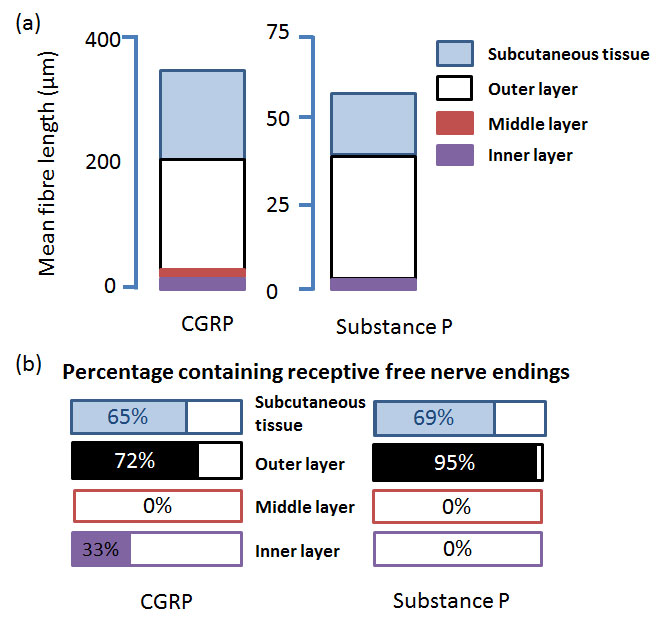
Studie som viser innervasjon av korsryggbindevev og påpeker at det er kun det ytre laget av bindevevet, det som er helt inn mot huden, som er tettpakket med sensoriske nerver og nociceptive fibre (som utskiller substans P og CGRP, og gir betennelser). De dypere lagene i midten av bindevevet eller ned mot musklene har nesten ingen nerveender eller sansesmuligheter.

http://www.ncbi.nlm.nih.gov/pubmed/21839150

Hele studien i min dropbox.

The subcutaneous tissue and the outer layer showed a particularly dense innervation with sensory fibers. SP-positive free nerve endings-which are assumed to be nociceptive-were exclusively found in these layers. Because of its dense sensory innervation, including presumably nociceptive fibers, the TLF may play an important role in low back pain.


Fig. 1. Structure of the rat thoracolumbar fascia (TLF) close to the spinous processes L4/L5. (a) Transversal section showing the three layers of the TLF (hematoxylin and eosin staining): OL, outer layer with transversely oriented collagen fibers; ML, middle layer composed of collagen fiber bundles oriented diagonally to the long axis of the body; IL, inner layer of loose connective tissue covering the multifidus muscle (muscle). SCT, subcutaneous tissue. (b) PGP 9.5-ir nerve fibers in the layers of the TLF. Black arrows, fibers on passage; open arrows, nerve endings. (c) Mean fiber length of PGP 9.5-ir fibers in the TLF. The great majority of all fibers were located in the outer layer (OL) of the fascia and in the subcutaneous tissue (SCT). White part of the bar: subcutaneous tissue plus outer layer of the TLF; black: middle layer; hatched: inner layer. n, number of sections evaluated.


Fig. 4. Distribution of CGRP and Substance P (SP)-immunoreactive nerve fibers in the TLF. (a) Mean fiber length of CGRP-ir nerve fibers. (b) Mean fiber length of SP-ir nerve fibers. Almost all fibers were found in the outer layer of the fascia and the subcutaneous tissue. The middle layer was free of SP-positive fibers. Gray part of the bars: subcutaneous tissue; white: outer layer of the TLF; black: middle layer; hatched: inner layer. n=number of sections evaluated. (c, d) Distribution of CGRP- (c) and SP-containing receptive free nerve endings (d) expressed as percent of the total number of CGRP- or SP-containing fibers in each layer. For classification as receptive endings, the structures had to exhibit at least three varicosities. SP-containing free nerve endings were restricted to the outer layer of the thoracolumbar fascia and the subcutaneous connective tissue while CGRP-containing free nerve endings were also found in the inner layer of the thoracolumbar fascia.

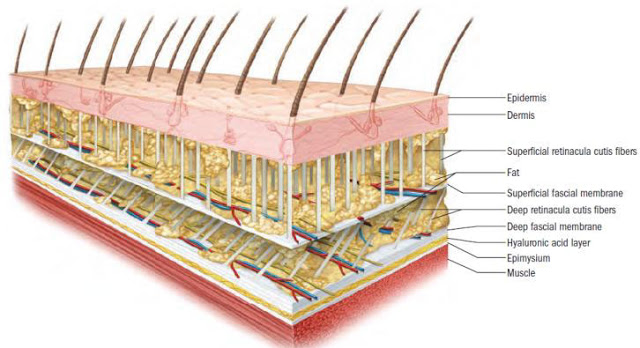
Og et bilde av de forskjellige bindevevslagene som er nevnt i denne studien.

Our study demonstrates that the rat TLF and the SCT overlying the fascia are densely innervated tissues, and therefore both the TLF and SCT, may play a role in low back pain. Most nerve fibers are located in the OL of the TLF and in the SCT, whereas in the ML nerve fibers are rare. Actually, no SP-ir fibers were found in this layer. Teleologically, the lack of fibers in the ML, particularly those containing SP, makes sense because each move- ment of the body causes shearing forces between the collagen fiber bundles, which might excite nociceptors.