Ukjent sin avatar

Upper Limb Neural Tension and Seated Slump Tests: The False Positive Rate among Healthy Young Adults without Cervical or Lumbar Symptoms

Nevner at nevrodynamiske tester også har «false positive» resultater, som man må være oppmerksom på. Ca.33% av alle uten problemer vil likevel få positive resultater på nervestrekk-tester. Så som alle andre diagnoser vi prøver å sette på menneskekroppen, er heller ikke nevrodynamikk spesielt spesifikk, pålitelig eller objektiv.

http://www.ncbi.nlm.nih.gov/pmc/articles/PMC2582423/

The purpose of this investigation was to determine the false positive rate of the seated slump test (SST) and the upper limb tension test (ULNTT) in a sample of healthy adults without spine or peripheral symptoms. The false positive rate was found to be high for both the SST (33.3%) and the ULNTT (86.9%), which raises question about the diagnostic validity of these tests as previously described using full-range knee and elbow testing. Based on the results of this investigation, it appears that there is a significant degree of inherent neural sensitivity among healthy adults without a history of spinal or peripheral symptoms when full-range testing is performed. To increase the diagnostic accuracy of these tests, we have proposed possible cut-off scores for these tests. Based on the 75th percentile, we suggest that a positive test only be identified when peripheral symptoms are reproduced before 22° of knee extension in the SST and 60° of elbow extension in the ULNTT.

Ukjent sin avatar

Understanding the Process of Fascial Unwinding

Studie som nevner hvordan «fascial unwinding» skjer ved hjelp av stimulering av mekanoreseptorer i huden. Parasympatikus aktiveres og gjør at muskelspenninger slipper taket.

http://ijtmb.org/index.php/ijtmb/article/view/43/75

Hypothetical Model: During fascial unwinding, the therapist stimulates mechanoreceptors in the fascia by applying gentle touch and stretching. Touch and stretching induce relaxation and activate the parasympathetic nervous system. They also activate the central nervous system, which is involved in the modulation of muscle tone as well as movement. As a result, the central nervous system is aroused and thereby responds by encouraging muscles to find an easier, or more relaxed, position and by introducing the ideomotor action. Although the ideomotor action is generated via normal voluntary motor control systems, it is altered and experienced as an involuntary response.

Conclusions: Fascial unwinding occurs when a physically induced suggestion by a therapist prompts ideomotor action that the client experiences as involuntary. This action is guided by the central nervous system, which produces continuous action until a state of ease is reached. Consequently, fascial unwinding can be thought of as a neurobiologic process employing the self-regulation dynamic system theory.

In this paper, I propose a model based on scientific literature to explain the process and mechanism of fascial unwinding (Fig. 1). The model is based on the theories of ideomotor action by Carpenter(18) and Dorko,(16) fascia neurobiologic theory by Schleip,(4,5) and the psychology of consciousness by Halligan and Oakley.(19)
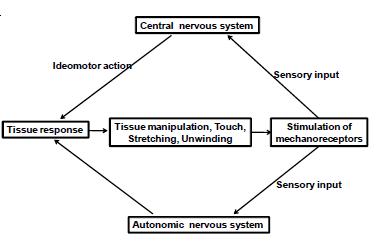
A set of conditions are required to initiate or facilitate the unwinding process. The therapist’s sensitivity and fine palpation skills form the most important part of these conditions, but it is also imperative that the client be able to relax and “let go” of his or her body.

In the first stage—the initiation or induction phase— the therapist working on a client will introduce touch or stretching onto the tissue. Touch is the entrance requirement for the process of unwinding. Touch stimulates the fascia’s mechanoreceptors and, in turn, arouses a parasympathetic nervous system response.(5) As a result of this latter response, the client is in a state of deep relaxation and calm, sometimes followed with rapid eye movement, twitching, or deep breathing—a state that can be observed clinically.(20,21) In this state, the conscious mind is relaxed and off guard. Stimulation of mechanoreceptors also influences the central nervous system. The central nervous system responds to this proprioceptive input by allowing the muscles to perform actions that decrease tone or that create movement in a joint or limb, making it move into an area of ease. At this point, ideomotor reflexes occur. Ideomotor action pertains to involuntary muscle movement, which can manifest in various ways and is directed at the central nervous system.(22)

These reflexes occur unconsciously, indicating dissociation between voluntary action and conscious experience.(23) In clinical situations, the client is unaware of the unconscious movement and thinks that it is generated by the therapist. This unconscious movement or stretching sensation stimulates a response in the tissue, providing a feedback to the central nervous system as outlined in the theory of ideomotor action.(24) The process is repeated until the client is relaxed or has reached a “still point” or state of ease.

The indirect stimulation of the autonomic nervous system (that is, the parasympathetic nervous system), which results in global muscle relaxation and a more peaceful state of mind, represents the heart of the changes that are so vital to many manual therapies. Gentler types of myofascial stretching and cranial techniques have also long been acknowledged to affect the parasympathetic nervous system.(25) Bertolucci(20) observed that, when a client is being treated with a muscle repositioning technique, the client begins to show involuntary motor reactions—reactions that include the involuntary action of related muscles and rapid eye movements. Several studies have evaluated the physiologic changes in the autonomic nervous system that occur as a result of craniosacral and MFR interventions,(21,26) clinically-known techniques that can trigger the unwinding process.

Recent studies have used heart rate variability, respiratory rate, skin conductance, and skin temperature as measures of physiologic change. Zullow and Reisman(26) indicated an increase in parasympathetic activity resulting from the compression of the fourth intracranial ventricle (CV4) maneuver and sacral holds, as measured by heart rate variability. Using heart rate variability measurement, Henley et al.(25) demonstrated that cervical MFR shifts sympathovagal balance from the sympathetic to the parasympathetic nervous system.

Dorko(16) was the first to suggest that fascial unwinding can be simply explained as an ideomotor movement. McCarthy et al.(29) were the first to document unwinding as an ideomotor-based manual therapy in the treatment of a patient with chronic neck pain. Their research showed that a reduction in pain intensity and perceived disability can be achieved with the introduction of ideomotor treatment.

A model built upon the neurobiologic, ideomotor action, and consciousness theories is proposed to explain the mechanism of unwinding. Touch, stretching, and manual therapy can induce relaxation in the parasympathetic nervous system. They also activate the central nervous system, which is involved in the modulation of muscle tone as well as movement. This activation stimulates the response to stretching: muscles find areas and positions of ease, the client experiences less pain or is more relaxed, thereby introducing the ideomotor action. The ideomotor action is generated through normal voluntary motor control systems, but is altered and experienced as an involuntary reaction. The stretching sensation provides a feedback to the nervous system, which in turn will generate the movements again.

Ukjent sin avatar

Nociception affects motor output: a review on sensory-motor interaction with focus on clinical implications.

Viktig studie som nevner forholdet mellom nocicepsjon og bevegelse. Hvis man har problemer ett sted i kroppen så blir det vanskelig å lære seg et nytt bevegelsesmønster. Dette påvirker også sympaticus nervesystemet (stressreaksjoner). Forskerene konkluderer med at det er nyttløst å endre bevegelsesmønster om man ikke først reparerer det som gir nociecpsjon.

http://www.ncbi.nlm.nih.gov/pubmed/21712714

Research has provided us with an increased understanding of nociception-motor interaction. Nociception-motor interaction is most often processed without conscious thoughts. Hence, in many cases neither patients nor clinicians are aware of the interaction. It is aimed at reviewing the scientific literature on nociception-motor interaction, with emphasis on clinical implications.

METHODS:

Narrative review.

RESULTS:

Chronic nociceptive stimuli result in cortical relay of the motor output in humans, and a reduced activity of the painful muscle. Nociception-induced motor inhibition might prevent effective motor retraining. In addition, the sympathetic nervous system responds to chronic nociception with enhanced sympathetic activation. Not only motor and sympathetic output pathways are affected by nociceptive input, afferent pathways (proprioception, somatosensory processing) are influenced by tonic muscle nociception as well.

DISCUSSION:

The clinical consequence of the shift in thinking is to stop trying to restore normal motor control in case of chronic nociception. Activation of central nociceptive inhibitory mechanisms, by decreasing nociceptive input, might address nociception-motor interactions.

Ukjent sin avatar

Influence of forward head posture on scapular upward rotators during isometric shoulder flexion

Denne nevner at Forward Head Posture gir en større spenning i trapzius når man løfter hendene. For å få trapzius og nakkespenninger til å slappe av må man altså få hodet tilbake i nøytral posisjon.

http://www.sciencedirect.com/science/article/pii/S1360859209000813

Significantly increased EMG activity in the upper trapezius and lower trapezius and significantly decreased EMG activity in the serratus anterior were found during loaded isometric shoulder flexion with FHP. Thus, FHP may contribute to work-related neck and shoulder pain during loaded shoulder flexion while sitting.

These results suggest that maintaining NHP is advantageous in reducing sustained upper and lower trapezius activity and enhancing serratus anterior activity as compared with FHP during loaded shoulder flexion.

Ukjent sin avatar

Alterations in Cortical and Cerebellar Motor Processing in Subclinical Neck Pain Patients Following Spinal Manipulation.

Interessant studie som nevner at personer med kronisk smerte (i nakken) får endret aktivitet i lillehjernen, som styrer våre bevegelsesmønstre. Med manipulering etterfulgt av 20 minutter motorisk trening blir lillehjernens aktivitet lik de som ikke har smerte. Studien nevner manipulering av ryggraden, men sannsynligvis vil også percussor eller en hvilken som helst annen behandling gi samme effekten.

http://www.ncbi.nlm.nih.gov/pubmed/24035521

Subclinical neck pain patients have altered CBI when compared with healthy controls, and spinal manipulation before a motor sequence learning task changes the CBI pattern to one similar to healthy controls.

Ukjent sin avatar

Om sukker, melkesyre og smerte

En svært god artikkel fra 2005 som tar for seg hyperglycemi (høyt blodsukker) sin påvirkning på smertetilstander. Det anbefales å redusere sukkerinntakt uansett hvilken smertetilstand man har.

http://tidsskriftet.no/article/1275100

Ved langvarige smertetilstander knyttet til iskemi eller inflammasjonstilstander spiller umyeliniserte nervefibrer (C-fibrer) en sentral rolle ikke bare ved at de direkte formidler smertesignaler, men også som årsak til nevrogen inflammasjon (1). Dette skyldes at aktiverte C-fibrer frigjør nevropeptider med proinflammatorisk eller vasodilaterende effekt, som for eksempel substans P, nevrokinin A og kalsitonin genrelatert peptid.

C-fibrer fungerer ikke bare som smertefibrer, men deltar også i regulering av lokal sirkulasjon og av hjertets og respirasjonsmuskulaturens aktivitet (2).

En av de best kjente aktiverende reseptorene er den såkalte vanilloidreseptoren, også kalt kapsaicinreseptoren. Kapsaicin er den aktive substansen i rødpepper (Capsicum). Vanilloidreseptoren reagerer både på lav pH og på skadelig høy temperatur (3). Den reagerer også på fysiologiske ligander med liknende effekt som kapsaicin (3).

Vanilloidreseptoren antas å spille en sentral rolle som medvirkende årsak til smerteopplevelse ved patofysiologiske tilstander som er ledsaget av vesentlig økning av den lokale konsentrasjon av melkesyre og som følge av dette senkning av ekstracellulær pH. Dette må åpenbart være viktig i forbindelse med smerte som har sammenheng med iskemi eller sterk hypoksi, for eksempel knyttet til unormal statisk belastning eller spasme i deler av skjelettmuskulaturen. Det må også antas å ha betydning i forbindelse med smerte hos kreftpasienter, i og med at det er vanlig at tumorvev produserer store mengder melkesyre. Videre er det også rimelig å anta at vanilloidreseptorene kan spille en viktig rolle ved smertetilstander knyttet til kroniske betennelsessykdommer som for eksempel revmatoid artritt.

Men vi bør likevel ikke glemme den betydning som også en lav ekstracellulær pH-verdi kan ha både som en viktig medvirkende årsak til smerte og som medvirkende årsak til nevrogen inflammasjon forårsaket av økt C-fiberaktivitet.

Forhøyet C-fiberaktivitet vil ikke bare gi økt smerteopplevelse, men kan også medvirke til forverring av selve sykdomstilstanden som følge av økt nevrogen inflammasjon. For eksempel kan substans P fra C-fibrene aktivere makrofager (4), slik at disse igjen produserer mer TNF-alfa (4), som igjen virker tilbake på C-fibrene og sensibiliserer disse (5). Derved oppstår en ond sirkel.

Når faste virker symptomdempende hos pasienter med revmatoid artritt (6), er det ikke urimelig at dette delvis kan bero på mindre stimulering av C-fibrene via vanilloidreseptoren, slik at denne onde sirkelen blir brutt.

Den praktiske konklusjon av dette er at de samme kostholdsråd som kan gis for å senke blodsukkernivået hos diabetikere også kan være bra for smertepasienter. Begrens inntaket av lettfordøyelige karbohydrater som sukkerholdige drikker, lyst brød, kaker og polert ris. Fysisk aktivitet kan også hjelpe til å senke blodsukkernivået.

Ukjent sin avatar

Myelinated nerve endings in human skin.

Viser at alle nerveender i huden stort sett er c-fibre fordi de mister myelinlaget rett før de går inn i huden.

http://www.ncbi.nlm.nih.gov/pubmed/17405136

we conclude that all cutaneous myelinated terminations are thinner terminal branches of large myelinated A beta fibers, whereas cutaneous terminations of small myelinated A delta fibers lose their myelin before entering the dermis and become indistinguishable from C-fiber terminations.

Ukjent sin avatar

The carbon dioxide rate of rise in awake apneic humans.

Viser at CO2 øker aller mest de første 7 sekundene når man holder pusten.

http://www.ncbi.nlm.nih.gov/pubmed/3152423

An estimate of the logarithmic PaCO2 rise during breath holding at functional residual capacity was 7 mmHg during the first 10 seconds (43 mmHg/minute), 2 mmHg during the next 10 seconds (13 mmHg/minute), and 6 mmHg/minute thereafter. In conclusion, PaCO2 increases more rapidly in awake apneic humans than earlier thought.

Ukjent sin avatar

Are psychological factors prognostic indicators of outcome in patients with sub-acute neck pain?

Basert på resultatene fra denne studien virker det som at det er bare én faktor som hemmer resultater for de som kommer til muskel- og leddbehandling: Hvor redd er du for at plagen blir værre med bevegelse?

http://www.manualtherapyjournal.com/article/S1356-689X(09)00140-4/abstract

The short and long term results for the three outcomes were very diverse. The sub-scales of the used questionnaires, i.e. the Pain Coping and Cognition List (PCCL), and the 4 Dimensional Symptom Questionnaire (4DSQ), did not contribute significantly to all of the multilevel models. Only the factor ‘fear of movement’ was consistently and significantly present in the univariable analysis for all outcomes at both follow-up measurements. The explained variance in the short term ranged from 16% to 30%, and from 6% to 34% in the long term. This can be considered to be low.

We conclude that all psychological factors showed a considerable variation on the specific measurement and time point used. Only ‘fear of movement’ consistently impedes short term and long term recovery.

A single question was as predictive of outcome as the Tampa Scale for Kinesiophobia

http://www.ncbi.nlm.nih.gov/pubmed/23177227

The correlation coefficient between the TSK and its substitute question was r=0.46 (p<0.001). The substitute question was better at predicting pain severity in the leg at 1 year follow-up than the TSK (addition of explained variation of 11% versus 4% in a logistic regression analysis). The TSK and its substitute question did not significantly differ in their prediction of global perceived effect at 1 year follow-up. The other substitute questions and both the RDQ and EQ-5D did not contribute significantly to one or both of their prediction models.