Ukjent sin avatar

Nye funn om D-vitamin og helse

God artikkel fra Dagensmedisin.no om ny forskning på D-vitamin, nevner bla hvordan det stopper autoimmune sykdommer og bl.a. slitasjegikt, bakterieflora, leddgikt, diabetes, ulcerøs colitt, chrons sykdom, eksem, systemisk lupus erytometous, influensa type A, autisme, MS, 15 forskjellige kreftformer, og MS.

http://www.dagensmedisin.no/debatt/nye-funn-om-d-vitamin-og-helse-/

«D-vitaminet har helsevirkninger langt ut over den klassiske rollen å regulere kalsium- og fosfor-metabolismen og dermed beskytte mot rakitt, osteoporose og myopati. Det skal ikke mye D-vitamin til for å sikre dette. 20-30 nanomolar 25OHD (kalsidiol – den sikrest målte indikatoren på D-vitaminstatus) i blodet er tilstrekkelig.
Langt større blodkonsentrasjoner trengs det for å oppnå optimale helsegevinster på andre områder.»

«Alle mutasjonene fører til mer eller mindre lys hud, som i solfattige strøk gir tre fortrinn framfor mørk hud: Den tillater 3-4 ganger mer effektiv syntese av D-vitaminer fra 7-dehydrokolesterol i overhuden fordi mindre UVB absorberes og, merkelig nok (våre funn), tilbakesprer mindre UVB. En afrikaner er «lysere» enn en europeer i UV-området. »

«Vårt D-vitaminnivå varierer derfor gjennom året, grovt regnet mellom 55 og 75 nanomolar, målt som kalsidiol. Ved ekvator er det konstant, men hvor høyt?
Nytt av året er at utearbeidende masaier og hadzaber i Tanzania har rundt 115 nanomolar i blodet, faktisk litt mindre enn badevakter i Florida har. Dette gir antakelig en pekepinn om optimale D-vitamin-nivåer.»

«Våre solarieundersøkelser viser at cirka ti minutter solariebestråling, tilsvarende cirka 15 minutter middagssol midtsommers to ganger i uken til hele kroppen, fører et vinternivå opp til et sommernivå av D-vitamin. Dette tilsvarer fire minutter sommersol per dag til hele kroppen, eller cirka 30 minutter daglig eksponering til ansikt, hender og underarmer. Dette er mye mer enn «noen få minutter», slik det sies i norske opplysningskampanjer om «sunn soling».»

» Et sommernivå av D-vitaminer kan for de fleste oppnås ved daglig tilførsel av cirka 2000 internasjonale enheter, tilsvarende tre minutter til hele kroppen eller 20 minutter daglig midtsommers til ansikt, hender og underarmer. »

«Overvektige personer trenger mer enn dobbelt så stort inntak som normalvektige. Gravide kvinner bør få nok D-vitamin fordi mange såkalte epigenetiske faktorer påvirkes i fosterlivet. »

«For å oppnå et slikt nivå, mener mange forskere at gravide kvinner bør innta rundt 4000 IE per dag.»

«Slitasjegikt (osteoartritt) rammer de fleste eldre mennesker i større eller mindre grad. Flere artikler antyder at utviklingen av denne lidelsen kan bremses og symptomene reduseres ved høyere D-vitamininntak.»

«VDR(reseptor for d-vitamin) tilhører den såkalte «kjernehormonreseptor-superfamilie», og ble etter hvert funnet på mononukleære celler, antigenpresenterende celler og aktiverte T- og B-lymfocytter. »

«En viktig effekt synes å være at D-vitaminet forårsaker en nedregulering av Th-1drevet autoimmunitet. Videre viser det seg at patogener til og med kan øke hastigheten på kalsitriolsyntesen i monocytter. Når kalsitriol binder seg til VDR, fungerer det som en transkripsjonsfaktor for ekspresjon av catelicin, og trigger i tillegg autofagi.»

» Det er vist at D-vitamin kan stabilisere homeostasen i innvollene og påvirke bakteriefloraen.»

«Revmatoid artritt (RA) – leddgikt – er en immunrelatert sykdom der både genetikk, kjønn og miljø er av betydning. Autoimmune reaksjoner i RA-pasienter ødelegger brusk- og beinstrukturer rundt ledd. Det er vel kjent at D-vitaminets metabolitt, hormonet kalsitriol, er immunmodulerende: VDR finnes på alle viktige immunceller (T- og blymfocytter, mononuleære celler, dendrittiske celler osv). En nedregulering av Th-1-regulert autoimmunitet forårsakes av D-vitamin. »

«En studie av militærpersonnel i USA (2012) viste at personer med under 60 nM hadde 3.5 ganger høyere risiko for å utvikle diabetes 1 (insulinavhengig) enn personer med verdier over 60 nM.»

«Sykdomsaktiviteten ved ulcerøs kolitt (blødende tykktarmsbetennelse) og Chrons sykdom, begge autoimmune lidelser, synes å være størst hos pasienter med lav D-vitaminstatus.»

«Atopisk dermatitt er en mye studert immunsykdom. Risikoen for AD er større for barn født om høsten og vinteren enn for barn født om våren og sommeren, og størst for barn født av kvinner med lav D-vitaminstatus under svangerskapet .»

«Pasienter med systemisk lupus erytematosus; en autoimmun bindevevssykdom som kan ramme mange organer, har generelt en dårlig D-vitaminstatus, hvilket enten forverrer tilstanden eller er forårsaket av sykdommen.»

«Kalsitriol regulerer Toll-like reseptorer som gjenkjenner strukturer på mikroorganismer. Ny litteratur viser at det bare er influensa type A som påvirkes av D-vitamin, noe som kan forklare at enkelte kliniske intervensjonsstudier er negative.»

«Ved siden av den rent kjemisk betingede membranbindingen er det tett med D-vitaminreseptorer i sentralnervesystemet, noe som vitner om vitaminets viktige rolle. Det ble i 2012 vist at et antimyelin-assosiert glykoprotein hadde forskjellig nivå i autistiske barn og normale barn, og at dette nivået kunne påvirkes av D-vitamin.»

» Laboratoriestudier, ekologiske- og andre typer epidemiologiske studier har avdekket mer enn 15 kreftformer som solstråling og/eller D-vitamin innvirker på. »

«I forhold til den laveste kvartil (under 40-50 nM 25OHD) var risikoen for kreftdød i løpet av oppfølgingstiden (6-9 år) redusert med cirka 64 prosent i forhold til den høyeste kvartil (over ca 75 nM). Pasienter med lymfomer, bryst-, kolon- og lunge-kreft var inkludert. »

«Et annet studium av pasienter med prostatakreft viste at supplementering med 4000 internasjonale enheter; 100 mikrogram av D-vitamin per dag, viste ingen toksisitet, men en betydelig større andel av disse pasientene enn i en historisk kontrollgruppe hadde reduksjon av tumorvolumet på ett år. »

«Enn videre viser en engelsk undersøkelse at overlevelsen for dem som har fått melanomer, bedres med økende D-vitaminstatus»

I kommentarfleste nevnes dette om behandling av MS:
«D3-vitamin i meget høye doser gjør at MS og andre autoimmune sykdommer går tilbake. Mennesker over hele verden som følger behandlingsprotokollen utviklet av professor Cicero Galli Coimbra lever normale liv uten symptomer. Dosene er fra 20.000-200.000 IU hver dag og blir individuelt bestemt etter prøver som tas. Ingen blir toksiske. Man holder seg unna melk og melkeprodukter og inntar minst 2,5 liter vann pr. dag, bl.a. Se dokumentaren som er laget http://youtu.be/erAgu1XcY-U. Den er tekstet på engelsk og spansk. Det er på tide at dere oppdaterer kunnskapen om D3-vitamin og dets virkning på MS og andre autoimmune sykdommer. En av de fremste D-vitaminforskerne i verden Dr. Heaney) mener at alt under 120 nmol/L er for lavt, og at man bør ha opp til 225 nmol/L D-vitamin i serum for å forebygge. En annen (Dr. Cannell) anbefaler minst 5.000 internasjonale enheter pr. dag året rundt. Det er nedslående å lese at man fortsatt omtaler for lave nivåer her i Norge. Ikke rart at mange får bl.a. autoimmune sykdommer og brystkreft her i landet.»

Ukjent sin avatar

Elevated lactate during psychogenic hyperventilation

Om CO2 relatert til melkesyre. Denne er ifh panikkangst, men gjelder også ifh trening og hva som helst av aktivitet eller sykdom hvor melkesyre er et element å ta hensyn til.

http://emj.bmj.com/content/28/4/269.long

«Whereas high lactates are usually associated with acidosis and an increased risk of poor outcome, in patients with psychogenic hyperventilation, high lactates are associated with hypocapnia and alkalosis.»

«However, provoked hyperventilation, a less life-threatening condition, has been shown to result in elevated lactate levels as well. Passive overbreathing under anaesthesia has been shown to induce hyperlactataemia in various studies.9 10 Furthermore, active voluntary overbreathing in individuals with panic disorders has been related to the development of a marked hyperlactataemia as well.11 12»

«As expected, median Pco2 (4.3 (2.0–5.5)) was below the lower reference value of 4.6 kPa, and median pH was slightly increased (7.47 (7.40–7.68)). Po2 and saturation were normal in all the patients without supplementary oxygen (table 1). Fourteen participants had a lactate level above the reference value of 1.5 mmol/l, of which 11 were still hyperventilating at the moment of drawing their blood, as reflected by the Pco2 values <4.6 kPa. The participants who were still actively hyperventilating had a higher median pH of 7.50 (7.42–7.68) versus 7.44 (7.40–7.49) (p<0.01) and a higher median lactate level of 1.4 (0.7–4.4) versus 0.9 (0.5–3.5) (p<0.01) compared with the participants diagnosed as having psychogenic hyperventilation who had ceased to actively hyperventilate at the moment of drawing their blood. In line with the higher pH in this group, bicarbonate and potassium concentrations were lower (table 1).»

«In univariate correlation analysis, there was a significant positive correlation of plasma lactate with both Po2 and pH, whereas significant inverse relations were found for potassium and bicarbonate (table 2). Most interestingly, a significant negative correlation was found between Pco2 and arterial lactate (r=−0.50, p<0.001; figure 2). This negative correlation was specifically present in patients with hypocapnia (ie, Pco2 <4.6 kPa): in these patients, there was a moderate significant negative correlation between Pco2 and plasma lactate levels (r=−0.53, p<0.003), whereas this correlation was not seen in normocapnic participants (r=−0.17, NS).»

«Scatter plot of the relation of Pco2 with lactate for patients diagnosed as having psychogenic hyperventilation (n=46). Depicted are the regression line in bold (r2=0.25, p<0.001), with estimated 95% CIs. The vertical dashed line denotes the lower reference value of arterial Pco2; and the horizontal line, the upper reference value of lactate.»

«In our study, we showed that lactate levels are elevated in 30% of the participants with psychogenic hyperventilation who present at the ED. Furthermore, we demonstrate that under these circumstances, Pco2 is the most important predictor of arterial lactate levels and that in this context, an elevated lactate level should not be regarded as an adverse sign.»

«The reported 0.5% incidence of hyperventilation in our study population seems to be low compared with that in previous studies, reporting incidences of 6%–11%.14» «We suppose that the relatively low incidence in our study population could be related to a substantial amount of patients with psychogenic hyperventilation who are not referred to the hospital at all by their general practitioner.»

«Our present study is the first to describe the presence of hyperventilation-related hyperlactataemia in an otherwise healthy patient population presenting in the ED in an observational setting.»

«Pco2 being the strongest lactate predictor of the two, as changes in pH during hyperventilation are modulated by changes in breathing rate (and thus Pco2). Our findings are in line with those of previous studies, which showed that intracellular hypocapnia and alkalosis contribute directly to both an increased lactate production and a reduced lactate clearance.18–21»

«However, it should be noted that in patients with critical illnesses, lactate is a risk marker not a risk mediator22: several studies have shown that the administration of exogenous lactate is safe or even beneficial.23 Lactate can be reused directly as a substrate to generate adenosine triphosphate by many organs, including the heart, the brain and the kidneys.24 25»

TABLE 1

Total Pco2≥4.6 Pco2<4.6
n 46 17 29
Sex (% male) 46 41 48
Age (years) 30 (18–77) 26 (18–66) 35 (18–77)
Respiratory rate at triage 25 (20–35) 24 (20–30) 25 (20–35)
Pco2 (kPa) 4.3 (2.0–5.5) 4.9 (4.7–5.5) 3.9 (92.0–4.5)
Lactate level (mmol/l) 1.2 (0.5–4.4) 0.9 (0.5–3.5) 1.4 (0.7–4.4)*
Lactate level >1.5 mmol/l (n) 14 3 11
Base excess 1.4 (−3.2–4.8) 2.1 (−2.7–4.3) 0.6 (−3.2–4.8)*
Potassium (mmol/l) 3.5 (2.8–4.2) 3.8 (3.3–4.0) 3.4 (2.8–4.2)*
HCO3 (mmol/l) 23 (17–27) 26 (21–27) 22 (17–25)
pH 7.47 (7.40–7.68) 7.44 (7.40–7.49) 7.50 (7.42–7.68)
Po2 (kPa) 13.3 (9.3–17.9) 12.9 (10.3–15.6) 13.8 (9.3–17.9)*
Saturation (%) 98 (97–99) 98 (97–99) 98 (97–99)
  • Clinical and biochemical characteristics of the 46 patients as indicated in figure 1 and after stratification for the presence of hypocapnia (Pco2 <4.6). The data are presented as median (range). Statistical comparisons between the normocapnic and hypocapnic subgroups were made by the χ2 test for dichotomous variables and for continuous variables by Mann–Whitney U test.

  • * p<0.05 compared with normocapnic participants.

  • † p<0.001 compared with normocapnic participants.

Ukjent sin avatar

Basilar Artery Response to Hyperventilation in Panic Disorder

Nevner hvordan hyperventilering fjerner CO2 og gjør at blodkar trekker seg sammen. Nevner spesielt basilary artery inni hjernen.

http://ajp.psychiatryonline.org/data/journals/ajp/3682/1603.pdf

«Gibbs (2) reported that nine panic disorder patients in a neurology clinic experienced a significantly greater decrease in basilar artery blood flow during voluntary hyperventilation (mean decrease, 62%) than did nine normal comparison subjects (mean decrease, 36%). However, no respiratory measures were assessed dur- ing hyperventilation, and this omission is important, since changes in carbon dioxide levels are critical in regulating cerebral arterial flow (3).»

«For mean blood flow, the panic patients had a 55% reduction (mean change=–21.1 cm/sec, SD=7.1), which was sig- nificantly greater than the 42% reduction for the com- parison group (mean change=–15.8 cm/sec, SD=5.4)»

«The increases in the dizziness ratings were associated with the percent- ages of the decreases in both peak flow (r=–0.60, N=24, p<0.01) and mean flow (r=–0.57, N=24, p<0.01).»

«The pCO2 level of the panic disorder patients decreased 33% during hyperventilation (pCO2 level dur- ing hyperventilation: mean=24.80 mm Hg, SD=7.29), which did not differ significantly from the 37% decrease for the comparison subjects (pCO2 during hyperventila- tion: mean=24.55 mm Hg, SD=3.09) (t=–0.14, df=7, n.s.).»

«The ratio of blood flow changes to pCO2 changes is approximately 1.0 in normative studies (4), which is consistent with the values for our comparison group. The patients with panic disorder had a ratio of blood flow change to pCO2 change that was almost twice that of the normal subjects. This suggests that the sensitivity of the basilar artery in patients with anxiety disorders may not be due solely to changes in respiratory physiology.»

Ukjent sin avatar

Subacromial impingement syndrome and rotator cuff tendinopathy: The dilemma of diagnosis

Studie presentert på Fysioterapeuten som viser at diagonstisk spesifisitet ikke er tilfredsstillende i vurdering av strukturelle funn. Dette er, etter min mening, helt åpenbart og selvfølgelig straks man innser at menneskekroppen er en organisme og ikke en (bio)mekanisme. I «organismer» er det flere levende systemer som påvirker hverandre på mange nivåer, så å finne ETT enkelt årsaksutgangspunkt er nytteløst. Ikke minst når det gjelder smertesymptomer.

http://fysioterapeuten.no/Fag-og-vitenskap/Fagartikler/Subacromial-impingement-syndrome-and-rotator-cuff-tendinopathy-The-dilemma-of-diagnosis

«Sometimes the specificity of a test may only be 50% (16, 17) which would not allow the clinician to develop an informed opinion as to where the symptoms were coming from. Calis et al (18) reported a sensitivity of 88.7% and a specificity of  30.5% for the Neer impingement sign. Litaker et al (19) reported values of 97.4% and 9.0% for the same test. Calis et al (18) reported sensitivity and specificity values of 92.1% and 25% for the Hawkin’s test. These figures clearly question the ability to arrive at a definitive diagnosis. Hegedus et al (20) have recently published a comprehensive review investigating clinical shoulder tests. They concluded that the use of any single shoulder orthopaedic tests to make a conclusive diagnosis is questionable. »

«Currently it appears that the process of making a diagnosis using a combination of clinical tests supported by imaging findings will not allow a clinician to arrive at a structural diagnosis with certainty (26). This has been recognized by clinicians treating other areas of the body (33, 34).»

Ukjent sin avatar

Neurological examination of the peripheral nervous system to diagnose lumbar spinal disc herniation with suspected radiculopathy: a systematic review and meta-analysis.

Studie som viser dårlig spesifisitet i diagnose av korsrygg plager og utstråling.

http://www.ncbi.nlm.nih.gov/pubmed/23499340

«Pooled data for sensory testing demonstrated low diagnostic sensitivity for surgically (0.40) and radiologically (0.32) confirmed disc herniation, and identification of a specific level of disc herniation (0.35), with moderate specificity achieved for all the three reference standards (0.59, 0.72, and 0.64, respectively). Motor testing for paresis demonstrated similarly low pooled diagnostic sensitivities (0.22 and 0.40) and moderate specificity values (0.79 and 0.62) for surgically and radiologically determined disc herniation, whereas motor testing for muscle atrophy resulted in a pooled sensitivity of 0.31 and the specificity was 0.76 for surgically determined disc herniation.»

Ukjent sin avatar

Diagnostic accuracy of the clinical examination in identifying the level of herniation in patients with sciatica.

Nevner at diagnostisk spesifisitet ikke er tilfredsstillende. Med tanke på at konvensjonell medisin legger så mye av sin yrkesstolthet i spesifikke diagnoser viser denne studien at vi kanskje må revurdere vårt mekaniske kroppsbilde og heller gå over til et organisk kroppsbilde hvor vi tar hensyn til at mange forkjellige systemer påvirker hverandre.

http://www.ncbi.nlm.nih.gov/pubmed/21224761

«The dermatomal pain location was generally the most informative individual neurologicaltest. »

«The current study did not find evidence to support the accuracy of individual tests from the neurologicalexamination in identifying the level of disc herniation demonstrated on MRI.»

Ukjent sin avatar

Factors contributing to the variability in muscle ageing

Nevner at aldring og muskelatrofi skjer mye på grunn av «low grade inflammation».

http://www.ncbi.nlm.nih.gov/m/pubmed/22902240

«Where an individual cannot change much in his or her genetic constitution, circulating hormones and systemic inflammation, (s)he can still significantly slow the rate of muscle ageing by an adequate dietary intake and regular physical activity. Finally, it is suggested that age-related alterations in the capillary bed may negatively affect muscle mass.»

Ukjent sin avatar

Gluten-free diet reduces adiposity, inflammation and insulin resistance associated with the induction of PPAR-alpha and PPAR-gamma expression.

Nevner at gluten-fri er viktig å teste ut i behandling av overvekt og metabolske sykdommer, siden det reduserer betennelser.

http://www.ncbi.nlm.nih.gov/m/pubmed/23253599

«There was an improvement in glucose homeostasis and pro-inflammatory profile-related overexpression of PPAR-γ.»

«Our data support the beneficial effects of gluten-free diets in reducing adiposity gain, inflammation and insulin resistance. The data suggests that diet gluten exclusion should be tested as a new dietary approach to prevent the development of obesity and metabolic disorders.»

Ukjent sin avatar

Physical activity, by enhancing parasympathetic tone and activating the cholinergic anti-inflammatory pathway, is a therapeutic strategy to restrain chronic inflammation and prevent many chronic diseases.

Viser hvordan trening demper betennelser ved å aktivere parasympaticus.

http://www.ncbi.nlm.nih.gov/m/pubmed/23395411

«We hypothesize that the «cholinergic anti-inflammatory pathway» (CAP) mediates the anti-inflammatory phenotype and range of health benefits associated with physical activity. The CAP is an endogenous, physiological mechanism by which acetylcholine from the vagus nerve, interacts with the innate immune system to modulate and restrain the inflammatory cascade.»

«Importantly, higher levels of physical activity are associated with enhanced parasympathetic (vagal) tone and lower levels of C-reactive protein, a marker of low-grade inflammation. «

Ukjent sin avatar

Lifestyle and nutritional imbalances associated with Western diseases: causes and consequences of chronic systemic low-grade inflammation in an evolutionary context

Nevner hvordan betennelsesmarkører og insulinsensitivitet henger sammen. Svært mange viktige poenger og en god oversiktig i denne studien. Info om betennelser, insulin, tyroksin, fett, oksidativt stress, D-vitamin, m.m.

http://www.jnutbio.com/article/S0955-2863(13)00054-5/abstract

http://www.jnutbio.com/article/S0955-2863(13)00054-5/fulltext 

Fra evolusjonens side er insulinresistens en overlevelsesmekanisme. Hjernen og nervesystemet bruker 20% av energien glukose metabolismen gir oss og for overlevelse er hjernen førsteprioritet. Når det er betennelser i kroppen vil immunforsvaret naturlig bruke opp mye av glukosen i blodet slik at det går på bekostning av hjernens energitilgang. Da må hjernen sette igang en «insulinresistens» for å sørge for at insuline ikke fjerner glukosen i blodet. Insulinresistens er en livsviktig mekanisme som skal fungere i kort tid av gangen (noen dager). Om det blir en kronisk systemisk betennelse blir det store problemer i kroppen som etter mange år gir utslag i livsstilsykdommer.

«Our sensitivity to develop insulin resistance traces back to our rapid brain growth in the past 2.5 million years. An inflammatory reaction jeopardizes the high glucose needs of our brain, causing various adaptations, including insulin resistance, functional reallocation of energy-rich nutrients and changing serum lipoprotein composition. «

Betenneler er en naturlig helbredelsesreaksjon ved skade eller infeksjoner. Men i vår vestlige kultur har vi introdusert en rekke «falske» betennelsestriggere. Altså elementer som gir kroppen betennelser uten at det foreligger en skade. Når betennelser blir kroniske er det ett eller annen «kronisk» vi gjør i vår livsstil som opprettholder betennelsene. Maten vi spiser er den viktigste bidragsyteren spesielt siden vårt moderne kosthold inneholder så mange betennelsestriggere. Bl.a. sukker og mel og overvekt av raffinerte næringsfattige karbohydrater. Skal man bli frisk fra kroniske plager og betennelser i muskel- og skjelettapparatet må man fjerne de falske betennelsestriggerene fra hverdagen.

«With the advent of the agricultural and industrial revolutions, we have introduced numerous false inflammatory triggers in our lifestyle, driving us to a state of chronic systemic low grade inflammation that eventually leads to typically Western diseases via an evolutionary conserved interaction between our immune system and metabolism. The underlying triggers are an abnormal dietary composition and microbial flora, insufficient physical activity and sleep, chronic stress and environmental pollution. «

Betenneler blir viktigere og viktigere i helsesammenheng. Hjerte/kar problemer, flere kreftformer, degenererende sykdommer, m.m. har alle samme utgangspunkt: systemisk betennelse og medfølgende insulinresistens.

«In recent years, it has become clear that chronic systemic low grade inflammation is at the basis of many, if not all, typically Western diseases centered on the metabolic syndrome. The latter is the combination of an excessive body weight, impaired glucose homeostasis, hypertension and atherogenic dyslipidemia (the “deadly quartet”), that constitutes a risk for diabetes mellitus type 2, cardiovascular disease (CVD), certain cancers (breast, colorectal, pancreas), neurodegenerative diseases (e.g., Alzheimer’s disease), pregnancy complications (gestational diabetes, preeclampsia), fertility problems (polycystic ovarian syndrome) and other diseases [1]. Systemic inflammation causes insulin resistance and a compensatory hyperinsulinemia that strives to keep glucose homeostasis in balance. Our glucose homeostasis ranks high in the hierarchy of energy equilibrium, but becomes ultimately compromised under continuous inflammatory conditions via glucotoxicity, lipotoxicity, or both, leading to the development of beta-cell dysfunction and eventually Type 2 diabetes mellitus [2]

Det er en evolusjonært tilpasset sammenheng mellom kroppsvekt og metabolisme hos dyr. Jo større dyret er jo mer energi krever metabolismen. Hjernen og nervesystemet er et av de mest energikrevende organene så når mennesket etterhvert utviklet en enorm hjerne relativt til kroppsvekt måtte dette gå på bekostning av andre energikrevende organer. Hos oss har tarmene blitt mindre.

«Our brain consumes 20–25%2 of our basal metabolism [11][12][13][14][15][16][17] and [20] and is thereby together with the liver (19%2), our gastrointestinal tract (15%2), and skeletal musculature (15%2) among the quantitatively most important organs in energy consumption [19]

«There is a linear relationship between body weight and basal metabolism among terrestrial mammals (Fig. 2). This apparently dogmatic relationship predicts that, due to the growth of our brain, other organs with high energy consumption had to be reduced in size, what in evolution is known as a “trade-off”.3 As a consequence of this “expensive tissue hypothesis” of Aiello and Wheeler [19], our intestines, amongst others, had to become reduced in size. «

Når vi får mange på glukose i blod blir det konkurranse mellom organene om å få nok. Dette skjer bl.a. under faste, i graviditet og under infeksjoner og betennelser. Hjernen vil alltid være førsteprioritet. Derfor har evolusjonen utviklet insulinresistens for å sørge for at glukose alltid er tilgjengelig for hjernen, uansett hvor mye andre organer eller immunforsvar prøver å ta det.

«A glucose deficit leads to competition between organs for the available glucose. As previously mentioned, this occurs during fasting, but also during pregnancy and infection/inflammation. «
«During competition between organs for glucose, we fulfill the high glucose needs of the brain by a reallocation of the energy-rich nutrients, and to that end, we need to become insulin resistant.»

Insulinresistens påvirker også blodgjennomstrømning ved at det hemmer vasodilatsjon (utvidelse av blodkar). Når blodårene blir trangere må hjertet pumpe hardere og vi får høyt blodtrykk. I tillegg vil manglende fleksibilitet i blodårene gjøre at nyrene blir veldig sensitive for salt. Nyrene kan hjelpe i kontrollen av blodtrykk ved å senke eller øke saltmengden, men dette er en sekundær funksjon. Det er blodkarenes utvidelse og sammentrekning som er er førsteprioritet i blodtrykkskontroll. Når denne funksjonen blir dårlig må nyrene jobbe på høygir og blir etter hvert overarbeidet og skadet.

» For example, the concomitant hypertension has been explained by a disbalance between the effects of insulin on renal sodium reabsorption and NO-mediated vasodilatation, in which the latter effect, but not the first, becomes compromised by insulin resistance, causing salt sensitivity and hypertension [54]

Her er en gjennomgang av alle aspektene og mekanismene i kroppen som påvirkes av lav-grads betennelser og medfølgende insulinresistens.

«However, it becomes increasingly clear that we could better refer to it as the “chronic systemic low-grade inflammation induced energy reallocation syndrome”. The reason for this broader name derives from the recognition that insulin resistance is only part of the many simultaneously occurring adaptations. To their currently known extent, these adaptations and consequences are composed of:
(i) reduced insulin sensitivity (glucose and lipid redistribution, hypertension),
(ii) increased sympathetic nervous system activity (stimulation of lipolysis, gluconeogenesis and glycogenolysis),
(iii) increased activity of the HPA-axis [hypothalamus-pituitary-adrenal gland (stress) axis, mild cortisol increase, gluconeogenesis, with cortisol resistance in the immune system],
(iv) decreased activity of the HPG-axis (hypothalamus-pituitary-gonadal gland axis; decreased androgens for gluconeogenesis from muscle proteins, sarcopenia, androgen/estrogen disbalance, inhibition of sexual activity and reproduction),
(v) IGF-1 resistance (insulin-like growth factor-1; no investment in growth) and vi) the occurrence of “sickness behavior” (energy-saving, sleep, anorexia, minimal activity of muscles, brain, and gut) [3]

Mennesket er det dyret med størst hjerne. Og siden hjernen er stappet full av nervetråder som krever svært mye energi for å fungere blir menneskekroppen svært sensitiv for glukose. Hvis vi får lite glukosetilgang har kroppen en etablert en robuste tilpasningsmekanismer for å overleve, men dette gjelder kun i kortere perioder.

«Summarizing thus far, we humans are extremely sensitive to glucose deficits, because our large brain functions mainly on glucose. During starvation, pregnancy and infection/inflammation, we become insulin resistant, along with many other adaptations. «

De forskjellige tilpasningsmekanismene vi har for å overleve ved betennelsestilstander (inkl insulinresisten) viser oss hvor tett immunsystemet og metabolismen er koblet i kroppen vår.  Det er ikke to forskjellige systemer, men vevet inn i hverandre.

«The metabolic adaptations caused by inflammation illustrate the intimate relationship between our immune system and metabolism. This relation is designed for the short term. In a chronic state it eventually causes the metabolic syndrome and its sequelae. We are ourselves the cause of the chronicity. Our current Western lifestyle contains many false inflammatory triggers and is also characterized by a lack of inflammation suppressing factors. These will be described in more detail below.»

Denne studien nevnte tidligere at betennelser skaper insulinresisten som følge av en naturlig overlevelsesmekanisme ved skader og akutte sykdommer. Men i vår moderne hverdag har vi en lang rekke «falske betennelsesfaktorer» som gir oss betennelser uten at det foreligger skade. Her er en oversikt over de viktigste «falske betennelsefaktorer» vi må se opp for om vi ønsker å bli kvitt smerter og livsstilssykdommer:

«Among the pro-inflammatory factors in our current diet, we find:
– the consumption of saturated fatty acids [82] and industrially produced trans fatty acids [83] and [84], a high ω6/ω3 fatty acid ratio [85], [86] and [87],
– a low intake of long-chain polyunsaturated fatty acids (LCP) of the ω3 series (LCPω3) from fish [88] and [89],
– a low status of vitamin D [90], [91] and [92], vitamin K [93] and magnesium[94], [95] and [96],
– the “endotoxemia” of a high-fat low-fiber diet [97] and [98],
– the consumption of carbohydrates with a high glycemic index and a diet with a high glycemic load [99] and [100],
– a disbalance between the many micronutrients that make up our antioxidant/pro-oxidant network [101], [102] and [103], and
– a low intake of fruit and vegetables [103] and [104].
The “dietary inflammation index” of the University of North Carolina is composed of 42 anti- and proinflammatory food products and nutrients. In this index, a magnesium deficit scores high in the list of pro-inflammatory stimuli [105]. Magnesium has many functions, some of them, not surprisingly, related to our energy metabolism and immune system, e.g., it is the cation most intimately connected to ATP [95].
Indirect diet-related factors are
– an abnormal composition of the bacterial flora in the mouth [106], gut [106] and [107], and gingivae [108], [109] and [110].
– Chronic stress[111] and [112],
– (passive) smoking and
– environmental pollution [77],
– insufficient physical activity [113],[114], [115], [116], [117] and [118] and
– insufficient sleep [119], [120], [121], [122] and [123] are also involved.»

«Diets high in refined starches, sugar, saturated and trans fats, and low in LCPω3, natural antioxidants, and fiber from fruits and vegetables, have been shown to promote inflammation [82], [83], [84], [129],[130] and [131] (Table 1).»

«Molecular oxygen is essential to aerobic life and, at the same time, an oxidizing agent, meaning that it can gain electrons from various sources that thereby become “oxidized,” while oxygen itself becomes “reduced”[252] and [253]. In general terms, an antioxidant is “anything that can prevent or inhibit oxidation” and these are therefore needed in all biological systems exposed to oxygen [252]
«The emergence of oxygenic photosynthesis and subsequent changes in atmospheric environment [254] forced organisms to develop protective mechanisms against oxygen’s toxic effects [255]. »

» Damage by oxidation of lipids[262], [265] and [266], nucleic acids and proteins changes the structure and function of key cellular constituents resulting in the activation of the NFκB pathway, promoting inflammation, mutation, cell damage and even death [252], [260] and [267] and is thereby believed to underlie the deleterious changes in aging and age-related diseases [102] and [244]

»
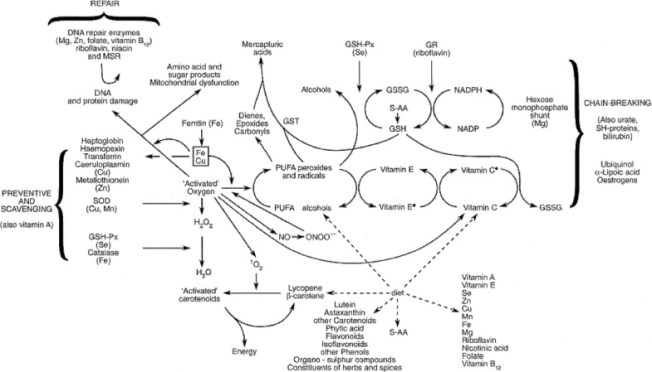
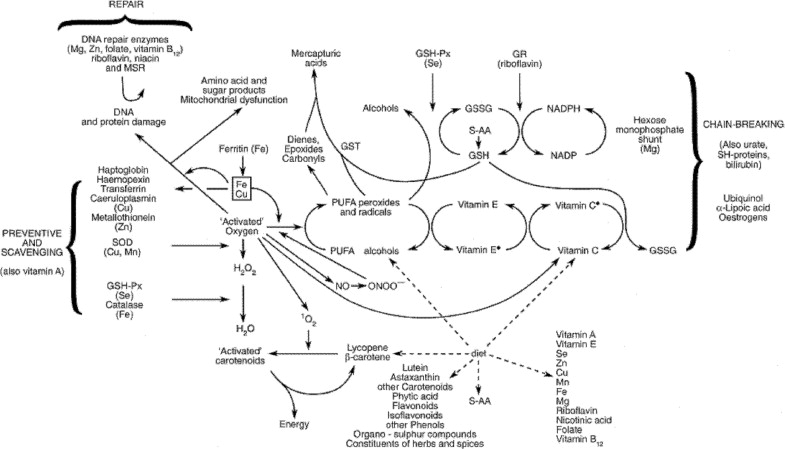
Fig. 8. Antioxidant defense mechanisms. An overview of the antioxidant system present in the human body. Various types of antioxidant systems have developed through time, reflecting different selection pressures. Different forms have developed for the same purpose, for example, SODs, peroxidases and GPx are important members of the antioxidant enzyme capacity group. Tocopherols and ascorbic acid, as representatives of the antioxidant network, are manufactured only in plants, but are needed by animals. Ascorbic acid is an essential antioxidant, but cannot be synthesized by Homo sapiens. In humans, therefore, antioxidant defense against toxic oxygen intermediates comprises an intricate network which is heavily influenced by nutrition. GR, glutathione reductase; GSG, reduced glutathione; GSH-Px, glutathione peroxidase; GSSG, oxidized glutathione; GST, glutathione-S-transferase; MSR, methionine sulphoxide reductase; PUFA, polyunsaturated fatty acids; S-AA, sulphur amino-acids; SH-proteins, sulphydryl proteins; SOD, superoxide dismutase; Fe Cu, transition metal-catalysed oxidant damage to biomolecules.»

«A certain level of ROS may also be essential to trigger antioxidant responses [276]

«Chronic inflammation results in the chronic generation of free radicals, which may cause collateral damage and stimulate signaling and transcription factors associated with chronic diseases [294] and [295]

«Our diet is composed of millions of substances that are part of a biological network. In fact, we eat “biological systems” like a banana, a fish or a piece of meat. There is a connection between the various nutrients in these systems. In other words, there is a balance and an interaction that is part of a living organism. »

«As clearly explained by Rose[328]: «If everyone smoked 20 cigarettes a day, then clinical, case–control and cohort studies alike would lead us to conclude that lung cancer was a genetic disease; and in one sense that would be true, since if everyone is exposed to the necessary agent, then the distribution of cases is wholly determined by individual susceptibility”. In other words: “disease susceptibility genes” is a misnomer from an evolutionary point of view.»

«Hemminki et al.[326] stated that “if the Western population was to live in the same conditions as the populations of developing countries, the risk of cancer would decrease by 90%, provided that viral infections and mycotoxin exposures could be avoided”.»

«It has become clear that most, if not all, typically Western chronic illnesses find their primary cause in an unhealthy lifestyle and that systemic low grade inflammation is a common denominator.»