Ukjent sin avatar

Neuromuscular strain as a contributor to cognitive and other symptoms in chronic fatigue syndrome: hypothesis and conceptual model

Viktig studie om nervesystemet og bindevevets «adhesions» som bidragsyter til smerte.

http://www.frontiersin.org/Integrative_Physiology/10.3389/fphys.2013.00115/full

«Work by Brieg, Sunderland, and others has emphasized the ability of the nervous system to undergo accommodative changes in length in response to the range of limb and trunk movements carried out during daily activity. If that ability to elongate is impaired—due to movement restrictions in tissues adjacent to nerves, or due to swelling or adhesions within the nerve itself—the result is an increase in mechanical tension within the nerve. »

«This adverse neural tension, also termed neurodynamic dysfunction, is thought to contribute to pain and other symptoms through a variety of mechanisms. These include mechanical sensitization and altered nociceptive signaling, altered proprioception, adverse patterns of muscle recruitment and force of muscle contraction, reduced intra-neural blood flow, and release of inflammatory neuropeptides. »

«In our clinical work, we have found that neuromuscular restrictions are common in CFS, and that many symptoms of CFS can be reproduced by selectively adding neuromuscular strain during the examination.»

«As defined by Yunus, central sensitivity is “clinically and physiologically characterized by hyperalgesia (excessive sensitivity to a normally painful stimulus, e.g., pressure), allodynia (painful sensation to a normally non-painful stimulus, e.g., touch and massage), expansion of the receptive field (pain beyond the area of peripheral nerve supply), prolonged electrophysiological discharge, and an after-stimulus unpleasant quality of pain (e.g., burning, throbbing, numbness)” (Yunus, 2008).»

«These symptoms might be mediated by amplified central sensitivity, but peripheral factors, which have been described in FM and irritable bowel syndrome (IBS), may also play a role (e.g., Price et al., 2009; Staud et al., 2009). »

«Staud has shown that local anesthetic injection into trapezius muscle tender points results in lower levels of thermal hyperalgesia in the forearm, consistent with peripheral nociceptive input as a contributor to central sensitization (Staud et al., 2009).»

«The interaction of nerve mechanics and function has been termed neurodynamics. As an example of the principles of neurodynamics, the median nerve elongates approximately 20% as the upper extremity moves from a position of full wrist and elbow flexion to one of full wrist and elbow extension (Butler, 1991). »

» If that ability to elongate is impaired—due to movement restrictions in tissues adjacent to the median nerve and its branches, or due to swelling or adhesions within the median nerve itself—the result is an increase in mechanical tension within the nerve. This adverse neural tension, also termed neurodynamic dysfunction, is thought to contribute to pain and other symptoms through mechanical sensitization and altered nociceptive signaling, altered proprioception, adverse patterns of muscle recruitment and force of muscle contraction, reduced intra-neural blood flow, and release of inflammatory neuropeptides (Lindquist et al., 1973; Kornberg and McCarthy, 1992;Shacklock, 1995; Slater and Wright, 1995; Balster and Jull, 1997; Van der Heide et al., 2001; Kobayashi et al., 2003; Orlin et al., 2005).»

«It is now well-established that manual stretch of nerves is capable of evoking increased sweating and alterations of blood flow in peripheral tissues, providing evidence of electrophysiologic activity in sympathetic nerve fibers (Lindquist et al., 1973; Kornberg and McCarthy, 1992; Slater and Wright, 1995; Orlin et al., 2005). Conversely, treatment of areas of adverse neural tension (for example in carpal tunnel syndrome, cervico-brachial pain, and osteoarthritis) leads to improved functional outcomes (Rozmaryn et al., 1998; Deyle et al., 2000; Tal-Akabi and Rushton, 2000;Akalin et al., 2002; Allison et al., 2002).»

«The most notable examples of these provocation maneuvers are ankle dorsiflexion, the passive straight leg raise test, the upper limb tension (or neurodynamic) tests, and the seated slump test (Butler, 1991,2000). Test-retest reliability is good for straight leg raise, slump testing, and upper limb neurodynamic testing. (Coppieters et al., 2001;Herrington et al., 2008

«Because it is not possible to differentiate completely between adverse neural tension and strain in muscles, fascia, and other soft tissues, we will use the more general term “neuromuscular strain” in this paper. »

«As shown on the left in Figure 1, neuromuscular strains and movement restrictions can develop as a result injuries and activities of daily life (for example, due to soft tissue and peri-neural adhesions around scars, contusions and fractures that reduce range of motion, anatomic abnormalities like scoliosis and kyphosis, overuse injuries, and others).»

«If the neuromuscular strains were not treated, and if the individual adapted to the increased symptom burden with decreased activity, then neural, soft tissue and muscular restrictions would be expected to worsen, leading to greater impairment and greater central sensitization. »

«In our clinical work, we have found that neuromuscular restrictions are common in CFS.»
«We have also noted that many symptoms of CFS can be reproduced by selectively adding neuromuscular strain during the examination (Rowe et al., 2013a,b). »

«Despite the elevation of the leg, which might have been expected to improve venous return to the heart and thereby improve blood flow to the brain, lightheadedness increased, as did visual blurring. Both individuals remained more fatigued than usual for 12–24 h. Thus, supine neuromuscular strain provoked increased fatigue and cognitive disturbance, the two symptoms not adequately explained by the central sensitivity hypothesis thus far.»

«We have observed that open treatment of these movement restrictions using manual therapy is associated with clinical improvement (Rowe et al., 2013a,b).»

«The hypothesis can be tested by evaluating the whether the response to a given neuromuscular strain differs between CFS subjects and controls with regard to immediate and delayed (24-h) symptoms, and with regard to measures of central sensitivity, such as changes in heart rate variability, or changes in pain sensitivity as measured by pressure-pain thresholds. «
Ukjent sin avatar

PROLONGED ALTERATION OF VASOCONSTRICTOR AND VASODILATOR RESPONSES IN RAT KNEE JOINTS BY ADJUVANT MONOARTHRITIS

Viktig bekreftelse på at blodsirkulasjon hemmes i betente ledd og at dette er noe av utgangspunktet for slitasjeskader siden vevet og skjelettet ikke får de næringsstoffene de trenger. Viktig studie å se på men vanskelig å copy-paste sitater…

Klikk for å få tilgang til 349.full.pdf

«These vasoactive responses were completely abolished in the chronically inflamed knee joint, the abolition persisting throughout the investigation. »

«Since articular cartilage is critically dependent on synovial fluid formation for its nutrition, loss of neurovascular control of the synovial microcirculation could contribute to the degenerative changes that commonly accompany chronic inflammatory joint diseases.»

«The role of synovial nerves in the development of various forms of acute inflammation has previously been reported (Lam & Ferel,1991)and it is thought that their efects may be mediated by local release of SP, which is known to be pro-inflammatory in this region.»

«These experiments showed that electrical stimulation of nerves supplying the rat knee joint caused a frequency-dependent constriction of articular bloodvesels, and that topical aplication of SP to the exposed joint surface produced a potent vasodilatation, although this particular effect was found to be transient.»

Viser at nervesignaler gjør at blodkar trekker seg sammen i leddet. Kan henvise til at et overstimulert nervesystem (sympaticus dominans) trekker blodkar sammen.

«A highly significant frequency-dependent decrease in joint bloodflow occurred in normal rats when electrical stimulation of the saphenous nerve was performed (P < 0 001, repeated measures one-way ANOVA; n = 10). The greatest vasoconstriction resulted when 30 Hz stimulation was applied to the nerve: this elicited a 37.3+7.3% fall in perfusion.»

Nevner at Substans P gir vasodilasjon (37%) umiddelbart, men at det over tid gir en vasokonstriksjon (40%).
«Substance P, when applied topically to the exposed surface of normal knee joints, produced a significant dose-dependent augmentation of joint bloodflow (P<0.001;n= 10), culminating in a peak rise of 45*1+8*6% with the10-9 mol dose.»
«At week 1, SP had no significant effect on synovial blood flow (P= 0.511;n= 10),but at week 3 vasoconstriction was recorded (P< 0*001;n= 9); at both these times the results were significantly different from those of normal rats (P < 0.001). A fall of articular perfusion of about 40% occurred at week 3 when 10-8 and10-t2 mol of SP was administered to the joint, but the intermediate doses produced less efect. »

Nevner at blodsirkulasjonen er dårlig i over 3 uker etterpå, selv om betennelsen er borte.
«Since articular cartilage is dependent on the synovial perfusion (McKibbin& Maroudas, 1979), this initial reduction in joint blood flow could cause the integrity of the joint to deteriorate and lead to degenerative changes. It has previously been shown that adjuvant- induced inflammation in the rat knee joint abolishes sympathetic vasoconstriction and the neuropeptidergic vasodilator response to SP at 1week post-treatment (McDougall et al. 1994).The investigation outlined here has shown that these alterations are not transitory, and are stil present 3 weeks after injection of adjuvant, even though the inflammatory process appears to be abating by then.»

Nevner at det blir vasokonstriksjon når det er betennelse samtidig.
«Chronically inflamed joints did not show vasodilatation in response to SP at any stage; indeed there was some evidence of vaso- constriction. This finding suggests that the SP receptors are either radically transformed or possibly inactivated by the inflammatory process.»

«Comparing this finding with that of the present study, it would appear that the integrity of sympathetic transmission and SP receptor activation in rat knee joints declines as inflammation becomes more chronic. Loss of these neurovascular controls could contribute to the degenerative changes that commonly accompany chronic inflammatory joint diseases.»

Ukjent sin avatar

The underlying mechanisms for development of hypertension in the metabolic syndrome

Studie som nevner «alt» om insulinresistens og hva det gjør i kroppen: magefett, symatisk overstimulering, oksidativt stress og blodkardysfunksjon, renin-angiotensin, betennelser og søvnapne.

http://www.nutritionj.com/content/7/1/10

«Visceral obesity, insulin resistance, oxidative stress, endothelial dysfunction, activated renin-angiotensin system, increased inflammatory mediators, and obstructive sleep apnea have been proposed to be possible factors to develop hypertension in the metabolic syndrome. These factors may induce sympathetic overactivity, vasoconstriction, increased intravascular fluid, and decreased vasodilatation, leading to development of hypertension in the metabolic syndrome.»

«As shown in Figure 1, accumulated visceral adipose tissue produce and secrete a number of adipocytokines, such as leptin, tumor necrosis factor-α (TNF-α), interleukin-6 (IL-6), angiotensinogen, and non-esterified fatty acids (NEFA), which induce development of hypertension [11]. «

«Insulin resistance is the main pathophysiologic feature of the metabolic syndrome. Several mechanisms connect insulin resistance with hypertension in the metabolic syndrome. An anti-natriuretic effect of insulin has been established by accumulating data indicating that insulin stimulates renal sodium re-absorption [1214]. This anti-natriuretic effect is preserved, and may be increased in individuals with insulin resistance, and this effect may play an important role for development of hypertension in the metabolic syndrome [15].»

«NEFA has been reported to raise blood pressure, heart rate, and α1-adrenoceptor vasoreactivity, while reducing baroreflex sensitivity, endothelium-dependent vasodilatation, and vascular compliance[28]. Insulin resistance increases plasma leptin levels, and leptin has been reported to elevate sympathetic nervous activity, suggesting that leptin-dependent sympathetic nervous activation may contribute to an obesity-associated hypertension [29]. Accumulating data suggest that metabolic syndrome is associated with markers of adrenergic overdrive [30].»

«In rats with the metabolic syndrome, induced by chronic consumption of a high fat, high refined sugar [31], hypertension is associated with oxidative stress [32], avid nitric oxide (NO) inactivation, and down-regulation of NO synthase (NOS) isoforms and endothelial NOS activator[32], suggesting that oxidative stress and endothelial dysfunction may be strongly associated with development of hypertension in the metabolic syndrome. Further, recent evidences suggest that oxidative stress, which is elevated in the metabolic syndrome [33], is associated with sodium retention and salt sensitivity [34].»

«The renin-angiotensin system (RAS) plays a crucial role in blood pressure regulation, by affecting renal function and by modulating vascular tone. The activity of the RAS appears to be regulated by food intake, and overfeeding of rodents has been reported to lead to increased formation of angiotensin II in adipocytes [38]. «

«Recent cohort studies have demonstrated that high-sensitivity C-reactive protein (hsCRP) independently presents additive prognostic values at all levels of metabolic syndrome [45]. Ridker PM, et al. suggest a consideration of adding hsCRP as a clinical criterion for metabolic syndrome[45]. Abnormalities in inflammatory mediators have been also reported to be implicated with development of hypertension.»

«TNF-α is involved in the pathophysiology of hypertension in the metabolic syndrome. TNF-α stimulates the production of endothelin-1 and angiotensinogen [48,49].»

«IL-6 stimulates the central nervous system and sympathetic nervous system, which may result in hypertension [54,55]. The administration of IL-6 leads to elevation in heart rate and serum norepinephrine levels in women [56]. Further, IL-6 induces an increase in plasma angiotensinogen and angiotensin II [57], leading to development of hypertension.»

«Patients with OSA are often considered to be obese, however, Kono M et al. reported that OSA was associated with hypertension, dyslipidemia, and hyperglycemia, independent of visceral obesity [59]. «

Ukjent sin avatar

The role of systemic inflammation in age-related muscle weakness and wasting

Om at kronisk betennelse svekker muskler, spesielt i alderdom. Det er mengden av TNF-a og varigheten som avgjør om det virker muskelsvekkende eller ikke. Store mengder over lang tid tærer på muskelen ved at cellene går inn i apoptose (celledød).

http://onlinelibrary.wiley.com/doi/10.1111/j.1600-0838.2009.01018.x/abstract

«Thus, the negative effect of systemic inflammation on muscle strength at old age may only become apparent when it exceeds a certain threshold and persists for a prolonged period.»

«Satellite cell function may be affected by circulating factors, as muscle regeneration in old mice sharing the circulation of young mice is not impaired. Chronic low-grade systemic inflammation in old organisms may be that environmental factor.»

«TNFα destabilizes MyoD, a muscle-specific transcription factor involved in satellite cell proliferation and differentiation, and induces apoptosis of satellite cells, particularly at old age. »

«Yet, the increase in TNFα during the normal inflammatory response helps, rather than impairs, the repair process. This apparent contradiction may be resolved by the fact that the effects of TNFα are concentration and time dependent.»

Ukjent sin avatar

Endothelial dysfunction as a possible link between C-reactive protein levels and cardiovascular disease

Nevner at lavgrads betennelse er utgangspunktet for arterosklerose. Og at det hemmer endotelfunksjonen, altså blodkar cellenes evne til å trekke seg sammen og utvide seg.

http://www.clinsci.org/cs/098/0531/cs0980531.htm

«Low-grade chronic inflammation, characterized by elevated plasma concentrations of C-reactive protein (CRP), is associated with an increased risk of atherosclerotic cardiovascular disease.»

«These data demonstrate for the first time a relationship between low-grade chronic inflammation and basal endothelial NO synthesis (measured using an invasive method), and support the notion that endothelial dysfunction is a critical intermediate phenotype in the relationship between inflammation and cardiovascular disease.»

«Inflammation may increase cardiovascular risk via effects on known cardiovascular risk factors (e.g. lipid profiles), by altering other putative risk markers (e.g. fibrinogen, plasminogen activator inhibitor-1), or by impairing carbohydrate metabolism [2]. «

«In this clinical study we provide, to the best of our knowledge, the first direct evidence for an association between endothelial dysfunction and low-grade chronic inflammation. »

Viser til at blodkar får vansker med å slappe av når det er betennelsesfaktorer tilstedet:
«Our data also complement previous experiments by Bhagat et al. [6,7], who noted that infusion of endotoxin or pro-inflammatory cytokines [interleukin-1, tumour necrosis factor-a (TNF-a)] into superficial hand veins of healthy volunteers (provoking a local acute inflammatory response) caused a selective impairment of endothelium-dependent relaxation. «

«Correlation does not imply causality, but the relationship we have suggested between inflammation and endothelial dysfunction is biologically plausible. Low-grade chronic vascular inflammation may promote biochemical (e.g. peroxidative) and cellular changes in the vessel wall.»

Viser at NO produksjonen synker ved betennelse og gjør at blodet lettere levrer seg, som videre øker sjansen for sammentrekning, trombose og full avstengning av blodkar.
«A decrease in basal NO production secondary to low-grade chronic inflammation would favour increased expression of cell-surface adhesion molecules for leucocytes and platelets, promote interaction between these cells and the vascular endothelium, and induce procoagulant activity. Such effects, in turn, might increase the likelihood of vasospasm, thrombosis and vessel occlusion [1]. Thus endothelial dysfunction may be a critical factor in the relationship between low-grade chronic inflammation and cardiovascular disease.»

Ukjent sin avatar

Alteration of substance P-mediated vasodilatation and sympathetic vasoconstriction in the rat knee joint by adjuvant-induced inflammation

Nevner at kronisk bentente ledd mister reaksjonsevnen på nerveimpulser og blodsirkulasjon. Kunne trengt å lese hele denne studien.

http://www.sciencedirect.com/science/article/pii/0304394094900027

«In control knees, nerve stimulation produced a frequency-dependent vasoconstruction»

«Chronically inflamed joints showed virtually no response to either nerve stimulation or SP application, suggesting a radical alteration in sympathetic and neuropeptidergic actions.»

Ukjent sin avatar

Systemic inflammatory responses to maximal versus submaximal lengthening contractions of the elbow flexors


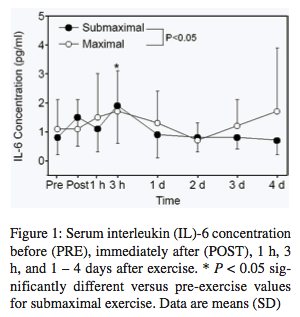
Nevner hvordan trening øker betennelse i både spesifikt muskelvev og systemisk, men konkluderer med at det er liten forskjell mellom treningsintensiteter. Forskjellige betennelsesfaktorer. IL-6 er spesielt viktig som anti-inflammatorisk faktor under trening. Kan gi en indikator på måling av stølhet etter trening, siden den øker drastisk etter 3-4 dager som vist i bildet.

http://www.medizin.uni-tuebingen.de/transfusionsmedizin/institut/eir/content/2006/72/article.pdf

«Lengthening muscle contractions elicit an inflammatory response. Within skeletal muscle, pro-inflammatory cytokines are produced, and phagocytic cells invade damaged muscle tissue (for review see ref. (22).»
» Within the systemic circu- lation, the complement cascade is activated, leukocytes are mobilized, and cytokine concentrations increase (22). These inflammatory responses share some similarities with the responses to trauma injury (8).»

«The inflammatory response to contraction-induced injury may be propor- tional to the severity of muscle damage, which in turn is dependent on mechanical loading of muscle during exercise. This relationship is important because the magnitude of the inflammatory response regulates adaptation to muscle injury (32).»

«Furthermore, muscle damage after lengthening contractions (as indicated by loss of muscular strength) corre- lates with blood leukocyte counts and serum C-reactive protein concentration (21).»

«Interleukin (IL)-6 plays an important role in mediating inflammatory responses to exercise. IL-6 is believed to exert anti-inflammatory effects during exercise by inhibiting the production of the pro-inflammatory cytokine tumor necrosis factor (TNF)-α, and stimulating the synthesis of other anti-inflammatory cytokines such as IL-1 receptor antagonist (IL-1ra), IL-10 and soluble TNF-α receptor 1 (sTNF-αR1) (25). IL-6 is produced within, and released from skeletal muscle during exercise in response to glycogen depletion, calcium signaling, changes in blood glucose availability, and to a lesser extent sympathetic activation (9, 11, 13).»

trening og betennelse

Viser at det ikke er noen forskjell på betennelsesfaktorer mellom forskjellige treningsintensiteter:
«The aim of this study was to compare systemic inflammatory responses to sub- maximal versus maximal lengthening contractions. Our data indicate that there were no significant differences in systemic markers of inflammation, despite evidence of greater muscle damage (as indicated by impaired muscular strength) following the maximal versus submaximal contractions.»

Nevner hvordan immunforsvaret reagerer på treningen:
«Elevated blood neutrophil counts are a consistent finding after lengthening contractions of the elbow flexors (17, 27-29). Neutrophils are most likely mobi- lized from endothelial surfaces into the circulation in response to tissue injury such as exercise-induced muscle damage. Once in the circulation, neutrophils travel to the site of injury, and then bind and break down damaged tissue frag- ments. In our study, neutrophil numbers were highest 3 h after exercise.»

«The small increase in serum IL-6 concentration after the submaximal contractions could represent the release of IL-6 from muscle in response to muscle glycogen depletion (13).»

«In conclusion, the present data indicate that although maximal lengthening contractions of the elbow flexors may result in greater muscle damage, this is not accompanied by a greater systemic inflammatory response.»

«Furthermore, although we could not detect differences in systemic inflammation, differences could exist locally within skeletal muscle.»

Ukjent sin avatar

Nitric oxide and pro-inflammatory cytokines correlate with pain intensity in chronic pain patients.

Bekrefter at mengden betennelsesfaktorer (f.eks. IL-6 og TNFa) er proporsjonal med smerteopplevelse. Og sier at NO er økt ved økt smerte. Dette burde tilsi bedre blodsirkulasjon, men det er åpenbart ikke det. NO har en tosidig effekt som både smertedempende og smerteøkende. (http://www.ncbi.nlm.nih.gov/pubmed/21723953)

http://www.ncbi.nlm.nih.gov/pubmed/17334668
«Pro-inflammatory cytokines (IL-1beta, IL-2, IL-6, IFN-gamma, TNF-alpha) in the plasma correlate with increasing pain intensity. Chronic pain patients show a significant increase in plasma levels of NO in comparison to healthy controls.»

Ukjent sin avatar

Reduced levels of antiinflammatory cytokines in patients with chronic widespread pain

Bekrefter at manglende anti-inflammatoriske stoffer (IL-4 og IL-10) er proporsjonalt med smertetilstander, spesielt fibromyalgi.

http://onlinelibrary.wiley.com/doi/10.1002/art.22026/full

«Chronic widespread pain is associated with a lack of antiinflammatory and analgesic Th2 cytokine activity, which may contribute to its pathogenesis.»

«This definition includes chronic widespread pain, which is pain of a duration of at least 3 months in an axial distribution, plus pain on both the left and the right side of the body, plus pain above and below the waist (2), combined with pain upon digital palpation with 4 kg of pressure on at least 11 of 18 defined tender points. »

«In a study with 113 FM patients, significantly increased serum IL-8 and IL-2 receptor expression was found by ELISA, and IL-8 levels were found to correlate with pain intensity (19).»

«IL-10 is produced by activated T cells, B cells, macrophages, mast cells, and keratinocytes. The production of IL-10 is inhibited by several cytokines such as IL-4, IL-13, and interferon-γ (IFNγ), and through autoregulation by IL-10 itself (24). »

«IL-4 is considered to be a pleiotropic antiinflammatory cytokine produced by activated CD4+ T cells, mast cells, eosinophils, and basophils. It affects T and B lymphocytes, natural killer cells, mast cells, synoviocytes, and endothelial cells, activates and supports the growth of B cells, and triggers the production of IgG and IgE. IL-4 inhibits macrophage activation and directs the T helper cell differentiation to the Th2 side (32). «

Ukjent sin avatar

Inflammation in complex regional pain syndrome A systematic review and meta-analysis

Studie som viser at betennelser er et viktig aspekt av CRPS (kompleks smertesyndrom). Og den nevner det viktige prinsippet om at betennelsesfaktorer er like fremtredene i den smertefrie siden. Dette kan også gjelde ved andre betennelsestilstander….

http://www.neurology.org/content/80/1/106.full

» CRPS is associated with the presence of a proinflammatory state in the blood, blister fluid, and CSF. Different inflammatory profiles were found for acute and chronic cases»

«In acute CRPS, the concentrations of interleukin (IL)-8 and soluble tumor necrosis factor receptors I (sTNF-RI) and II (sTNF-RII) were significantly increased in blood.
In chronic CRPS, significant increases were found in 1) TNFα, bradykinin, sIL-1RI, IL-1Ra, IL-2, sIL-2Ra, IL-4, IL-7, interferon-γ, monocyte chemoattractant protein-1 (MCP-1), and sRAGE (soluble receptor for advanced glycation end products) in blood; 2) IL-1Ra, MCP-1, MIP-1β, and IL-6 in blister fluid; and 3) IL-1β and IL-6 in CSF. »

«Inflammatory factor concentrations in CSF were reported in 3 chronic CRPS studies comparing CRPS cases to predominantly hospital controls.26,,28 »

«Complex regional pain syndrome (CRPS) is characterized by severe pain, allodynia, hyperalgesia, and motor and autonomic signs and symptoms.1»

Om CRPS: http://en.wikipedia.org/wiki/Complex_regional_pain_syndrome

«We found that the inflammatory factor profile in chronic CRPS, shown in figures 3 to 5, suggests a proinflammatory drive. In particular, the presence of cytokines such as IL-1 and IL-6 in the CSF suggests that the highly proinflammatory Th17 mechanisms may be active. »

«Previous work has shown that chronic pain is associated with higher levels of proinflammatory37 and lower antiinflammatory activity.38»

«Finally, our study found little empirical support for the position that the CRPS-affected limb expresses higher inflammatory factors than the unaffected limb.»
«Importantly, those studies that performed these side-to-side comparisons concluded that the levels of inflammatory factors in blood are not significantly different between the affected and the unaffected limb in either acute or chronic CRPS.»