Ukjent sin avatar

Recognition of central sensitization in patients with musculoskeletal pain: Application of pain neurophysiology in manual therapy practice

Nevner det aller meste om sentral sensitering og hvordan de gjenkjennes i klinisk praksis.

http://www.thblack.com/links/RSD/ManTher2010_15_135_CSinMusculoskelPain-PainNeurophys.pdf

«Even with acute pain the nervous system undergoes some changes. When tissue is damaged and pain persists for a few days with adaptation of unimodal nociceptors, the responsiveness of polymodal nociceptive endings is enhanced by substances released from various sources (i.e. serotonin released by platelets) (Purves et al., 1997). This process is called primary hyperalgesia or peripheral sensitization of nociceptors, and represents a protective action by the human body in order to prevent further use of damaged structures and consequent further damage of the traumatized and surrounding tissues.»

«Secondary hyperalgesia refers to increased responsiveness of dorsal horn neurons localized in the spinal segments of the primary source of nociception.»

«Central sensitization is defined as an augmentation of responsiveness of central neurons to input from unimodal and polymodal receptors (Meyer et al., 1995). Central sensitization encompasses altered sensory processing in the brain (Staud et al., 2007), malfunctioning of descending anti-nociceptive mechanisms (Meeus et al., 2008), increased activity of pain facilitatory path- ways, temporal summation of second pain or wind-up (Meeus and Nijs, 2007; Staud et al., 2007), and long-term potentiation of neuronal synapses in the anterior cingulate cortex (Zhuo, 2007).»

«The presence of central sensitization in patients with musculoskeletal pain implies an increased complexity of the clinical picture (i.e. an increase in unrelated symptoms and hence a more difficult clinical reasoning process) (Nijs et al., 2009), as well as decreased odds for a favorable rehabilitation outcome (Jull et al., 2007).»

«Central sensitivity syndromes is a term first used by Yunus in 2000 to describe a group of overlapping conditions bound by a common pathophysiological mechanism of central sensitization (Yunus, 2007a).»

«Another example is chronic non-specific low back pain. Some studies provided evidence in support of the presence of central sensitization in patients with non-specific chronic low back pain (Giesecke et al., 2004; Schmidt-Wilcke et al., 2006), while others refute such an association (Hoffman et al., 2005; Julien et al., 2005). It is concluded that central sensitization is present in some cases of chronic non-specific low back pain, possibly representing one of the subgroups of this frequent musculoskeletal disorder (Wand and O’Connell, 2008).»

«The myofascial variety within the heterogeneous group of temporomandibular disorders is also characterized by central sensitization (Yunus, 2007a). Likewise, regional chronic pain conditions that present with tender and/or trigger points in the absence of structural pathology (frequently referred to as myofascial pain syndrome) should alert the manual therapist to the possibility that central sensitization is determining the clinical picture (Yunus, 2007a). However, to our knowledge available evidence in support of central sensitization in patients with myofascial pain syndrome is limited to chronic whiplash associated disorders, temporoman- dibular disorders and chronic non-specific low back pain.»

«Furthermore, various subgroups of headache, chronic tension-type headache (Langemark et al., 1993; Pielsticker et al., 2005) and migraine (Burnstein et al., 2000; Weissman-Fogel et al., 2003) can be viewed as central sensitivity syndromes. Finally, rheumatoid arthritis and osteoarthritis are examples of local musculoskeletal disorders possibly causing continuous activation of polymodal nociceptors that initiate or sustain central sensitization (Yunus, 2007a).»
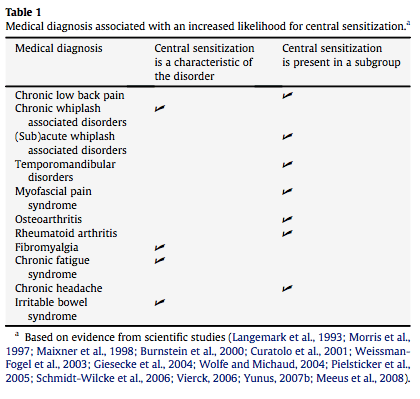
table1

«Central sensitization entails much more than generalized hypersensitivity to pain: it is characterized by an increased responsiveness to a variety of stimuli including mechanical pressure (Desmeules et al., 2004), chemical substances (Morris et al., 1997), cold temperature (Kasch et al., 2005), heat temperature (Meeus et al., 2008), electrical stimuli (Banic et al., 2004; Desmeules et al., 2004), stress, emotions, and mental load. The clinical picture is suggestive of a general intolerance to all kinds of physical and emotional stressors and hence a large decreased load tolerance of the human body in general.»
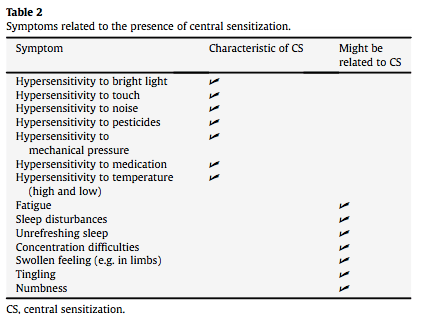
table2

«An ongoing source of peripheral nociception is required before the process of peripheral sensitization can establish central sensitization (Nijs and Van Houdenhove, 2009). Tissue injury healing and focal pain recovery should occur as soon as possible to prevent development of central sensitization (Vierck, 2006).»

«One of the main characteristics of central sensitization in patients with musculoskeletal pain is a generalized rather than a localized decrease in their pressure pain threshold. Here, ‘generalized’ implies more than a segmental spreading of the symptom area, in that it means that the increased sensitivity is localized at sites segmentally unrelated to the primary source of nociception (e.g. the lower limbs in case of a whiplash trauma).»

«Lower pressure pain thresholds at symptomatic areas most often represent primary hyperalgesia due to sensitized polymodal noci- ceptors within injured musculoskeletal structures. By measuring pressure pain thresholds outside the area of primary nociception, widespread hyperalgesia or secondary hyperalgesia can be detec- ted.»

«In cases of secondary hyperalgesia, a reduced pressure pain threshold in the various tissues innervated by the same segment (or two neighboring segments) can be detected.»

«Findings of numerous areas of hyperalgesia at sites outside and remote from the symp- tomatic site, together with a non-segmental general decrease in pressure pain threshold, may imply a generalized hyperexcitability of central nociceptive pathways (Sterling et al., 2004).»

«Pressure algometry provides a reliable and valid measure of the pressure pain threshold (Vanderweeen et al., 1996; Farasyn and Meeusen, 2003). In the absence of a pressure algometer, manual palpation can be used. Even when a manual therapist is not sus- pecting central sensitization, the finding of generalized hypersen- sitivity to manual palpation during routine clinical examination should alert the clinician.»

«Like every other tissue in the human body, peripheral nerves and nervous tissues (including connective tissue) themselves can become hypersensitive to mechanical stimuli such as tension and pressure.»

«Besides the passive tests listed above (Table 3), altered sensory processing can be demonstrated during exercise. Pain thresholds increase during physical activity in healthy individuals and can stay augmented for up to 30 min post-exercise. This is the result of endogenous opioid release (Koltyn and Arbogast, 1998) and related activation of several (supra)spinal anti-nociceptive mechanisms such as the adrenergic and serotonergic pathways (Millan, 2002).»


«Stress (particularly when chronic) may well trigger lower pain thresholds. This was demonstrated by Suarez-Roca et al. (2008) who reported reduced GABA neurotransmission and consequent hyperalgesia in rats after repeated forced swimming stress.»

«A constant or decreased pain threshold during and following exercise suggests malfunc- tioning of these anti-nociceptive mechanisms (Whiteside et al., 2004) and hence central sensitization. An abnormal pain threshold response to exercise should be regarded as one of the many possible signs of central sensitization.»
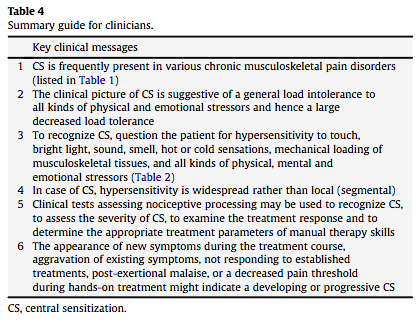
table4


Ukjent sin avatar

PROLONGED ALTERATION OF VASOCONSTRICTOR AND VASODILATOR RESPONSES IN RAT KNEE JOINTS BY ADJUVANT MONOARTHRITIS

Viktig bekreftelse på at blodsirkulasjon hemmes i betente ledd og at dette er noe av utgangspunktet for slitasjeskader siden vevet og skjelettet ikke får de næringsstoffene de trenger. Viktig studie å se på men vanskelig å copy-paste sitater…

Klikk for å få tilgang til 349.full.pdf

«These vasoactive responses were completely abolished in the chronically inflamed knee joint, the abolition persisting throughout the investigation. »

«Since articular cartilage is critically dependent on synovial fluid formation for its nutrition, loss of neurovascular control of the synovial microcirculation could contribute to the degenerative changes that commonly accompany chronic inflammatory joint diseases.»

«The role of synovial nerves in the development of various forms of acute inflammation has previously been reported (Lam & Ferel,1991)and it is thought that their efects may be mediated by local release of SP, which is known to be pro-inflammatory in this region.»

«These experiments showed that electrical stimulation of nerves supplying the rat knee joint caused a frequency-dependent constriction of articular bloodvesels, and that topical aplication of SP to the exposed joint surface produced a potent vasodilatation, although this particular effect was found to be transient.»

Viser at nervesignaler gjør at blodkar trekker seg sammen i leddet. Kan henvise til at et overstimulert nervesystem (sympaticus dominans) trekker blodkar sammen.

«A highly significant frequency-dependent decrease in joint bloodflow occurred in normal rats when electrical stimulation of the saphenous nerve was performed (P < 0 001, repeated measures one-way ANOVA; n = 10). The greatest vasoconstriction resulted when 30 Hz stimulation was applied to the nerve: this elicited a 37.3+7.3% fall in perfusion.»

Nevner at Substans P gir vasodilasjon (37%) umiddelbart, men at det over tid gir en vasokonstriksjon (40%).
«Substance P, when applied topically to the exposed surface of normal knee joints, produced a significant dose-dependent augmentation of joint bloodflow (P<0.001;n= 10), culminating in a peak rise of 45*1+8*6% with the10-9 mol dose.»
«At week 1, SP had no significant effect on synovial blood flow (P= 0.511;n= 10),but at week 3 vasoconstriction was recorded (P< 0*001;n= 9); at both these times the results were significantly different from those of normal rats (P < 0.001). A fall of articular perfusion of about 40% occurred at week 3 when 10-8 and10-t2 mol of SP was administered to the joint, but the intermediate doses produced less efect. »

Nevner at blodsirkulasjonen er dårlig i over 3 uker etterpå, selv om betennelsen er borte.
«Since articular cartilage is dependent on the synovial perfusion (McKibbin& Maroudas, 1979), this initial reduction in joint blood flow could cause the integrity of the joint to deteriorate and lead to degenerative changes. It has previously been shown that adjuvant- induced inflammation in the rat knee joint abolishes sympathetic vasoconstriction and the neuropeptidergic vasodilator response to SP at 1week post-treatment (McDougall et al. 1994).The investigation outlined here has shown that these alterations are not transitory, and are stil present 3 weeks after injection of adjuvant, even though the inflammatory process appears to be abating by then.»

Nevner at det blir vasokonstriksjon når det er betennelse samtidig.
«Chronically inflamed joints did not show vasodilatation in response to SP at any stage; indeed there was some evidence of vaso- constriction. This finding suggests that the SP receptors are either radically transformed or possibly inactivated by the inflammatory process.»

«Comparing this finding with that of the present study, it would appear that the integrity of sympathetic transmission and SP receptor activation in rat knee joints declines as inflammation becomes more chronic. Loss of these neurovascular controls could contribute to the degenerative changes that commonly accompany chronic inflammatory joint diseases.»

Ukjent sin avatar

Alteration of substance P-mediated vasodilatation and sympathetic vasoconstriction in the rat knee joint by adjuvant-induced inflammation

Nevner at kronisk bentente ledd mister reaksjonsevnen på nerveimpulser og blodsirkulasjon. Kunne trengt å lese hele denne studien.

http://www.sciencedirect.com/science/article/pii/0304394094900027

«In control knees, nerve stimulation produced a frequency-dependent vasoconstruction»

«Chronically inflamed joints showed virtually no response to either nerve stimulation or SP application, suggesting a radical alteration in sympathetic and neuropeptidergic actions.»

Ukjent sin avatar

Nitric Oxide Inhibits Nociceptive Transmission by Differentially Regulating Glutamate and Glycine Release to Spinal Dorsal Horn Neurons

Mer om NO sin funksjon som både smertedempende og smerteøkende. Nevner alle faktorer som spiller inn i både nervesystem, ryggmarg og perifert. Viktig studie som også indirekte kan brukes i å forstå sammenhengen mellom hvordan CO2 og økning av eNOS (i blodkar) kan dempe nNOS (i nervesystemet).

http://www.jbc.org/content/286/38/33190.full

«Our findings suggest that spinal endogenous NO enhances inhibitory glycinergic input to dorsal horn neurons through sGC-cGMP-protein kinase G. Furthermore, NO reduces glutamate release from primary afferent terminals through S-nitrosylation of voltage-activated Ca2+ channels. Both of these actions probably contribute to inhibition of nociceptive transmission by NO at the spinal level.»

«Nitric oxide (NO) is freely diffusible across the cell membranes and is synthesized by the nitric-oxide synthase (NOS)2 from L-arginine and different cofactors.»

«The three NOS isoforms, including neuronal NOS (nNOS), endothelial NOS (eNOS), and inducible NOS (iNOS), have distinct structures and functions (1, 2). »

Refererer til Superoxid, den viktigste antioksidanten som CO2 beskytter. Og til peroxynitritt, den farligste oksidanten som CO2 også beskytter mot.

«The diverse effects of NO is commonly mediated through increased cGMP production upon activation of NO-sensitive soluble guanylyl cyclase (sGC), S-nitrosylation, tyrosine nitration, and the interaction with superoxide to form peroxynitrite (3,,5). »

Hvordan NO gir smerte, og at NO-hemmere demper smerte.:
«Some studies suggest that spinal NO is involved in the potentiation of nociception. For example, mechanical hypersensitivity induced by nerve injury or tissue inflammation is reduced by intrathecal administration of nNOS inhibitors and in nNOS-knock-out mice (6, 9, 10). »

Hvordan NO demper smerte:
«In contrast, other studies have shown that spinal NO plays a role in the inhibition of nociceptive processing. In this regard, intrathecal administration of L-arginine increases the mechanical nociceptive withdrawal threshold in rats (12). »

Mengden har mye å si for effekten, med lite er det smertedempende, men mye er det smerteøkende.
«For instance, it has been shown that intrathecal injection of low doses of L-arginine or NO donors reduce nociception, but L-arginine or NO donors at the high doses potentiates nociceptive responses to formalin injection or nerve injury (16, 17).»

Nevner at hvis én type NO er nedregulert blir en annen type oppregulert. Muligheten er da for at om eNOS (i blodårer) er lav pga dårlig blodsirkulasjon og lite CO2, kan nNOS (i nervesystemet) økes og dermed gi smerter. Ved å øke eNOS kan man da få mindre nNOS og dermed en indirekte smertedemping.
«In addition, it should be noted that in eNOS-, nNOS-, or iNOS-knock-out mice, an increase in the expression of other NOS isoforms in the spinal cord has been reported (18, 19). This compensatory up-regulation of other NOS subtypes in specific NOS isoform-knock-out mice further confounds the interpretation of the results.»

Om at NO både øker nocicepsjon og demper den:

«The discrepancy may result from the use of different pain models, the amount of NO produced locally, and the specific CNS sites involved. For example, NO-cGMP inhibits dorsal horn neuronal activity at the spinal level but excites spinal dorsal horn neurons at the supraspinal level (15, 39). Also, while low concentrations of NO inhibit NMDA receptor activity (40, 41), high concentrations of NO stimulate TRPV1 and TRPA1 receptors (42). »

«GABA and glycine are the two predominant inhibitory neurotransmitters in the spinal cord. Blocking GABAA or glycine receptors in the spinal cord induces pain hypersensitivity in rats (4344).»

«Of note, L-arginine and SNAP had similar effects on glycinergic sIPSCs and mIPSCs, suggesting that NO can potentiate glycine release from presynaptic terminals of interneurons in the spinal dorsal horn. Thus, our findings indicate that NO potentiates glycinergic input to spinal dorsal horn neurons to attenuate nociceptive transmission

«Glutamate is an excitatory neurotransmitter critically involved in nociceptive transmission in the spinal dorsal horn. In this study, we found that L-arginine and SNAP significantly inhibited the frequency of glutamatergic sEPSCs of lamina II neurons. L-Arginine and SNAP also consistently inhibited glutamatergic EPSCs evoked from primary afferents in most lamina II neurons.»

«Thus, it is unlikely that the inhibitory effect of NO on synaptic glutamate release to dorsal horn neurons is secondary to increased glycine release and stimulation of presynaptic glycine receptors (35). Our findings strongly suggest that NO attenuates synaptic glutamate release by inhibition of HVACCs at primary afferent terminals.»

«Another salient finding of our study is that NO potentiates glycinergic input and inhibits glutamatergic synaptic transmission in the spinal dorsal horn through distinct signaling pathways.»

«Therefore, our findings suggest that spinal NO primarily inhibits glutamate release through S-nitrosylation of HVACCs at primary afferent terminals.»

«In addition to its inhibitory effect on HVACCs shown in our study, NO can inhibit NMDA receptor currents in recombinant systems (6061) and in spinal lamina II neurons (41). Because both HVACCs and NMDA receptors are critically involved in nociceptive transmission, it seems difficult to explain the proposed pronociceptive role of NO at the spinal level. Of note, systemic use of NO or NO donors has been shown to reduce pain intensity caused by sickle cell crisis or diabetic neuropathy in patients (62, 63). We found in the present study that intrathecal administration of L-arginine or SNAP in rats significantly increased the nociceptive mechanical thresholds.»

«Hence, NMDA receptor activation could lead to increased NO production and release, and NO can diffuse to the presynaptic site to reduce glutamate release from primary afferent terminals. By reducing glutamatergic transmission, NO could serve as a feedback regulator to attenuate nociceptive transmission at the spinal level during painful conditions.»

«In summary, our study provides important new evidence that spinal NO potentiates inhibitory glycinergic input but reduces glutamatergic synaptic transmission between primary afferents and dorsal horn neurons through distinct signaling mechanisms. The opposing effects of NO on glutamatergic and glycinergic synaptic transmission could contribute to the antinociceptive effect of NO at the spinal level. This new information is important for our understanding of the synaptic actions underlying the antinociceptive effect of NO at the spinal level.»


Ukjent sin avatar

Pain and analgesia: The dual effect of nitric oxide in the nociceptive system.

Om at NO har en tosidig effekt som både smertedempende og smerteøkende.

http://www.ncbi.nlm.nih.gov/pubmed/21723953
«Nitric oxide is an important neurotransmitter involved in the nociceptive process and, in the dorsal horn of the spinal cord, it contributes to the development of central sensitization. On the other hand, experimental data have also demonstrated that NO inhibits nociception in the peripheral and also in the central nervous system. »

«In addition, it has been shown that nitric oxide mediates the analgesic effect of opioids and other analgesic substances. «

Ukjent sin avatar

Nitric oxide and pro-inflammatory cytokines correlate with pain intensity in chronic pain patients.

Bekrefter at mengden betennelsesfaktorer (f.eks. IL-6 og TNFa) er proporsjonal med smerteopplevelse. Og sier at NO er økt ved økt smerte. Dette burde tilsi bedre blodsirkulasjon, men det er åpenbart ikke det. NO har en tosidig effekt som både smertedempende og smerteøkende. (http://www.ncbi.nlm.nih.gov/pubmed/21723953)

http://www.ncbi.nlm.nih.gov/pubmed/17334668
«Pro-inflammatory cytokines (IL-1beta, IL-2, IL-6, IFN-gamma, TNF-alpha) in the plasma correlate with increasing pain intensity. Chronic pain patients show a significant increase in plasma levels of NO in comparison to healthy controls.»

Ukjent sin avatar

Reduced levels of antiinflammatory cytokines in patients with chronic widespread pain

Bekrefter at manglende anti-inflammatoriske stoffer (IL-4 og IL-10) er proporsjonalt med smertetilstander, spesielt fibromyalgi.

http://onlinelibrary.wiley.com/doi/10.1002/art.22026/full

«Chronic widespread pain is associated with a lack of antiinflammatory and analgesic Th2 cytokine activity, which may contribute to its pathogenesis.»

«This definition includes chronic widespread pain, which is pain of a duration of at least 3 months in an axial distribution, plus pain on both the left and the right side of the body, plus pain above and below the waist (2), combined with pain upon digital palpation with 4 kg of pressure on at least 11 of 18 defined tender points. »

«In a study with 113 FM patients, significantly increased serum IL-8 and IL-2 receptor expression was found by ELISA, and IL-8 levels were found to correlate with pain intensity (19).»

«IL-10 is produced by activated T cells, B cells, macrophages, mast cells, and keratinocytes. The production of IL-10 is inhibited by several cytokines such as IL-4, IL-13, and interferon-γ (IFNγ), and through autoregulation by IL-10 itself (24). »

«IL-4 is considered to be a pleiotropic antiinflammatory cytokine produced by activated CD4+ T cells, mast cells, eosinophils, and basophils. It affects T and B lymphocytes, natural killer cells, mast cells, synoviocytes, and endothelial cells, activates and supports the growth of B cells, and triggers the production of IgG and IgE. IL-4 inhibits macrophage activation and directs the T helper cell differentiation to the Th2 side (32). «

Ukjent sin avatar

Inflammation in complex regional pain syndrome A systematic review and meta-analysis

Studie som viser at betennelser er et viktig aspekt av CRPS (kompleks smertesyndrom). Og den nevner det viktige prinsippet om at betennelsesfaktorer er like fremtredene i den smertefrie siden. Dette kan også gjelde ved andre betennelsestilstander….

http://www.neurology.org/content/80/1/106.full

» CRPS is associated with the presence of a proinflammatory state in the blood, blister fluid, and CSF. Different inflammatory profiles were found for acute and chronic cases»

«In acute CRPS, the concentrations of interleukin (IL)-8 and soluble tumor necrosis factor receptors I (sTNF-RI) and II (sTNF-RII) were significantly increased in blood.
In chronic CRPS, significant increases were found in 1) TNFα, bradykinin, sIL-1RI, IL-1Ra, IL-2, sIL-2Ra, IL-4, IL-7, interferon-γ, monocyte chemoattractant protein-1 (MCP-1), and sRAGE (soluble receptor for advanced glycation end products) in blood; 2) IL-1Ra, MCP-1, MIP-1β, and IL-6 in blister fluid; and 3) IL-1β and IL-6 in CSF. »

«Inflammatory factor concentrations in CSF were reported in 3 chronic CRPS studies comparing CRPS cases to predominantly hospital controls.26,,28 »

«Complex regional pain syndrome (CRPS) is characterized by severe pain, allodynia, hyperalgesia, and motor and autonomic signs and symptoms.1»

Om CRPS: http://en.wikipedia.org/wiki/Complex_regional_pain_syndrome

«We found that the inflammatory factor profile in chronic CRPS, shown in figures 3 to 5, suggests a proinflammatory drive. In particular, the presence of cytokines such as IL-1 and IL-6 in the CSF suggests that the highly proinflammatory Th17 mechanisms may be active. »

«Previous work has shown that chronic pain is associated with higher levels of proinflammatory37 and lower antiinflammatory activity.38»

«Finally, our study found little empirical support for the position that the CRPS-affected limb expresses higher inflammatory factors than the unaffected limb.»
«Importantly, those studies that performed these side-to-side comparisons concluded that the levels of inflammatory factors in blood are not significantly different between the affected and the unaffected limb in either acute or chronic CRPS.»

Ukjent sin avatar

Nevropatiske utglidninger

Artikkel fra Tidsskriftet om forenkling av nevropatiske liderlser og diagnoseverktøyet painDETECT. Nevner bl.a. mye om at diagnoser er veldig individuelle basert på hvilke spesialister man oppsøker. + nevner mye om nevropati generelt.

http://tidsskriftet.no/article/3012269

«Det er lite klinisk kunnskapsgrunnlag for at det er mulig å stille valide, patogenetisk baserte diagnoser hos flertallet av pasienter med uspesifikke ryggplager uten tegn til radikulopati (9). Det er generelt lav diagnostisk konsensus, og diagnosen som stilles, avhenger i stor grad av hvilken type «ryggspesialist» som oppsøkes (10). Slik diagnostisk uenighet bidrar til forvirring og helseangst hos pasienten, medfører ofte overbehandling, og i verste fall ytterligere kronifisering (7,8).»

«Ved radikulopatier er den diagnostiske presisjon høyere, og her gir det mer mening å bruke nevropatibetegnelsen. «

Ukjent sin avatar

Why does my shoulder hurt? A review of the neuroanatomical and biochemical basis of shoulder pain

Beskriver smertefunksjon og perifere forklaringsmodeller for skuldersmerter.

http://m.bjsm.bmj.com/content/early/2013/02/20/bjsports-2012-091492.long?view=long&pmid=23429268

«This means that any cause of inflammation in or around the shoulder may give rise to the so-called ‘irritable’ shoulder joint. Therefore, clinically it may be difficult to discriminate between rotator cuff tendinopathy and calcific tendinitis or inflammatory joint disease, for example; there is a clear lack of clarity with regard to whether common diagnostic tests used in clinical examination are useful in differentially diagnosing pathologies of the shoulder.68 ,72»

«A variety of factors including patient expectation, emotions such as anxiety and mood all have significant effects on the complex neurobiological process that lies behind placebo analgesia.79 ,80«