Ukjent sin avatar

The exercise-induced growth hormone response in athletes.

Studie som gir oversikt over mange faktorer rundt veksthormonøkning i trening.

http://www.ncbi.nlm.nih.gov/pubmed/12797841

«A number of physiological stimuli can initiate hGH secretion, the most powerful, non-pharmacological of which are sleep and exercise. »

«The exercise-induced growth hormone response (EIGR) is well recognised and although the exact mechanisms remain elusive, a number of candidates have been implicated. These include neural input, direct stimulation by catecholamines, lactate and or nitric oxide, and changes in acid-base balance. Of these, the best candidates appear to be afferent stimulation, nitric oxide and lactate. Resistance training results in a significant EIGR.»

«An exercise intensity above lactate threshold and for a minimum of 10 minutes appears to elicit the greatest stimulus to the secretion of hGH. Exercise training above the lactate threshold may amplify the pulsatile release of hGH at rest, increasing 24-hour hGH secretion.»

«In a great many cases, the impact of some of the deleterious effects of ageing could be reduced if exercise focused on promoting the EIGR. «

Ukjent sin avatar

Growth hormone release during acute and chronic aerobic and resistance exercise: recent findings.

Studie som bekrefter hvordan veksthormon påvirkes av trening. Viser at det er et lineært forhold mellom trening og veksthormon. Flere treningsøkter om dagen gir mest økning i veksthormon.

http://www.ncbi.nlm.nih.gov/pubmed/12457419

«Contrary to previous suggestions that exercise-induced GH release requires that a «threshold» intensity be attained, recent research from our laboratory has shown that regardless of age or gender, there is a linear relationship between the magnitude of the acute increase in GH release and exercise intensity. »

» As a result, 24-hour integrated GH concentrations are not usually elevated by a single bout of exercise. However, repeated bouts of aerobic exercise within a 24-hour period result in increased 24-hour integrated GH concentrations.»

«While exercise interventions may not restore GH secretion to levels observed in young, healthy individuals, exercise is a robust stimulus of GH secretion. «

Ukjent sin avatar

Nevropatiske utglidninger

Artikkel fra Tidsskriftet om forenkling av nevropatiske liderlser og diagnoseverktøyet painDETECT. Nevner bl.a. mye om at diagnoser er veldig individuelle basert på hvilke spesialister man oppsøker. + nevner mye om nevropati generelt.

http://tidsskriftet.no/article/3012269

«Det er lite klinisk kunnskapsgrunnlag for at det er mulig å stille valide, patogenetisk baserte diagnoser hos flertallet av pasienter med uspesifikke ryggplager uten tegn til radikulopati (9). Det er generelt lav diagnostisk konsensus, og diagnosen som stilles, avhenger i stor grad av hvilken type «ryggspesialist» som oppsøkes (10). Slik diagnostisk uenighet bidrar til forvirring og helseangst hos pasienten, medfører ofte overbehandling, og i verste fall ytterligere kronifisering (7,8).»

«Ved radikulopatier er den diagnostiske presisjon høyere, og her gir det mer mening å bruke nevropatibetegnelsen. «

Ukjent sin avatar

Physician variation in diagnostic testing for low back pain. Who you see is what you get.

Studie som nevner at diagnostisering i ryggplager er nytteløst siden avhenger så mye av terapeutens individualitet.

http://www.ncbi.nlm.nih.gov/pubmed/8129759?dopt=Abstract

«There is little consensus, either within or among specialties, on the use of diagnostic tests for patients with back pain. Thus, the diagnostic evaluation depends heavily on the individual physician and his or her specialty, and not just the patient’s symptoms and findings. «

Ukjent sin avatar

Mechanical or inflammatory low back pain. What are the potential signs and symptoms

Studie som beskriver forskjellen mellom betennelses og mekansik smerte. Dog det er liten forskjell med tanke på kronisk smerte, nevner denne studien mange interessante poenger.

http://www.ncbi.nlm.nih.gov/pubmed/18555728
Hele som pdf: http://www.researchgate.net/publication/5300497_Mechanical_or_inflammatory_low_back_pain._What_are_the_potential_signs_and_symptoms/file/d912f50e6f8ae9e751.pdf

«NSLBP is commonly described as being ‘‘mechanical’’ (Batt and Todd, 2000; Chaudhary et al., 2004; Valat, 2005) or ‘‘inflammatory’’ (Saal, 1995; Ross, 2006). Although these labels have no universally accepted defini- tions, there is evidence to support the involvement of both mechanical and inflammatory factors in the generation of LBP (Biyani and Andersson, 2004; Hurri and Karppinen, 2004; Igarashi et al., 2004; Abbott et al., 2006; Al-Eisa et al., 2006; Ross, 2006).»

«The relationship between inflammation and pain, however, is not clear. Although a recent study found that the mean intensity of pain over 24 h was indepen- dently associated with high levels of high sensitivity C reactive protein in patients with acute sciatica (less than 8 weeks), this association was not found in patients with chronic LBP (Stu ̈ rmer et al., 2005).»

«Similarly, the relationship between pain that wakes a patient up and inflammation is not clear.»
«Although the levels of inflammatory cytokines, such as interleukin-6 may alter sleep behaviour (Mullington et al., 2001), there did not appear to be an association between improvements in pain and joint stiffness»
«Although pain on lifting is commonly thought to rep- resent mechanical pain, the relationship between spinal load and pain is not clear.»

Ukjent sin avatar

Influence of blood glucose on heart rate and cardiac autonomic function

Interessant studie som beskriver sammenhengen mellom hjerterytme (HR), blodsukker og HRV både hos diabetikere og normale. Nevner også at sympaticus dominans kan gi insulinresisten.

http://hal.archives-ouvertes.fr/docs/00/55/50/75/PDF/Valensi_DME_article.pdf

«HR, but not HRV, was associated with glycaemic status and capillary glucose. After deep- breathing, HR recovery was altered in known diabetic patients, and was associated with reduced HRV»

«Elevated heart rate (HR) predicts cardiovascular morbidity and mortality in both diabetic [1,2] and non- diabetic individuals [3,4]. HR is the result of fitness, neurohormonal factors and the autonomic nervous system function. In type 2 diabetic patients, HR is faster [5] and this may be related to cardiac autonomic neuropathy (CAN). Fasting plasma glucose is associated with higher resting HR [6] and in the Insulin Resistance Atherosclerosis Study, HR was associated with insulin sensitivity and with the acute insulin response to glucose [7].»

«In type 2 diabetes, CAN is associated with age, obesity, systolic blood pressure, glycaemic control, and duration of diabetes [14] and in non-diabetic individuals, with age, overweight, pre-diabetes, HR, diminished HRV, treatment for hypertension, metabolic syndrome and insulin resistance [3,15].»

«Interestingly, a longitudinal study has shown that autonomic nervous system dysfunction (high HR, low HRV), may be associated with incident diabetes [1].»

«Known diabetic participants had a more severe cardio-vascular risk profile: 75% had the metabolic syndrome in comparison to only 15% in normoglycemic individuals.»

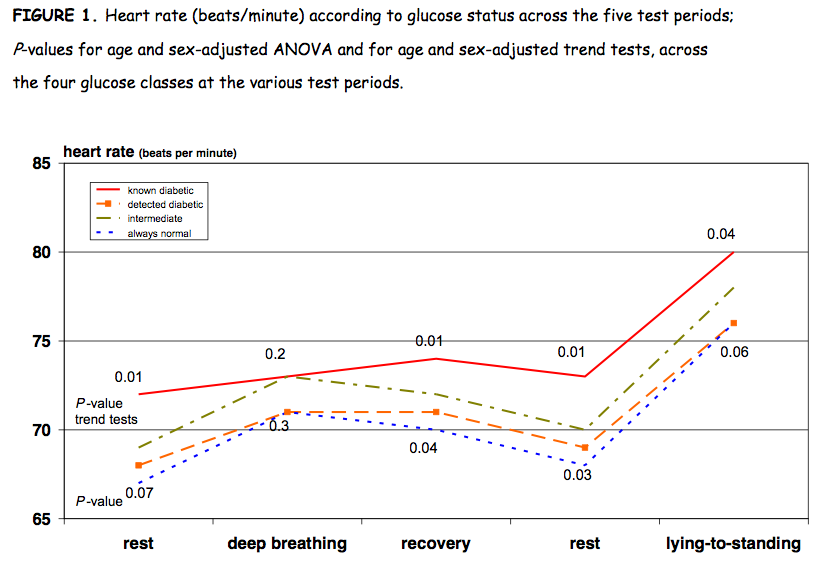
«HR was related with glycaemic status (Figure 1), particularly during recovery after deep-breathing, and during subsequent rest (P < 0.04,0.03), and known diabetic patients had the highest HR.»

«HR was higher in those with the metabolic syndrome for all test periods (Table 2), but was attenuated after adjustment on BMI with a significantly different HR remaining only during deep-breathing.»

«HRV was more closely related with glycaemic status at deep-breathing and particularly at recovery, than at other periods; patients with known diabetes had the lowest HRV (Fig. 3 A-F). At recovery, the detected diabetic and IFG individuals had similar HRV, and all six HRV indices were significantly lower than in those with normal glucose.»

«significant HR difference between the four glycaemic groups; treated diabetic patients had the highest HR, those with screened diabetes or IFG had slightly elevated HR in all test periods; HR was correlated with capillary glucose and triglycerides during all test periods;»

«HR which continued to increase between deep-breathing and recovery in diabetic patients in contrast to other groups;»

«Higher sympathetic tone can cause insulin resistance [20]. Conversely insulin resistance and hyperinsulinemia can cause sympathetic overactivity and depress vagal activity in healthy subjects [21] and in insulin-resistant non-diabetic offspring of type 2 diabetes patients [22].»

«The present data suggest that glucose is a determinant of HR.»

«The heart-rate profile during exercise and recovery (high resting HR, low HR increase during exercise, low HR decrease after exercise) predicts sudden death [23].»

«In our study, in the known diabetic patients, HR increased less between rest and deep-breathing and continued to increase during the recovery time after deep- breathing while in all other groups, HR decreased, the differences remaining significant after BMI adjustment.»

«These results suggest that this relatively simple test has good sensitivity, and could be a new marker, worthy of evaluation.»

«Lower HRV has been reported in fasting hyperglycemia [3], glucose intolerance [14]; the metabolic syndrome has been implicated in reduced HRV in non-diabetic individuals, independently of glucose [3]. Some data suggest that HRV impairment is associated with more severe insulin resistance in non-diabetic obese individuals [24].»

«The value of this simple forced deep-breathing test warrants further evaluation in diabetic as well as in pre-diabetic patients.»

Dette er metoden, om hjerterytmen fortsetter å stige etter dyp pust så er det mulig diabetes problematikk:

HR and HRV have been measured during static conditions (at rest) and dynamic conditions (deep- breathing and lying-to-standing:

  •   5 minutes resting in recumbent position,
  •   1 minute deep-breathing in recumbent position: 6 deep respiratory cycles during 1 minute [14],
  •   1 minute recovery,
  •   1 minute resting,

hjerterytme i dyp pust

Ukjent sin avatar

YOGA OF PSYCHIC HEAT (GTUM-MO) RESEARCH TECHNIQUES AND RESULTS

En russisk artikkel fra en forsker som har interessante teorier om tummo og varmegenereringen. Spesielt det som skjer i lungenes blod hvor fettsyrer forbrennes og dermed skaper varme. Forfatteren nevner at kolestrolnivået synker etter bare 10 minutter med tummo. Interessante teorier som er verdt å undersøke videre, men fullstendig umulig å bruke denne artikkelen som vitenskapelig grunnlag.

http://www.worldscientists.ru/psychology-and-pedagogy/38-yoga-of-psychic-heat-gtum-mo-research-techniques-and-results.html

«Technique of inner fire awakening is described in Yoga Kundalini Upanishad as follows: “When Apana on its way up reaches the place of fire then fire awaken by the wind inflates and grows. Then Prana itself ignites with the came fire and then fire overwhelms all body with continuous burning”»

«In the 50-ies of the 20th century K.S. Trincher, the physiologist, proved it and published his monograph Heat-Generating Function and Alkalinity of Pulmonary Tissue Response [13] in which he stated that under some conditions human lungs could perform not only respiratory but also non-respiratory functions. In particular, non-fermentative blood lipids peroxidation could take place in lungs. Energy releasing reaction of aerobic lipids peroxidation results in significant alteration of thermodynamic characteristics of the body.»

«First experiment was taken in March, 2004. During experiment venous blood sampling was taken after which Tummo was practiced during 10 minutes. Then repeated venous blood sampling was taken. Blood was analyzed for blood lipids. The analyses revealed cholesterol, lipoproteins and triglycerides quantity reduction. It was found that the author’s total cholesterol was 6.54 mmole/l before practice and 6.14 mmole/l after practice (N 3.6 – 5.2).»

«»

Ukjent sin avatar

THE EFFECT OF GUIDED IMAGERY IN A HYPNOTIC CONTEXT ON FOREARM BLOOD FLOW

Nevner hvordan hypnose og visualisering kan øke blodgjennomstrømning i spesifikke deler av kroppen.

http://bscw.rediris.es/pub/bscw.cgi/d4434404/McGuirk-Effect_guided_imagery_forearm_blood_flow.pdf
«This study was conducted to determine in a non- ulcerated population, the potential of guided imagery in a hypnotic context to influence blood flow, which is a critical variable in the process of ulcer healing.»

«It is known, however, that psychologi- cal factors are important in healing. Stress, for example, can affect the healing of experimental wounds (Kiecolt-Glaser et al., 1995) and there is contradictory evidence as to whether it affects healing of duodenal ulcers (Holtmann et al., 1992; Armstrong et al., 1993).»

«More specifically in the case of leg ulcers the pathological process is associated with disturbed blood flow and consequent tissue breakdown due to inade- quate oxygenation. Any psychological intervention that assisted in altering and cor- recting the blood flow in the affected limbs would be expected to facilitate healing.»

«Similarly Moore and Wiesner (1996) used suggestions of hand- warming in hypnosis, augmented by biofeedback, to create local vasodilation (as measured by objective increases in hand temperature) with a concomitant reduction in pain in patients with upper extremity repetitive strain injury. In earlier work from the same research group Moore and Kaplan (1983) reported acceleration of burn wound healing and pain reduction by hypnotically induced vasodilation in the targeted hand compared with the control hand.»

«The authors concluded that while the blood flow change is under central neurological control, and hence can be directly affected by hypnotic suggestion, ery- thema reflects local changes related to the release of inflammatory mediators.»

Subjective temperature (arbitrary units)

Target ‘hot’ arm 90·8 (18·6)
Target ‘cold’ arm 89·4 (21·7)
Before After

103·5 (18·6) 38·1 (21·8)

Change (%)
+12·7 (13·9) –51·3 (57·4)

*Means (and standard deviations)

«The subjective temperature change, however, was greater for ‘cold’ imagery. This may be because the subjects perceived their arms as already warmer than usual prior to the imagery suggestions, thereby creating a ceiling effect. An alternative explanation is that the cold script was the more powerful of the two or possibly that reducing perceived temperature in a limb is an inherently easier task. «

Ukjent sin avatar

Neurocognitive and Somatic Components of Temperature Increases during g-Tummo Meditation

Viktig studie om tummo som oppklarerer flere misforståelser og beskriver mange aspekter som tidligere ikke er beskrevet. Nevner bl.a. at vestlige også kan øke sin kroppstemperatur med disse teknikkene.

http://www.plosone.org/article/info%3Adoi%2F10.1371%2Fjournal.pone.0058244

«Reliable increases in axillary temperature from normal to slight or moderate fever zone (up to 38.3°C) were observed among meditators only during the Forceful Breath type of g-tummo meditation accompanied by increases in alpha, beta, and gamma power.»

«Overall, the results suggest that specific aspects of the g-tummo technique might help non-meditators learn how to regulate their body temperature, which has implications for improving health and regulating cognitive performance.»

«The authors reported that three g-tummo meditators showed a dramatic increase of up to 8.3°C in peripheral body temperature (fingers and toes), more modest skin temperature increases of 1.9°C in the navel and lumbar regions, and no increase in rectal temperature. Unfortunately, these findings have subsequently been distorted in reports in other sources, possibly due to confusion between Fahrenheit and Centigrade scales or lack of clear specification regarding the anatomical sites of temperature measurement, leading to general claims of temperature increases during g-tummo ranging from “… up to 15 degrees only within a few moments of concentration” [3] to “17 degrees in peripheral body temperature” [8]

«The visual effect of steaming sheets reported by eye-witnesses of the g-tummo ceremony cannot be taken as evidence of elevated body temperature. Wet sheets wrapped around a practitioner’s body would steam and dry due to the significant temperature difference between the wet sheets (heated by a human body) and the cold air outside, even if the practitioners simply maintain their normal body temperature.»

«Furthermore, they did not exceed the peripheral body temperature increases reported in clinical studies of (non-meditating) individuals who were able to increase hand or finger temperature by up to 11.7°C during biofeedback alone or in combination with hypnosis, mental imagery, or autogenic training[9][11]. Subsequent clinical research, however, reported that such peripheral temperature increases were primarily mediated by somatic (e.g., altered respiration and/or tensing and contracting of muscles) but not cognitive factors [12]

«The g-tummo practice involves both somatic and neurocognitive components. The somatic component involves specialized breathing techniques as well as isometric exercises (i.e. exercises performed in static positions, rather than incorporating a range of motion) involving muscle tensing and contraction. The neurocognitive component involves meditative visualization requiring the generation and maintenance of mental images of flames at specific locations in the body accompanied by intense sensations of bodily heat in the spine.»

«Recent studies report that raising body temperature might be an effective way to boost immunity and treat infectious diseases and immunodeficiencies [13][15] as well as to induce synaptic plasticity in the hippocampus [16]. It has been long recognized that increased body temperature (in the zone of a slight fever) is associated with higher alertness, faster reaction time, and better cognitive performance on tasks such as visual attention and working memory [17][19]. »

«Some, but not all, of these monasteries test their practitioners’ capabilities at the end of a three-year retreat with a ceremony where the practitioners dry wet sheets. As a testament to the importance of the g-tummo practice at Gebchak nunnery, this ceremony is held annually, at dawn, and all of the experienced practitioners walk slowly for a few hours around the nunnery complex in −25°C to −30°C weather, wearing only short skirts and shoes and a wet sheet draped around their naked torsos.»

«The g-tummo practice is characterized by a special breathing technique, “the vase”, accompanied by isometric muscle contractions, where after inhalation, during a period of holding their breath (apnea), the practitioners contract both abdominal and pelvic muscles so that the protruding lower belly takes the shape of a vase or pot [1]

Tilsvarerer akselereringsfasen i vårt tummo konsept.
«FB is forceful and vigorous, while GB is gentle and without any strain. Whereas the goal of FB is to raise “psychic heat”, the goal of GB is to maintain it. During FB, attention is focused on visualizing a rising flame that starts below the navel and with each breath rises up to the crown of the head, whereas GB is accompanied by visualization of the entire body being filled with a surging sensation of bliss and heat.»

Man kan enkelt måle kjernetemperatur selg med termometer i armhulen eller munnen.
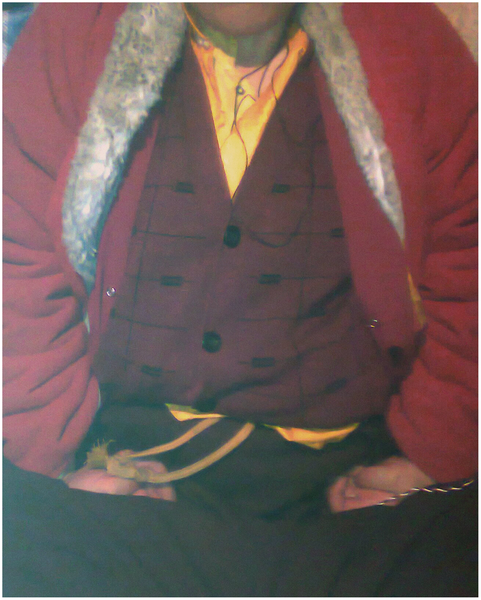
«We recorded EEG activity of the meditators as well as their peripheral (left fifth finger) and core body temperature (left armpit) during g-tummo practices»
«Although not as precise as an internally taken rectal or oral measurement of core body temperature [20], axillary measurements are less intrusive. Importantly, they are not affected by muscle contractions (e.g., anal sphincter), or the airflow through the mouth, during the vase breathing.»

«The results indicated peripheral (finger) temperature increases between 1.2°C to 6.8°C during different conditions»

«During BFB, the maximum CBT increase was 1.14°C (participant #3) and the maximum temperature reached was 37.45°C (participant #4).»
«The maximum CBT increase from the beginning of the experiment to the end of MFB was 2.2°C (participant #3), and the maximum temperature reached was 38.30°C (participant #5).»
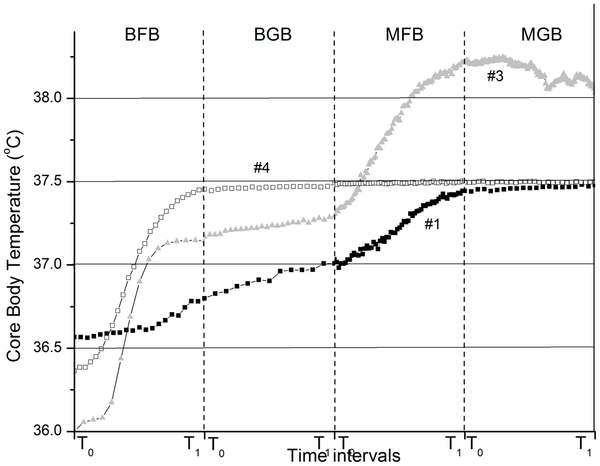
«Figure 3. CBT increases for Study 1 participants #1, #3, and #4 during BFB, BGB, MFB, and MGB performed in a continuous sequence.
Since the duration of each of the four practices varied from participant to participant, to simplify the figure presentation, the duration of each practice is rescaled from 0 to 1, with t0 the starting point of each practice, and t1 the ending point.»

«During FB (either BFB or MFB), participants’ CBTs typically exhibited a step-like pattern, with a period of steady temperature increase followed by a plateau or equilibrium phase corresponding to the “temperature saturation point”, above which the participants were not able to raise their CBT further despite their efforts to continue with FB. This pattern of CBT increases is very similar to that usually observed during induction of systemic hyperthermia (i.e., deliberate heating of a patient’s body to achieve an elevated core temperature for therapeutic purposes), where the equilibrium phase indicates the beginning of heat losses due to physiological mechanisms (e.g. vasodilation, evaporation) limiting the rate of heating that can be achieved, and thus protecting the body from excessively high temperatures [22]


«we defined the rise time (ΔTr) as the time taken for the CBT to rise from 10% to 90% of its final value »

«In summary, the results suggest that although CBT increases during BFB were not as dramatic as during MFB, participants were able to produce body heat, utilizing only the somatic component of the FB practice (breathing and isometric techniques). However, the meditators were able to reach an elevated CBT, significantly above the normal axillary temperature, only during MFB practice. As for GB practice, consistent with practitioners’ reports that it is used to maintain (but not to increase) body heat, no significant changes in participants’ CBT were observed during either GB baseline or meditation.»

«Furthermore, the higher the increases in alpha power developed by participants during FB meditation, the larger their increases in CBT during FB meditation, while the CBT increases during BFB were achieved without any changes in alpha power. This suggests that different mechanisms may be affecting CBT increases during MFB versus BFB, and that meditative visualization characterized by significant increases in alpha power might uniquely contribute to overall CBT increases beyond the contribution of the vase breathing technique.»

«In summary, our findings indicate that the two parameters, apnea duration and increases in alpha power achieved during meditative visualization are significant predictors of the overall CBT increases during FB practice. The apnea duration is significantly related to the rate of CBT increase. The increase in alpha power developed during FB meditation is related to the CBT rise time, that is, it predicts how long the meditators are capable of sustaining their CBT increases without reaching equilibrium.»

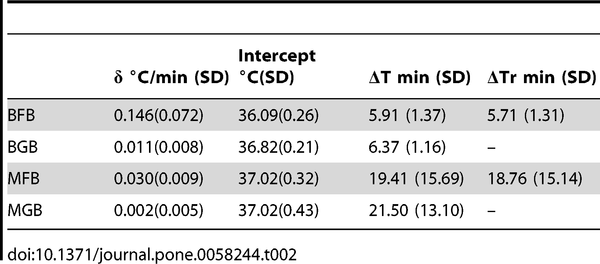
«The average initial CBT of all the participants before BFB was 36.38°C (SD = 0.23), while the average temperature at the end of BFB reached 36.99°C (SD = 0.13), only marginally above the normal axillary temperature of 36.6°C in the healthy population [one sample two-tailed t(10) = 2.02, p = 0.07]. The maximum CBT reached during BFB was 37.02°C. «

«The average apnea duration of the participants was 30.38 sec (SD = 6.35), ranging from 19 to 41 sec; the apnea duration correlated with the rate of CBT increase during BFB: r = 0.60, p = 0.050.»

«all the Western non-meditator participants returned to their baseline CBT during the next 20 minutes. This is in contrast to Tibetan practitioners performing GB (Study 1) who did not show any decreases in their CBTs during either BGB or MGB (δ = 0.011°C/min and δ = 0.002°C/min respectively), and were able to maintain an elevated body temperature throughout the whole duration of MGB (on average 21.50 min). This further confirms that the GB practice facilitates maintenance of body temperature.»


«Figure 7. CBT increases during FB as performed by a Western non-meditator and a Western g-tummo practitioner.»

«In summary, the results of Study 2 indicate that the BFB technique brings about significant increases in CBTs not only in meditators but also in those individuals who do not have any prior experience in meditation. »

«As for the increased gamma activity observed during FB meditation, studies on meditation consider it a signature of “samadhi” (deep meditative states of consciousness), but the regions of increase have varied, with recent studies reporting in some cases a frontally distributed increase in gamma [28], and in other cases an increase in gamma at posterior and occipital electrodes [29]. »

«In the case of FB meditation, one of the possible mechanisms preventing heat loss could be the mental imagery of flames and heat. Indeed, previous research has regarded mental imagery as a potentially effective technique in influencing peripheral body temperature, blood flow, and local vasodilation [38][41]. »

«If future studies show that it is possible to self regulate CBT, by mastering vase breathing in conjunction with guided mental imagery without extensive meditation experience, it will open a wide range of possible medical and behavior interventions, such as adapting to and functioning in hostile (cold) environments, improving resistance to infections, boosting cognitive performance by speeding response time, and reducing performance problems associated with decreased body temperature as reported in human factor studies of shift work and continuous night operations[44], [45]

Ukjent sin avatar

The kinaesthetic senses

Viktig studie som oppsummerer det meste rundt de kinestetiske sansene, og nevner spesielt at hudens nerveender har mer å si for ledd utslag enn selve ledd-cellene. Den nevner også hvordan hjernens egengenererte opplevelse av bevegelsen spiller inn.

http://m.jp.physoc.org/content/587/17/4139.long

«Peripheral receptors which contribute to kinaesthesia are muscle spindles and skin stretch receptors. Joint receptors do not appear to play a major role at most joints. The evidence supports the existence of two separate senses, the sense of limb position and the sense of limb movement.»

«The term ‘kinaesthesia’ was coined by Bastian (1888) and refers to the ability to sense the position and movement of our limbs and trunk. It is a mysterious sense since, by comparison with our other senses such as vision and hearing, we are largely unaware of it in our daily activities.»

«The cutaneous receptor most likely to subserve a kinaesthetic role is the skin stretch receptor, the slowly adapting Type II receptor served by Ruffini endings (Chambers et al. 1972; Edin, 1992).»

«More recent observations have shown that skin input can also have an occluding action. Signals from local, rapidly adapting receptors evoked by low-amplitude, high frequency vibration can impede movement detection (Weerakkody et al. 2007).»

«While joint receptors were first thought to be all-important in kinaesthesia, the present-day view is that their contribution at most joints is likely to be minor. Typically they respond to joint movement, but often with response peaks at both limits of the range of joint motion (Burgess & Clark, 1969). They are now thought of as limit detectors. »

«It was believed that signals of motor command could calibrate sensory input coming from the periphery but did not generate sensations in their own right. For a review see Gandevia (1987). In these new experiments (Gandevia et al. 2006) conduction in both afferent and motor fibres to the hand was blocked with a pressure cuff applied to the upper arm. When subjects tried to move their paralysed, anaesthetised hand they perceived a distinct displacement of the hand by up to 20 deg (Fig. 3). »

«Thus most kinaesthetic afferents must reside in muscle or skin since joint replacement surgery does not lead to any deficit in kinaesthesia (Grigg et al. 1973).»

«It has been reported by Shergill et al. (2003) that self-generated forces were perceived as weaker than externally generated forces, suggesting that central mechanisms allow us to distinguish between our own actions and those imposed on us from outside. It reminds us that to be able to move about freely in the environment and to carry out actions with the necessary levels of accuracy requires us to know what parts belong to our own body, the sense of ownership, and where those parts are located. We have a body map, or schema, of our body parts (e.g. Maravita et al. 2003).»