Ukjent sin avatar

Systemic inflammatory responses to maximal versus submaximal lengthening contractions of the elbow flexors


Nevner hvordan trening øker betennelse i både spesifikt muskelvev og systemisk, men konkluderer med at det er liten forskjell mellom treningsintensiteter. Forskjellige betennelsesfaktorer. IL-6 er spesielt viktig som anti-inflammatorisk faktor under trening. Kan gi en indikator på måling av stølhet etter trening, siden den øker drastisk etter 3-4 dager som vist i bildet.

http://www.medizin.uni-tuebingen.de/transfusionsmedizin/institut/eir/content/2006/72/article.pdf

«Lengthening muscle contractions elicit an inflammatory response. Within skeletal muscle, pro-inflammatory cytokines are produced, and phagocytic cells invade damaged muscle tissue (for review see ref. (22).»
» Within the systemic circu- lation, the complement cascade is activated, leukocytes are mobilized, and cytokine concentrations increase (22). These inflammatory responses share some similarities with the responses to trauma injury (8).»

«The inflammatory response to contraction-induced injury may be propor- tional to the severity of muscle damage, which in turn is dependent on mechanical loading of muscle during exercise. This relationship is important because the magnitude of the inflammatory response regulates adaptation to muscle injury (32).»

«Furthermore, muscle damage after lengthening contractions (as indicated by loss of muscular strength) corre- lates with blood leukocyte counts and serum C-reactive protein concentration (21).»

«Interleukin (IL)-6 plays an important role in mediating inflammatory responses to exercise. IL-6 is believed to exert anti-inflammatory effects during exercise by inhibiting the production of the pro-inflammatory cytokine tumor necrosis factor (TNF)-α, and stimulating the synthesis of other anti-inflammatory cytokines such as IL-1 receptor antagonist (IL-1ra), IL-10 and soluble TNF-α receptor 1 (sTNF-αR1) (25). IL-6 is produced within, and released from skeletal muscle during exercise in response to glycogen depletion, calcium signaling, changes in blood glucose availability, and to a lesser extent sympathetic activation (9, 11, 13).»
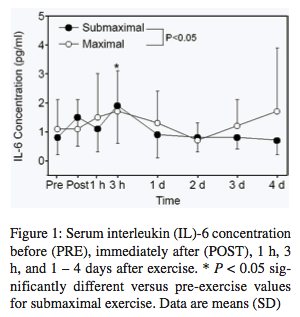
trening og betennelse

Viser at det ikke er noen forskjell på betennelsesfaktorer mellom forskjellige treningsintensiteter:
«The aim of this study was to compare systemic inflammatory responses to sub- maximal versus maximal lengthening contractions. Our data indicate that there were no significant differences in systemic markers of inflammation, despite evidence of greater muscle damage (as indicated by impaired muscular strength) following the maximal versus submaximal contractions.»

Nevner hvordan immunforsvaret reagerer på treningen:
«Elevated blood neutrophil counts are a consistent finding after lengthening contractions of the elbow flexors (17, 27-29). Neutrophils are most likely mobi- lized from endothelial surfaces into the circulation in response to tissue injury such as exercise-induced muscle damage. Once in the circulation, neutrophils travel to the site of injury, and then bind and break down damaged tissue frag- ments. In our study, neutrophil numbers were highest 3 h after exercise.»

«The small increase in serum IL-6 concentration after the submaximal contractions could represent the release of IL-6 from muscle in response to muscle glycogen depletion (13).»

«In conclusion, the present data indicate that although maximal lengthening contractions of the elbow flexors may result in greater muscle damage, this is not accompanied by a greater systemic inflammatory response.»

«Furthermore, although we could not detect differences in systemic inflammation, differences could exist locally within skeletal muscle.»

Ukjent sin avatar

Exercise-induced dehydration with and without environmental heat stress results in increased oxidative stress.

Viser at dehydrering øker oksidativt stress og dermed celleskade i trening.

http://www.ncbi.nlm.nih.gov/pubmed/21980993

«Oxidized glutathione (GSSG) increased significantly postexercise in dehydration trials only»

«Finally, both 90-min and 5-km TT performances were reduced during only the DE-W trial, likely a result of combined cellular stress, hyperthermia, and dehydration. »

Fra fecebook artikkel om studien:

«The results of this study show that regardless of temperature, oxidative stress (as measured by oxidized glutathione in the blood) was increased in exercise-induced dehydration, but this increase did not occur when hydration was normal. »

«This study shows that both heat and dehydration influence cellular mechanisms during exercise, but it is not the oxidative stress per se that reduced exercise performance during to the heat-dehydration trial. «

Ukjent sin avatar

Nitric Oxide Inhibits Nociceptive Transmission by Differentially Regulating Glutamate and Glycine Release to Spinal Dorsal Horn Neurons

Mer om NO sin funksjon som både smertedempende og smerteøkende. Nevner alle faktorer som spiller inn i både nervesystem, ryggmarg og perifert. Viktig studie som også indirekte kan brukes i å forstå sammenhengen mellom hvordan CO2 og økning av eNOS (i blodkar) kan dempe nNOS (i nervesystemet).

http://www.jbc.org/content/286/38/33190.full

«Our findings suggest that spinal endogenous NO enhances inhibitory glycinergic input to dorsal horn neurons through sGC-cGMP-protein kinase G. Furthermore, NO reduces glutamate release from primary afferent terminals through S-nitrosylation of voltage-activated Ca2+ channels. Both of these actions probably contribute to inhibition of nociceptive transmission by NO at the spinal level.»

«Nitric oxide (NO) is freely diffusible across the cell membranes and is synthesized by the nitric-oxide synthase (NOS)2 from L-arginine and different cofactors.»

«The three NOS isoforms, including neuronal NOS (nNOS), endothelial NOS (eNOS), and inducible NOS (iNOS), have distinct structures and functions (1, 2). »

Refererer til Superoxid, den viktigste antioksidanten som CO2 beskytter. Og til peroxynitritt, den farligste oksidanten som CO2 også beskytter mot.

«The diverse effects of NO is commonly mediated through increased cGMP production upon activation of NO-sensitive soluble guanylyl cyclase (sGC), S-nitrosylation, tyrosine nitration, and the interaction with superoxide to form peroxynitrite (3,,5). »

Hvordan NO gir smerte, og at NO-hemmere demper smerte.:
«Some studies suggest that spinal NO is involved in the potentiation of nociception. For example, mechanical hypersensitivity induced by nerve injury or tissue inflammation is reduced by intrathecal administration of nNOS inhibitors and in nNOS-knock-out mice (6, 9, 10). »

Hvordan NO demper smerte:
«In contrast, other studies have shown that spinal NO plays a role in the inhibition of nociceptive processing. In this regard, intrathecal administration of L-arginine increases the mechanical nociceptive withdrawal threshold in rats (12). »

Mengden har mye å si for effekten, med lite er det smertedempende, men mye er det smerteøkende.
«For instance, it has been shown that intrathecal injection of low doses of L-arginine or NO donors reduce nociception, but L-arginine or NO donors at the high doses potentiates nociceptive responses to formalin injection or nerve injury (16, 17).»

Nevner at hvis én type NO er nedregulert blir en annen type oppregulert. Muligheten er da for at om eNOS (i blodårer) er lav pga dårlig blodsirkulasjon og lite CO2, kan nNOS (i nervesystemet) økes og dermed gi smerter. Ved å øke eNOS kan man da få mindre nNOS og dermed en indirekte smertedemping.
«In addition, it should be noted that in eNOS-, nNOS-, or iNOS-knock-out mice, an increase in the expression of other NOS isoforms in the spinal cord has been reported (18, 19). This compensatory up-regulation of other NOS subtypes in specific NOS isoform-knock-out mice further confounds the interpretation of the results.»

Om at NO både øker nocicepsjon og demper den:

«The discrepancy may result from the use of different pain models, the amount of NO produced locally, and the specific CNS sites involved. For example, NO-cGMP inhibits dorsal horn neuronal activity at the spinal level but excites spinal dorsal horn neurons at the supraspinal level (15, 39). Also, while low concentrations of NO inhibit NMDA receptor activity (40, 41), high concentrations of NO stimulate TRPV1 and TRPA1 receptors (42). »

«GABA and glycine are the two predominant inhibitory neurotransmitters in the spinal cord. Blocking GABAA or glycine receptors in the spinal cord induces pain hypersensitivity in rats (4344).»

«Of note, L-arginine and SNAP had similar effects on glycinergic sIPSCs and mIPSCs, suggesting that NO can potentiate glycine release from presynaptic terminals of interneurons in the spinal dorsal horn. Thus, our findings indicate that NO potentiates glycinergic input to spinal dorsal horn neurons to attenuate nociceptive transmission

«Glutamate is an excitatory neurotransmitter critically involved in nociceptive transmission in the spinal dorsal horn. In this study, we found that L-arginine and SNAP significantly inhibited the frequency of glutamatergic sEPSCs of lamina II neurons. L-Arginine and SNAP also consistently inhibited glutamatergic EPSCs evoked from primary afferents in most lamina II neurons.»

«Thus, it is unlikely that the inhibitory effect of NO on synaptic glutamate release to dorsal horn neurons is secondary to increased glycine release and stimulation of presynaptic glycine receptors (35). Our findings strongly suggest that NO attenuates synaptic glutamate release by inhibition of HVACCs at primary afferent terminals.»

«Another salient finding of our study is that NO potentiates glycinergic input and inhibits glutamatergic synaptic transmission in the spinal dorsal horn through distinct signaling pathways.»

«Therefore, our findings suggest that spinal NO primarily inhibits glutamate release through S-nitrosylation of HVACCs at primary afferent terminals.»

«In addition to its inhibitory effect on HVACCs shown in our study, NO can inhibit NMDA receptor currents in recombinant systems (6061) and in spinal lamina II neurons (41). Because both HVACCs and NMDA receptors are critically involved in nociceptive transmission, it seems difficult to explain the proposed pronociceptive role of NO at the spinal level. Of note, systemic use of NO or NO donors has been shown to reduce pain intensity caused by sickle cell crisis or diabetic neuropathy in patients (62, 63). We found in the present study that intrathecal administration of L-arginine or SNAP in rats significantly increased the nociceptive mechanical thresholds.»

«Hence, NMDA receptor activation could lead to increased NO production and release, and NO can diffuse to the presynaptic site to reduce glutamate release from primary afferent terminals. By reducing glutamatergic transmission, NO could serve as a feedback regulator to attenuate nociceptive transmission at the spinal level during painful conditions.»

«In summary, our study provides important new evidence that spinal NO potentiates inhibitory glycinergic input but reduces glutamatergic synaptic transmission between primary afferents and dorsal horn neurons through distinct signaling mechanisms. The opposing effects of NO on glutamatergic and glycinergic synaptic transmission could contribute to the antinociceptive effect of NO at the spinal level. This new information is important for our understanding of the synaptic actions underlying the antinociceptive effect of NO at the spinal level.»


Ukjent sin avatar

Pain and analgesia: The dual effect of nitric oxide in the nociceptive system.

Om at NO har en tosidig effekt som både smertedempende og smerteøkende.

http://www.ncbi.nlm.nih.gov/pubmed/21723953
«Nitric oxide is an important neurotransmitter involved in the nociceptive process and, in the dorsal horn of the spinal cord, it contributes to the development of central sensitization. On the other hand, experimental data have also demonstrated that NO inhibits nociception in the peripheral and also in the central nervous system. »

«In addition, it has been shown that nitric oxide mediates the analgesic effect of opioids and other analgesic substances. «

Ukjent sin avatar

Nitric oxide and pro-inflammatory cytokines correlate with pain intensity in chronic pain patients.

Bekrefter at mengden betennelsesfaktorer (f.eks. IL-6 og TNFa) er proporsjonal med smerteopplevelse. Og sier at NO er økt ved økt smerte. Dette burde tilsi bedre blodsirkulasjon, men det er åpenbart ikke det. NO har en tosidig effekt som både smertedempende og smerteøkende. (http://www.ncbi.nlm.nih.gov/pubmed/21723953)

http://www.ncbi.nlm.nih.gov/pubmed/17334668
«Pro-inflammatory cytokines (IL-1beta, IL-2, IL-6, IFN-gamma, TNF-alpha) in the plasma correlate with increasing pain intensity. Chronic pain patients show a significant increase in plasma levels of NO in comparison to healthy controls.»

Ukjent sin avatar

Reduced levels of antiinflammatory cytokines in patients with chronic widespread pain

Bekrefter at manglende anti-inflammatoriske stoffer (IL-4 og IL-10) er proporsjonalt med smertetilstander, spesielt fibromyalgi.

http://onlinelibrary.wiley.com/doi/10.1002/art.22026/full

«Chronic widespread pain is associated with a lack of antiinflammatory and analgesic Th2 cytokine activity, which may contribute to its pathogenesis.»

«This definition includes chronic widespread pain, which is pain of a duration of at least 3 months in an axial distribution, plus pain on both the left and the right side of the body, plus pain above and below the waist (2), combined with pain upon digital palpation with 4 kg of pressure on at least 11 of 18 defined tender points. »

«In a study with 113 FM patients, significantly increased serum IL-8 and IL-2 receptor expression was found by ELISA, and IL-8 levels were found to correlate with pain intensity (19).»

«IL-10 is produced by activated T cells, B cells, macrophages, mast cells, and keratinocytes. The production of IL-10 is inhibited by several cytokines such as IL-4, IL-13, and interferon-γ (IFNγ), and through autoregulation by IL-10 itself (24). »

«IL-4 is considered to be a pleiotropic antiinflammatory cytokine produced by activated CD4+ T cells, mast cells, eosinophils, and basophils. It affects T and B lymphocytes, natural killer cells, mast cells, synoviocytes, and endothelial cells, activates and supports the growth of B cells, and triggers the production of IgG and IgE. IL-4 inhibits macrophage activation and directs the T helper cell differentiation to the Th2 side (32). «

Ukjent sin avatar

Inflammation in complex regional pain syndrome A systematic review and meta-analysis

Studie som viser at betennelser er et viktig aspekt av CRPS (kompleks smertesyndrom). Og den nevner det viktige prinsippet om at betennelsesfaktorer er like fremtredene i den smertefrie siden. Dette kan også gjelde ved andre betennelsestilstander….

http://www.neurology.org/content/80/1/106.full

» CRPS is associated with the presence of a proinflammatory state in the blood, blister fluid, and CSF. Different inflammatory profiles were found for acute and chronic cases»

«In acute CRPS, the concentrations of interleukin (IL)-8 and soluble tumor necrosis factor receptors I (sTNF-RI) and II (sTNF-RII) were significantly increased in blood.
In chronic CRPS, significant increases were found in 1) TNFα, bradykinin, sIL-1RI, IL-1Ra, IL-2, sIL-2Ra, IL-4, IL-7, interferon-γ, monocyte chemoattractant protein-1 (MCP-1), and sRAGE (soluble receptor for advanced glycation end products) in blood; 2) IL-1Ra, MCP-1, MIP-1β, and IL-6 in blister fluid; and 3) IL-1β and IL-6 in CSF. »

«Inflammatory factor concentrations in CSF were reported in 3 chronic CRPS studies comparing CRPS cases to predominantly hospital controls.26,,28 »

«Complex regional pain syndrome (CRPS) is characterized by severe pain, allodynia, hyperalgesia, and motor and autonomic signs and symptoms.1»

Om CRPS: http://en.wikipedia.org/wiki/Complex_regional_pain_syndrome

«We found that the inflammatory factor profile in chronic CRPS, shown in figures 3 to 5, suggests a proinflammatory drive. In particular, the presence of cytokines such as IL-1 and IL-6 in the CSF suggests that the highly proinflammatory Th17 mechanisms may be active. »

«Previous work has shown that chronic pain is associated with higher levels of proinflammatory37 and lower antiinflammatory activity.38»

«Finally, our study found little empirical support for the position that the CRPS-affected limb expresses higher inflammatory factors than the unaffected limb.»
«Importantly, those studies that performed these side-to-side comparisons concluded that the levels of inflammatory factors in blood are not significantly different between the affected and the unaffected limb in either acute or chronic CRPS.»

Ukjent sin avatar

The exercise-induced growth hormone response in athletes.

Studie som gir oversikt over mange faktorer rundt veksthormonøkning i trening.

http://www.ncbi.nlm.nih.gov/pubmed/12797841

«A number of physiological stimuli can initiate hGH secretion, the most powerful, non-pharmacological of which are sleep and exercise. »

«The exercise-induced growth hormone response (EIGR) is well recognised and although the exact mechanisms remain elusive, a number of candidates have been implicated. These include neural input, direct stimulation by catecholamines, lactate and or nitric oxide, and changes in acid-base balance. Of these, the best candidates appear to be afferent stimulation, nitric oxide and lactate. Resistance training results in a significant EIGR.»

«An exercise intensity above lactate threshold and for a minimum of 10 minutes appears to elicit the greatest stimulus to the secretion of hGH. Exercise training above the lactate threshold may amplify the pulsatile release of hGH at rest, increasing 24-hour hGH secretion.»

«In a great many cases, the impact of some of the deleterious effects of ageing could be reduced if exercise focused on promoting the EIGR. «

Ukjent sin avatar

Growth hormone release during acute and chronic aerobic and resistance exercise: recent findings.

Studie som bekrefter hvordan veksthormon påvirkes av trening. Viser at det er et lineært forhold mellom trening og veksthormon. Flere treningsøkter om dagen gir mest økning i veksthormon.

http://www.ncbi.nlm.nih.gov/pubmed/12457419

«Contrary to previous suggestions that exercise-induced GH release requires that a «threshold» intensity be attained, recent research from our laboratory has shown that regardless of age or gender, there is a linear relationship between the magnitude of the acute increase in GH release and exercise intensity. »

» As a result, 24-hour integrated GH concentrations are not usually elevated by a single bout of exercise. However, repeated bouts of aerobic exercise within a 24-hour period result in increased 24-hour integrated GH concentrations.»

«While exercise interventions may not restore GH secretion to levels observed in young, healthy individuals, exercise is a robust stimulus of GH secretion. «

Ukjent sin avatar

Nevropatiske utglidninger

Artikkel fra Tidsskriftet om forenkling av nevropatiske liderlser og diagnoseverktøyet painDETECT. Nevner bl.a. mye om at diagnoser er veldig individuelle basert på hvilke spesialister man oppsøker. + nevner mye om nevropati generelt.

http://tidsskriftet.no/article/3012269

«Det er lite klinisk kunnskapsgrunnlag for at det er mulig å stille valide, patogenetisk baserte diagnoser hos flertallet av pasienter med uspesifikke ryggplager uten tegn til radikulopati (9). Det er generelt lav diagnostisk konsensus, og diagnosen som stilles, avhenger i stor grad av hvilken type «ryggspesialist» som oppsøkes (10). Slik diagnostisk uenighet bidrar til forvirring og helseangst hos pasienten, medfører ofte overbehandling, og i verste fall ytterligere kronifisering (7,8).»

«Ved radikulopatier er den diagnostiske presisjon høyere, og her gir det mer mening å bruke nevropatibetegnelsen. «